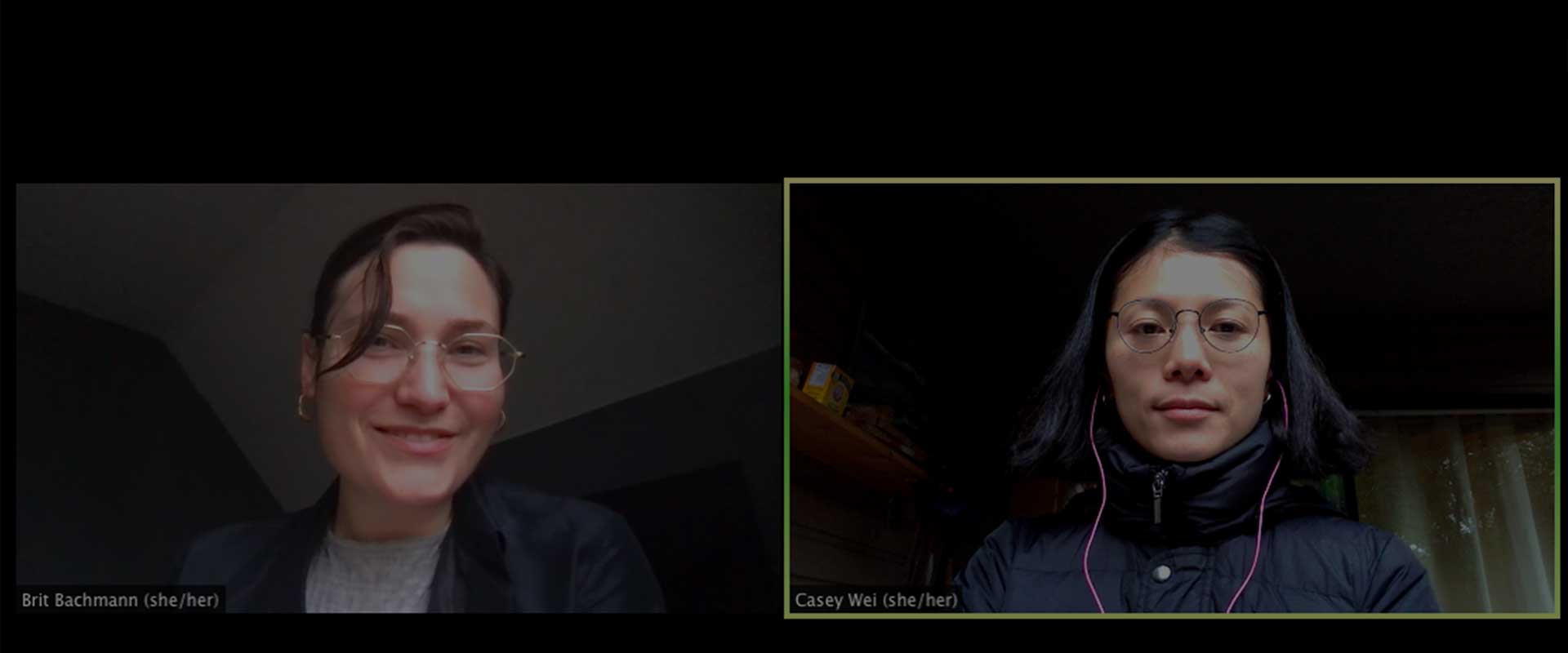
In Summer 2019, Casey Wei (CW) and Brit Bachmann (BB), both interdisciplinary artists and administrators, began envisioning a well-funded arts publication that encourages cross-disciplinary pursuits, where artists could develop their writing practice. The everyday space to create discourse — outside of the academy and outside of the market — is integral for a diverse, equitable, and experimental arts community. With this belief, Casey and Brit sought to build an argument for the value and importance of sustaining critical art discourse in Western Canada.
UNIT/PITT in partnership with VIVO Media Arts Centre were awarded Vancouver Foundation’s Systems Change Grant in late 2019, allowing for the development of ReIssue, named in nod to Issue Magazine (1983-1985/2014-2016). Brit and Casey focused their research on a series of conversations with individuals who have contributed to art writing and publishing initiatives on the West Coast.
Through these conversations, ReIssue has evolved beyond a magazine, to endeavour to provide opportunities for intergenerational knowledge-sharing, mentorship, and peer-to-peer learning. Taking inspiration from alternative education models, Casey and Brit devised a Free School to exist alongside a publishing program.
The following is a loose dialogue between Casey and Brit on the impetus and aspirations for ReIssue, informed by ongoing conversations with local artists, curators, writers and publishers.
CW: Now that we’ve launched, I wonder how ReIssue looks to people who haven’t spent the last year making it. For me, it’s a kind of level-up from what I’ve been working towards through my publishing projects via Agonyklub. As an artist, I think I’ve always been interested in pursuing projects which create alternatives to systems I was critical of, or that felt inaccessible to me, and ReIssue does just that. How does it feel for you, in relation to your practice?
BB: My own artistic practice is a tangle of competing interests in clay, drawing, radio and writing, so ReIssue fits in, but my greater motivation for developing this platform is as a gift to the broader arts community. We/they deserve something like ReIssue! This is to say, a dynamic publishing initiative that values reciprocity and pays contributors fairly. We’re so fortunate to have funding through Vancouver Foundation, not to mention the support of our respective artist-run centres, to give this project a good 2-3 year effort before having to figure out next steps. From the conversations we had, it seems that securing funding was the biggest hurdle, and ultimately resulted in the demise of our favourite Vancouver-based art publications. Were there any quotes or thoughts about funding that stuck out in your mind?
CW: The recurring line about “when our funding was cut” echoes in my mind for sure. Just going back in recent history to the Olympics when there was this influx of Cultural Olympiad money, which led to devastating cutbacks once the party was over.1But reaching further back, Glenn Alteen (Program Director Emeritus, grunt gallery) pointed out that in his experience, Canada Council never funded publications alone — that work itself is not enough. grunt figured out that “as long as you told them your publication was only part of the project, you could get the funding, but if you made just the publication, they wouldn’t go near it.”
As much as I am thankful for Canada’s public funding to the cultural sector, as it at least provides some kinds of opportunities for a ‘career’ in the arts after school, it’s important to recognize that it is a state-funded investment. There’s room to negotiate and navigate through their systems, and as artists, we are good at finding creative solutions! We’re really settling into a new epoch right now, one where such initiatives like ReIssue are taken up as a ‘systems change.’ In our conversation with Jonah Gray, whose project Pyramid Power (2006-2010) was somewhat of a formative publication for me, he reflects that “the kinds of publications we’re talking about don’t have a market per se, in that they are making their own market, and that is what needs to be supported.”
“…larger institutions that get national and international exposure don’t always celebrate the diversity of practices across the province and along the coast.” – BB
BB: True! I see parallels in our conversations with Jonah about Pyramid Power and with Karen Knights (Crista Dahl Media Library & Archive, VIVO Media Arts Centre) about Video Guide (1978-1992), who both raised open-ended questions about where limited funds ought to have been prioritized — towards printing expenses, staffing, or paying contributors? Video Guide paid all their contributors, although not very well. That said, it was approachable and accessible: “It was that type of resource where you could have people who were just starting out or who were not necessarily writers, but were involved in interesting activities, be able to have someplace to publish,” explained Karen. Video Guide could not have continued without the funds to hire additional Video In staff to manage the publication, and I wonder what the state of critical discourse for media art would look like today if Video Guide had continued, especially given its international presence and distribution channels.
CW: It’s a good question, it brings me to our conversation with Ardele Lister (Criteria [1974-78] co-founder and editor with Willard Holmes). After reading through Criteria vol.2 no.1, The Politics of Film in Canada, and watching her video work Conditional Love, I see how on a broader, national scale, Canadian filmmaking was quite limited by the Canada Cooperation Project2, and so the writing to promote filmmaking practices was proportionally marginal. Without veering too off course — perhaps this is an essay topic to explore further — I would say that ‘west coast’ sensibility in film and media art has really developed its own particular aesthetic because there wasn’t really a Canadian canon. Today, at the risk of generalizing, moving image has become a ubiquitous medium for artists working across many disciplines. As we have seen recently, media curator positions have been consolidated because media has become inherent to modern life.
A strong impetus for ReIssue was your conversations with local emergent filmmakers who wanted more opportunities to write about each other’s works and my work with STILLS, a scrappy lil’ film pamphlet I started with Steffanie Ling3. This speaks to how we understand the need for writing to contextualize and exist alongside the practices, as emphasized by our ‘Moving Image’ category.
BB: I imagine people will wonder why we have a separate “Moving Image” section — which can be essays or reviews or whatever — and the short answer is that you and I both love film and media art, and their intersection with music, sound and noise. We bonded over our appreciation of the weird stuff! Plus, critical reflections on moving image art is terribly underrepresented in Canadian print.
“…at this point in history I think we need to get vanguard about systems that aren’t sustainable.” – CW
Another question people might have is why we’re organizing a Free School in addition to a publishing program. ReIssue has always been about community-building through resource-sharing, and access to learning materials outside of academic institutions. We’ve taken a lot of inspiration from Colin Browne’s tales from the early days of the Kootenay School of Writing (KSW), where collaborations were formed at the afterparties for poetry readings and writing workshops — most notably, Artspeak artist-run centre, founded by Cate Rimmer and Kay Higgins in 1986. We’ve had to adjust our expectations for the Free School since COVID-19 reached Vancouver and changed how we connect with others, but I’m optimistic that we’ll be able to host dynamic virtual learning modules over this next year.
CW: The Free School is something that I hope will grow and nourish the artistic process to write. It’s an interesting dilemma — on one hand writing is the most accessible and direct medium: you only need something to write with and something to write on. On the other hand, writing is inaccessible to people because it’s so immaterial. In art school it’s always treated secondary to your studio practice, but that’s short-sighted; it produces a very vulnerable art. How many times have we heard about artists begrudging curators, writers, and institutions for misrepresenting their work? How many times have I experienced this myself? I’m not saying we as artists have to do everything all the time, but at this point in history I think we need to get vanguard about systems that aren’t sustainable.
How do we carry out values of access, decolonization, diversity, and equity? I see ReIssue and the Free School contributing to that journey. The pandemic has heightened attention to long-running issues of displacement and capital. Rent has frozen for the time being and has even dipped a little, but property values are still climbing. In our conversation with Melanie O’Brian, she was optimistic in how we could approach this as an opportunity to expand notions of locale, and I’m all for that decentralization of cultural capital. But initially, it’s interesting to me how many submissions we’ve received from Vancouverites, as it proves that the writing is here, it just needs a platform.
BB: The writing is here, and everywhere. I feel fortunate to have a more holistic understanding of art writing and publishing in Vancouver now that we’ve talked to so many key individuals, but I am also very reluctant to centre Vancouver moving forward. I was raised in Kelowna, and most of my art education happened at UBC-Okanagan, on the unceded territories of the Syilx First Nation. To generalize, in the same way that Vancouver feels ignored or misrepresented by Toronto, the rest of British Columbia feels ignored or misrepresented by Vancouver. It is an art centre, but the larger institutions that get national and international exposure don’t always celebrate the diversity of practices across the province and along the coast.
I would be remiss to not acknowledge the difficulty of situating ReIssue geographically. Our concept for this project hinges on the idea of place being central to the development of one’s critical perspective, and empowering people who see and seek to understand art through a Western Canadian lens. Yet, at the same time, the language we use to describe place is overtly or inherently colonial — Western Canada, British Columbia, Pacific Northwest, West Coast. I hope ReIssue can be a platform for people to challenge these terms.
From our fateful meeting at the Astoria when you cut your finger on a guitar string, through our various publishing projects, I’m excited to embark on this new collaboration with you.
CW: Me too, didn’t we learn that we have really compatible charts? It’s in the stars!
Notes:
- Jackie Wong, “More Cuts in B.C. Arts Funding,” July 7, 2010, BC Business, https://www.bcbusiness.ca/more-cuts-in-bc-arts-funding.
- In 1948, the Canadian Government and the Motion Picture Export Association of America (MPEAA, now MPAA) signed the Canadian Cooperation Project, an agreement which allowed the US to have untaxed and unrestricted access to Canadian theaters. Lister explores the implications of this in Conditional Love (1997; Manhattan, NY: self-distributed, 2021), digital.
- STILLS: a moving image tract, began as a correspondence criticism project between the two in 2017.