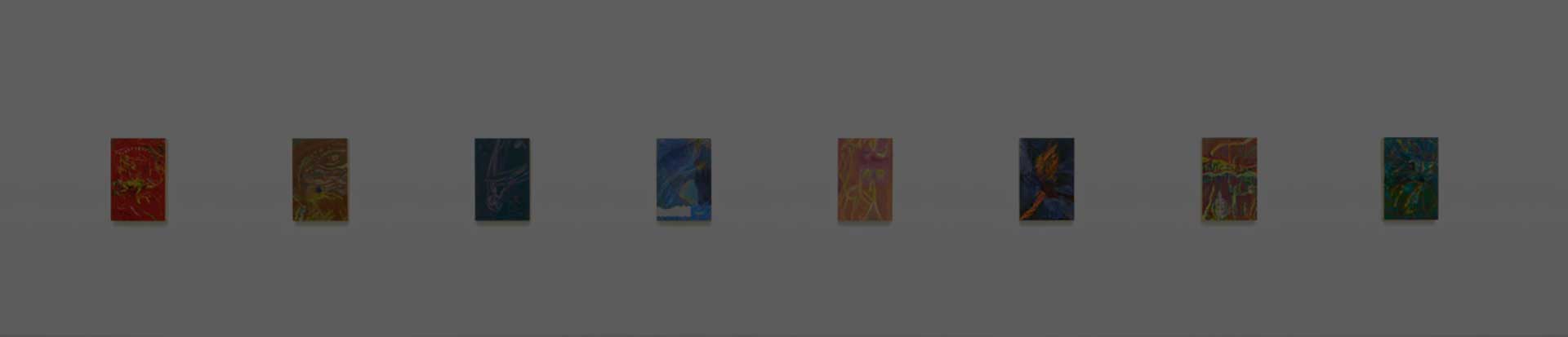
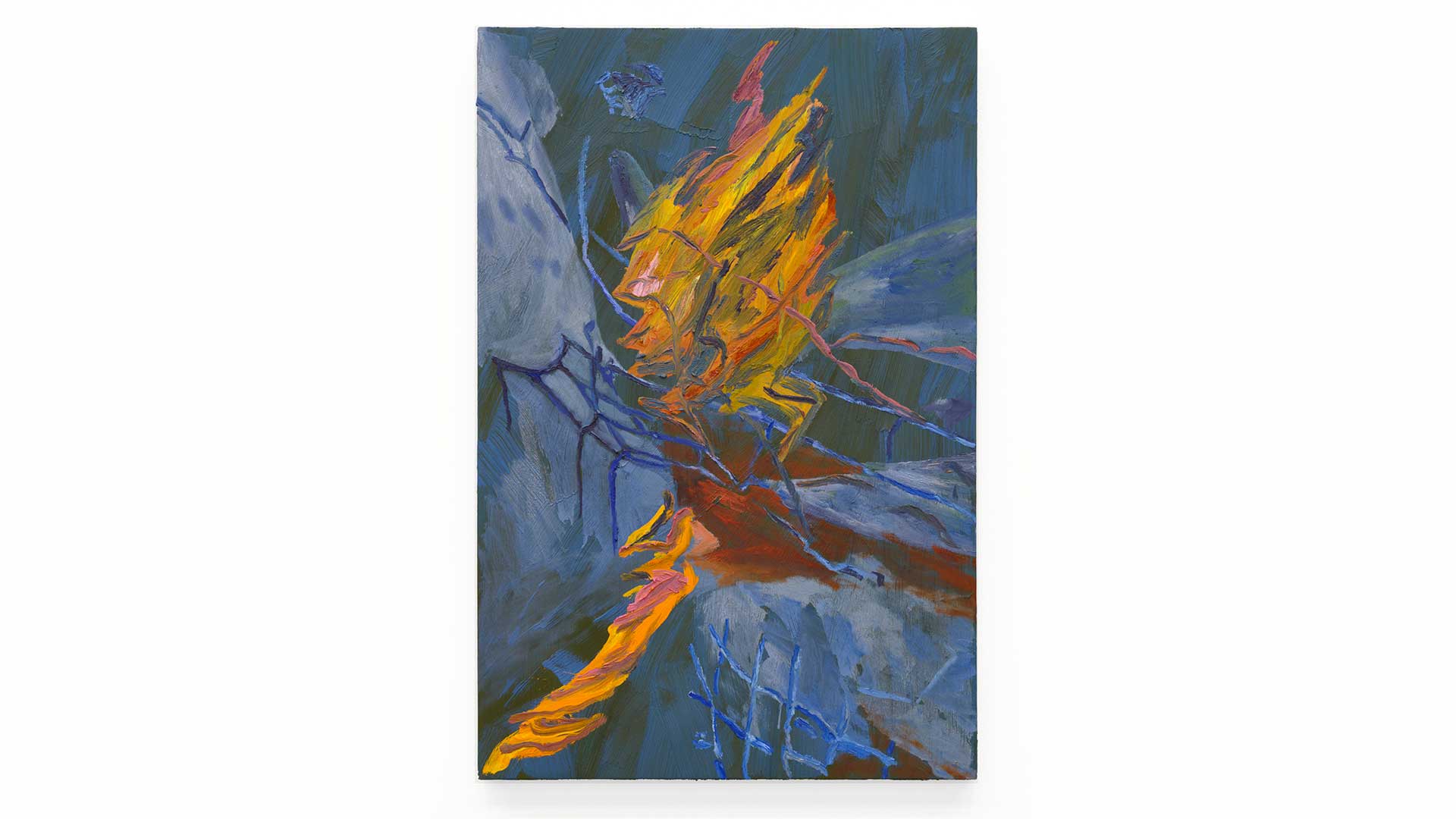
It is difficult to know what exactly we are looking at in Rebecca Brewer’s paintings.
The mind jumps and skips through a range of visual associations in the split-second act of viewing. For a brief moment in time, the surface of a painting might appear as if it were reflected in a pool in the rain. Seconds later, the same surface might shift into something more unusual, like the mottled skin of a tropical plant.
For her recent solo exhibition Eidetic Cloud at Catriona Jeffries, Brewer enacts this morphological slippage through recourse to an obscure painterly genre: the sottobosco. In the history of art, the sottobosco is a subgenre of the still-life. Its practitioners are rare, examples are hard to come by. Typically, the genre of still-life traffics in the realm of social reproduction. It is a painterly mode that turns its attention to the habitual, the base, the everyday objects and forms of social life. It is a genre most commonly populated by asparagus, cups of beer, cut flowers, rotting fruit, empty vases, clams or seashells, as well as (my favorite) dismembered fish and fowl.
Sottobosco, however, operates at a lower plane of reality than that of the still-life — it is literally the undergrowth of nature. Its contents contain all that is outside of the house, far beyond the kitchen table, outside of civilization in some festering swamp or backwater. To put it in more familiar terms, the sottobosco rejects the anthropocentrism of the interior for the creaturely realm of nature. In Brewer’s hands, the sottobosco is ultimately confused as to what it actually is — it thinks of itself as a still-life but acts more like a landscape, an abstract and polymorphous landscape at that.
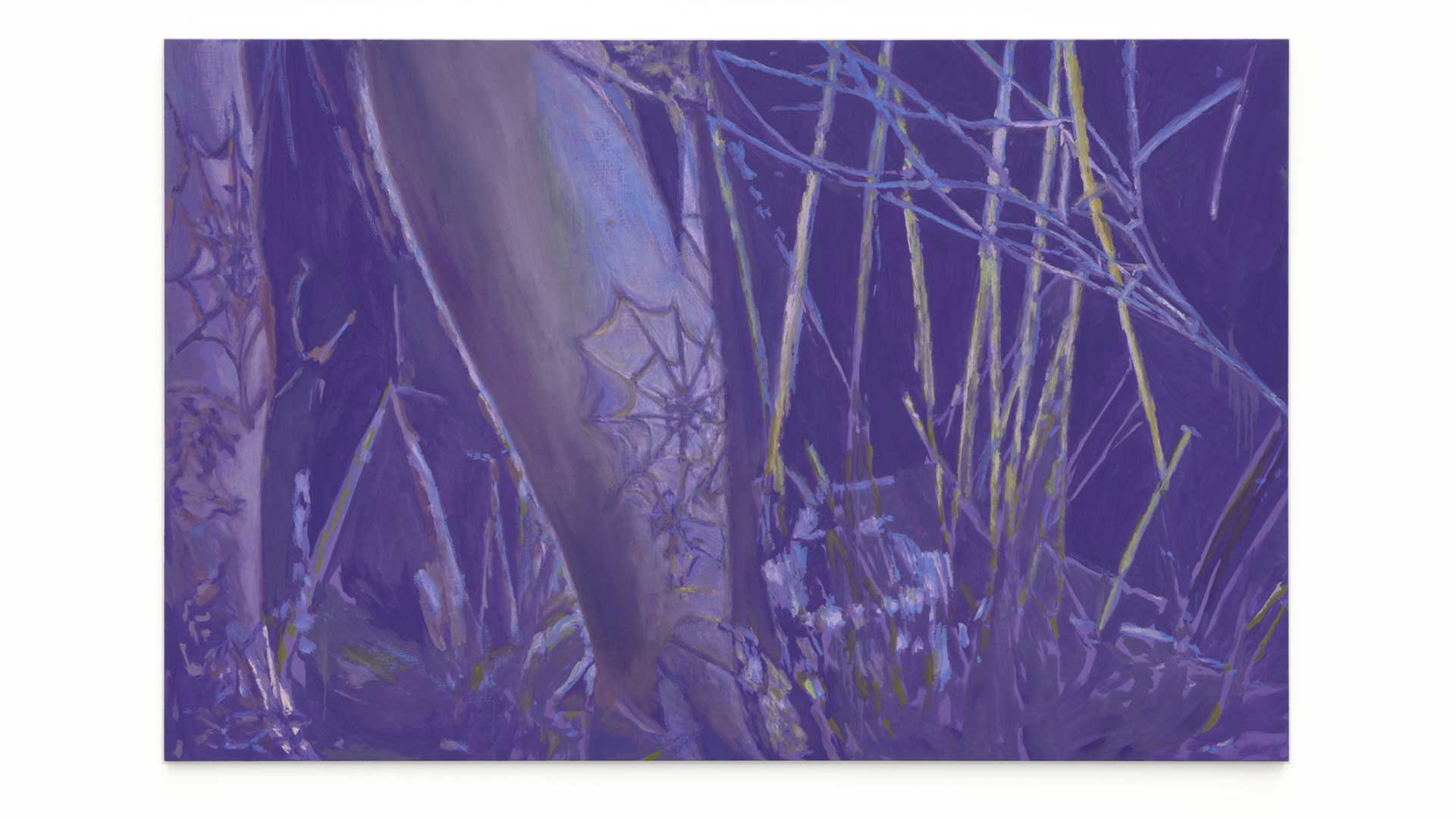
One of the more compelling paintings in Brewer’s show is Hyper Trained Systems (2023). What we see in the picture is a world awash in purple, dissected by two long limbs and spindly forms. One can imagine a scene like this found in the deep recesses of a forest, its forms decomposing in a twilight haze. The faint lines that cross the picture evoke a spider’s web, knotting and twisting across the surface, entangling the picture as well as arresting the eye.
This experience of not knowing what to make of Brewer’s work, not knowing how to classify her paintings, is perhaps also a product of how her imagery is processed and filtered. During the act of composition, Brewer fed an Artificial Intelligence engine a series of linguistic prompts. Phrases like ‘fog-point of view,’ ‘bas relief,’ ‘convergent evolution’ (among many others) provided the schematic content for the AI to do its work.
The AI engine serves the same function as a pseudo-Surrealist parlor game (minus the uncanny psychosomatic spark), where subjective agency cedes to an external engine. Feed the engine a series of prompts and it will spit out an image. Treating the procedure like a preliminary sketch, all the artist has to do is assemble the fragments of their experiment and then transfer the details onto their support.
For anyone who has also experimented with AI, the process is probably more enjoyable than the final product. You can ask AI to compose a ‘post-impressionist landscape in the style of Matisse set in Downtown Vancouver’ (not Brewer’s prompt, but mine), but looking at results on your phone is perhaps less interesting than typing in the prompt and seeing the results almost immediately.
Although Brewer’s paintings summon the undergrowth of nature, her palette doesn’t mimic its depth or glow. Her work for Eidetic Cloud appears to have been painted quickly, without an underpainting. The application of underpainting has a way of intensifying vision. When done right, one can liken the effect to the appearance of light found in dying embers, rotting leaves or sinking suns — forms that are just crossing over into the shadows of death, and yet have not fully succumbed.
Perhaps this is the point: Brewer’s work read as flat abstract ciphers of nature rather than as a figurative or mimetic approximation. This is not to say that the paintings revive an older lyrical and romantic tradition of regional abstraction in the mode of Toni Onley or Jack Shadbolt.
When looking at the paintings in Eidetic Cloud, I was reminded of a classroom experiment I was assigned in Grade 7. At the tail end of the school year, my teacher asked us to collect pond water, place our samples in glass slides, wait a few days, and then look at what we had collected under a microscope. When viewed through the microscope’s lens, the pond water revealed a strange world illuminated below: bacteria, fungi, single and multi-cell life forms (who knows what else). To a twelve year old who was looking through a microscope for the first time, the world seemed otherworldly, unclassifiable. The common, backyard sample of pond water transformed into an image of visual and aesthetic fascination — this fascination became the world’s otherness.
I recalled this experiment when looking at Brewer’s work because it reminded me of a line by the Ukrainian-born painter, Kazimir Malevich, who saw the development of abstract art not as a process of material refinement but as a process akin to the action of bacteria within an organism.1 For Malevich, bacteria can bring about unexpected changes to the organism it inhabits. In this way, Brewer’s work counters a dominant account of abstract art that is typically tied to an esoteric impulse or a modernist utopian project, an explicit evocation of a metaphysics or a transcendental vision or state. Her account of abstraction is a lot messier and polymorphous, not simply concerned with her own subjective imagining of a gutter or a backwater swamp, but how the grammar of abstraction and the representation of nature can be re-imagined through AI to see the world anew.
Notes: