Disclaimer:
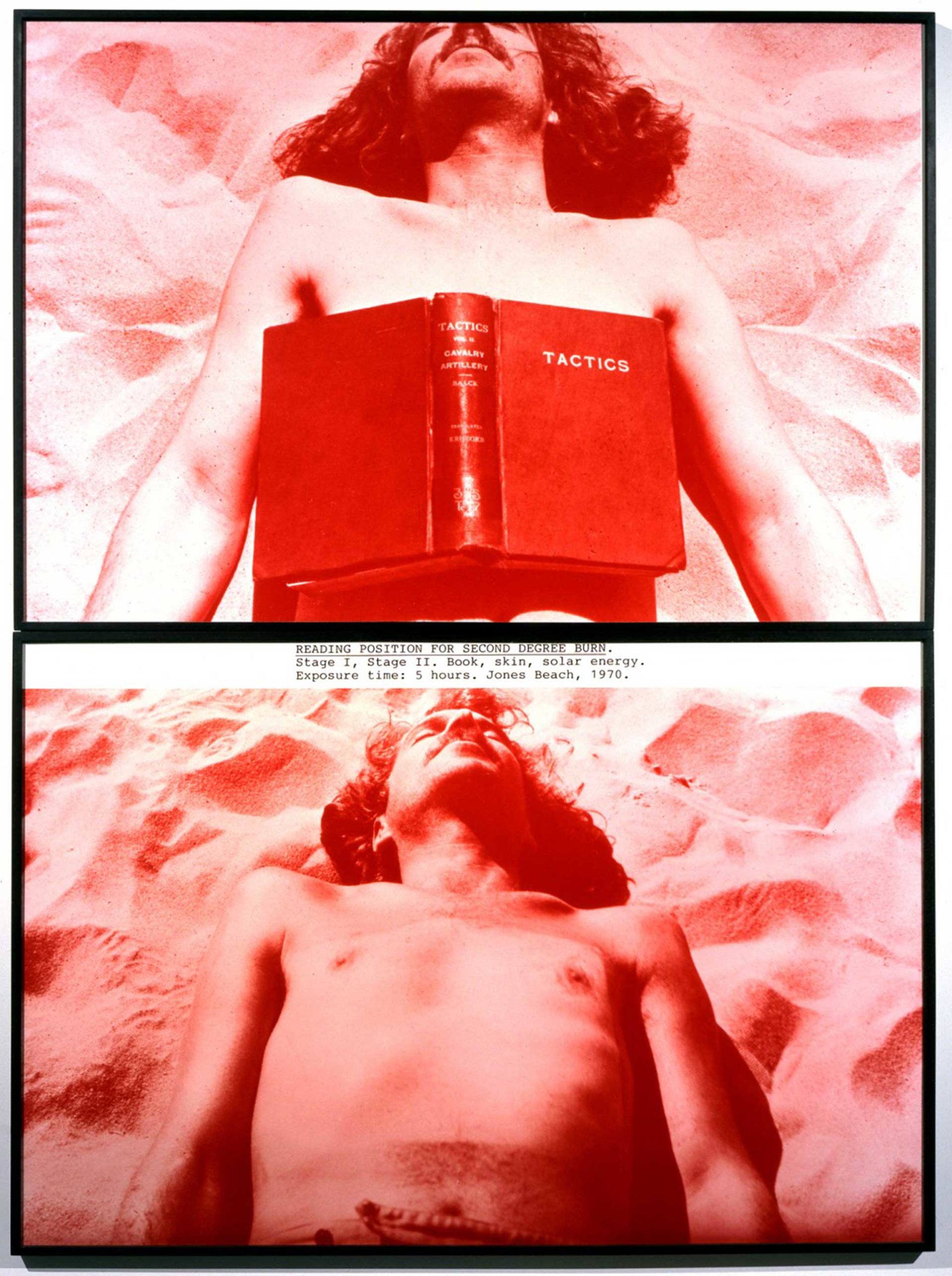
What follows is a list of 11 directives that would theoretically allow a body to sun tan permanently. The list itself, and the image of the sun bathing subject it renders, are submitted here as an oblique means to approach issues of impairment, disability, and the various arbitrary constraints posed by those ways of being, as embodied through experimental writing. The invocation of the interminably sun-tanning figure operates as an allegory for other invariable patterns of monstrous behavior imposed on disabled bodies and minds: capitalistic structures of economy and social organization with their profuse modes of ableist dehumanization, and the marring produced by those functions. The system’s indifference towards physical and neurological variety is made manifest through brutal proliferation of market driven homogeneity, their flawed mechanics endlessly propped up by the same indifference and lack of imagination they promote. This systematic inability to conceive of a lived context for a wider scope of possible embodiment(s) is what the interminable sun-tanner and the bizarre abundance of their attending accessories are a reflection-of and a rejoinder-towards. The sun-tanner and their apparatus are forwarded here as the inert stunt-doubles for this titanic and ongoing practice of injury.
*
Question:
If the statistically determined median life expectancy of a North American is approximately 78 years old, how could one such body be made capable of sun-tanning perpetually, for the entire duration of their adult life span, (approximately 60 years when beginning from 18)?
When a body is left in sunlight for too long, it dies in three ways: nonexertional heatstroke, dehydration, and skin cancers (primarily Bacal Cell Carcinoma, Squamous Cell Carcinoma and Melanoma). The following program is a list of accommodations meant to mitigate the challenges presented by these sunny hazards. When put into effective play, a body may sun-tan ceaselessly until it dies for other reasons.
1. The appropriate setting must be secured. It needs to be an adequately staffed location given over to an economy of unremitting leisure and set within a climate suited to the practice of tanning. This will ensure that the tan will remain uninterrupted by neither weather constraints, nor the weight of material practicalities. A Club Med resort would be an excellent choice because “at Club Med you can do absolutely everything, including absolutely nothing.”1
2. Funding must be amassed in order to buttress a life lived under the sun in this way. These resources can be secured through either public or private channels, so long as the funding bodies do not interfere with the objectives of the interminably-tanning enterprise.
3. The interminable sun-tanner lays supine in permanence — feeding and hydrating the body will have to be accommodated within these horizontal bounds. This can be mitigated through the use of an administered intravenous system supplying basic nutrients as well as much needed electrolyte-laden hydration to stave off severe heat-injury. The floppy bags and tubes containing said nourishment can be hung on a steel rod; the steel rod can be driven into the sand adjacent to the tanner at whatever angle, so long as that angle renders no shade.
4. There is the shitting and the pissing. A urinary catheter resolves all front-matter, while a rectal catheter tends to the rest of that muck. Tube-feeding carries the set-back of complicating skin-integrity, while faecal collection via rectal catheter is known to aggravate this issue and will have to be monitored closely with the attention of resort staff.
5. Medications are to be regularly delivered via the saggy-bagged intravenous in an effort to manage the influence of total sun-exposure. Recommended medications are as follows: Clonazepam for tamping down the sharper edges of delirium, Dilaudid (Hydromorphone) for the shadeless headaches, and something like Evoxac or Salagen to pharmaceutically encourage salivation for when the mouth goes all dry with extreme dehydration and has difficulty producing its own spittle.
6. Lightweight clothing is suggested for covering whatever parts of the body want covering. The clothes should be highly fugitive in their material constitution as they will be removed and replaced often. The clothes need to be in vibrant colours for the durability of morale, outfits for smiling and those blue-bird-grins.2
8. With the fumes and the heat and the sunshine there is vomiting, inevitably. An endotracheal tubing system, fitted with an inflatable cuff in the upper segments, must be fed down through the mouth. Despite its state of atrophy and general sun-weariness, this measure ensures that the body will not prematurely pass by choking on spit-up.
9. As consciousness fluctuates through various stages of sleep and delirium, the head must be held in place to prevent accidental disconnection from the protective systems described. For this, ‘bumpers’ are set in place on either side of the head, bounding it like a second set of smiling cheeks. These bumpers can be made from adapted car seat headrests — the exposed steel pillars usually used to feed the headrest into the top of the seat are utilized here to drive the headrest into the sand, thereby fixing it into a secure position.
10. The skin of the body needs sunscreen: a slick barrier marking the ever porous border between sun-ray and dermis.3 For ideal results, the product must meet a minimum SPF rating of 30, and be applied twice daily by the resort staff (the frequency of application may need to be increased in the case of a profusely sweating body to prevent the product from being washed away in salty little rivers). Note: the rotation of the tanner should take place in tandem with this rubbing-in of the sunscreen, the body gently overturned with each application.
11. There is the trouble of the setting sun. This is incompatible with a practice of interminable tanning. As the sunlight diminishes, the tanner must be transferred manually to a near-by tanning bed. This can lay ready adjacent to the daytime-bed, placed at a right angle against the top (head portion), so that the required tubing of the life support apparatus can remain undisturbed throughout the transfer. The tanning bed is run off of a hook-up to a second diesel generator, and is wrapped in a blaze orange tarp in an effort to guard it from those occasional sticky rains typical of the resort climate.
*
And so, with these measures and recommendations in place, The Interminable Sun-Tanning body can assume its position beneath an unending sunshine. This ever reclining figure, cradled there in the plushness of the sand, with the lidless eye of that weird hot star glaring down, will lie there for all the time it takes until this body runs out altogether.
Notes:
- “Club Med Commercial (1990)” 1990, Youtube video, 0:30, https://www.youtube.com/watch?v=YiM9EsCRGmc.
- Giacomo Balla, “Futurist Manifest of Men’s Clothing,” accessed June 17, 2020, https://www.readingdesign.org/futurist-manifesto-mens-clothing. “…hap, hap, hap, happy clothes, daring clothes with brilliant colours and dynamic lines. They must be simple, and above all they must be made to last for a short time only in order to encourage industrial activity and to provide constant and novel enjoyment for our bodies.”
- “Coppertone Commercial 1990”, 1990, Youtube video, 0:30, https://www.youtube.com/watch?v=HIi2Ab6C_ZA. “…something special between you and the sun.”