Things My Dad Taught Me is a three-part film photography exhibit by documentary photographer and contemporary artist Jackie Dives. The first series, A Room for the Pain, is exhibited at Gallery Gachet; the second, Things My Dad Taught Me is displayed online at gachetfromaway.org; and the third, Grief Point, can be seen at public transit shelters throughout Vancouver as part of Capture Photo Festival. Each series seeks to address the grief unique to losing a loved one to the stigmatizing death of overdose.
At Gachet, A Room for the Pain consists of a photographic series of in-camera double exposures, beginning in the SRO hotel room in which the artist’s father died of an accidental drug overdose. Gallery Gachet is located in Vancouver’s Downtown Eastside, the heart of an overdose crisis and public health emergency that has claimed the lives of more than 7,000 people in the five years since provincial data has been collected.1 This isn’t the area’s first overdose crisis: in the 1990s, it was affected simultaneously by a surge in overdoses and deaths related to HIV/AIDS.2 The gallery is within a short distance from the room depicted in the first series.
The first photograph, Muertos Christmas, runs the spectrum from light to dark, bright to dim. Lit almost entirely by daylight from the gallery’s front window, the image’s brightly illuminated, colourful garland is layered with rows upon rows of tall, skinny cacti, evoking a sense of duality — of joy and of pain, of light and of shadow, of celebration and levity, but also of confinement.
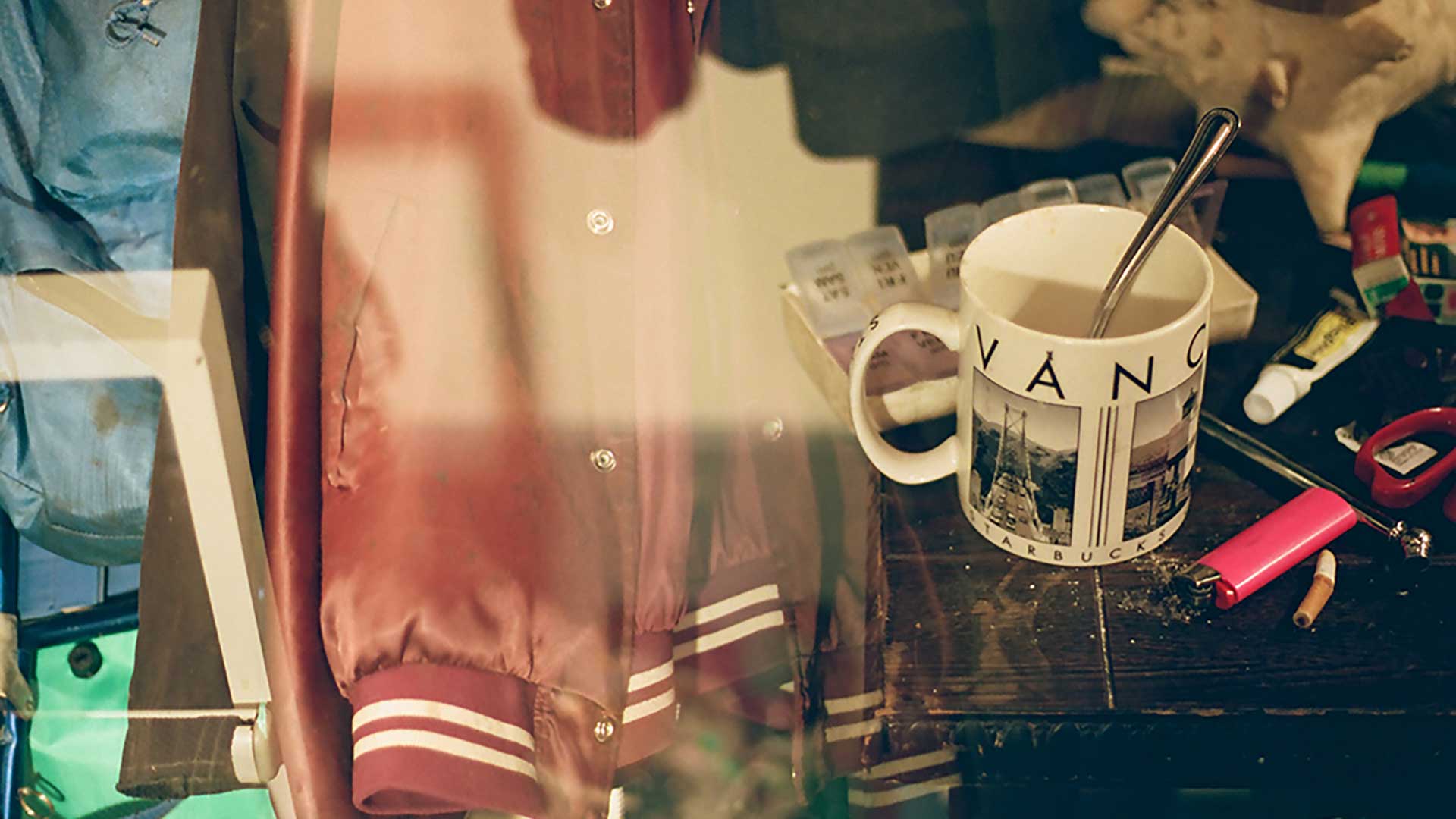
The next four works feel more intentionally monochromatic. In I Gave Him That Mug, I begin to learn about Dives’ father: he drank coffee, he smoked cigarettes, and given the tire pressure gauge, he must know a thing or two about automobiles. But the emerging shadows and patterns of the double exposure evoke a feeling of reaching for a memory no longer there, producing an affective response of sadness.
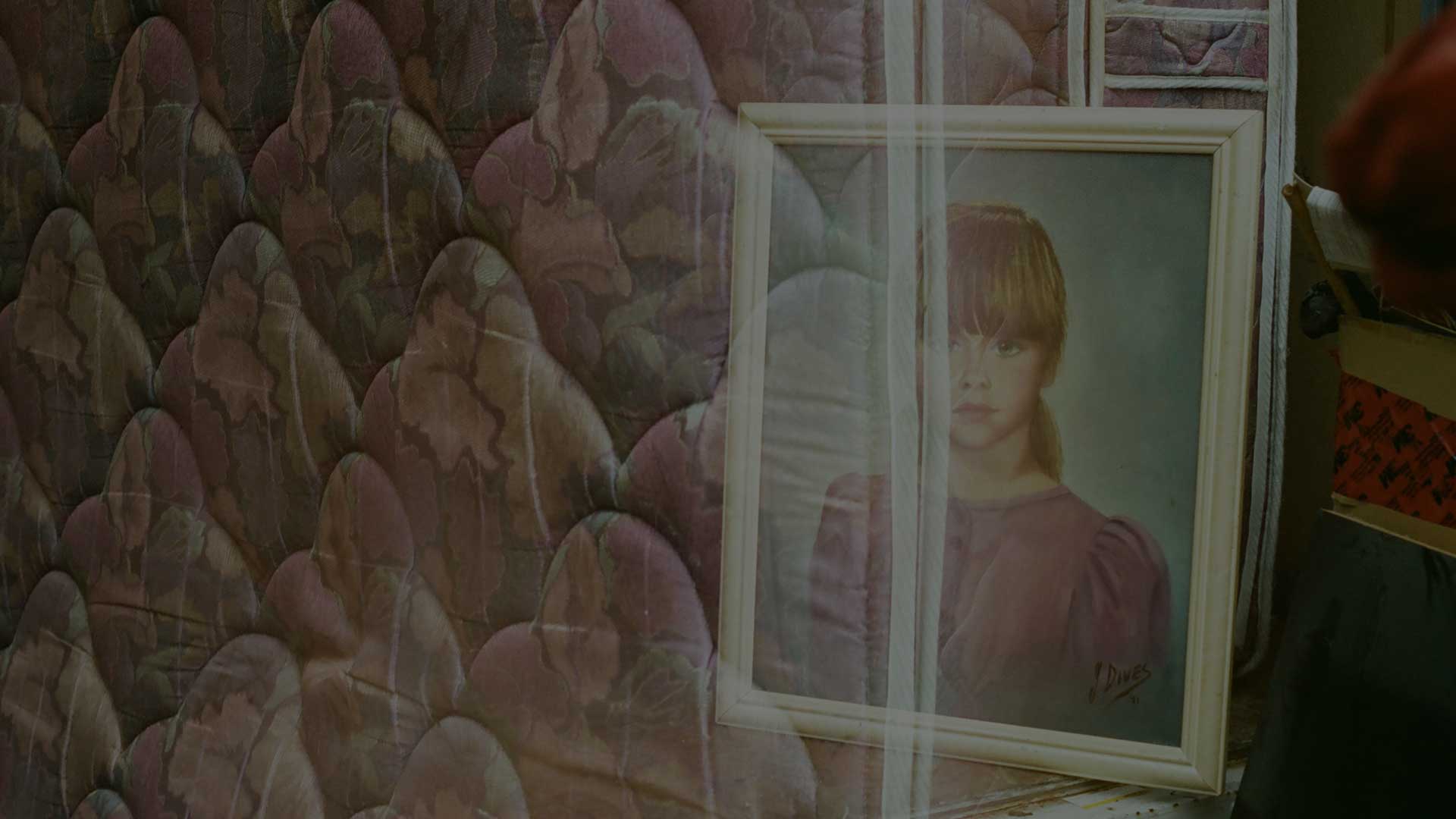
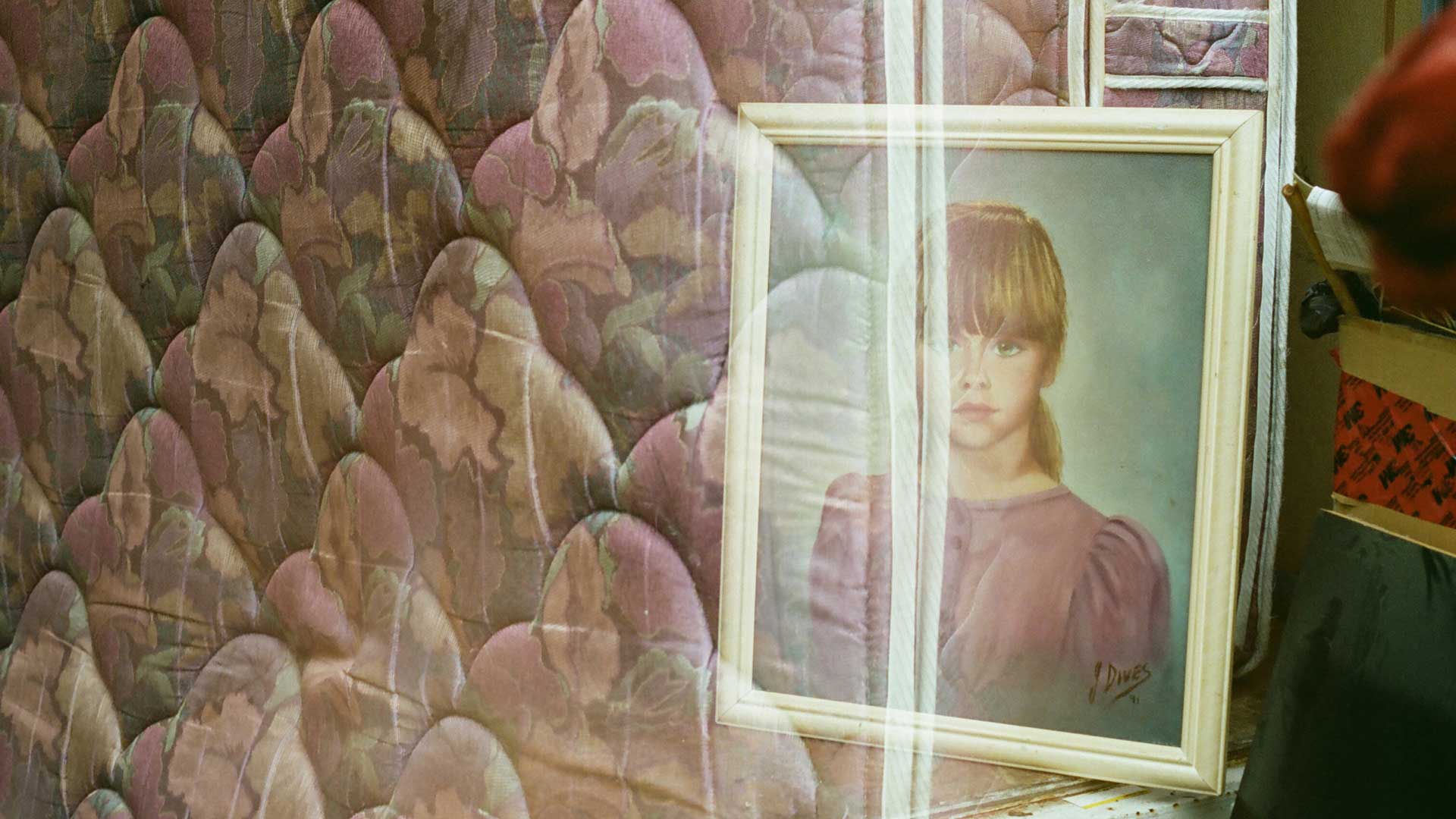
Grandpa’s Painting of Me is as beautiful as it is jarring, as a hand-painted portrait of the artist sits against the floral pattern of an old, discarded mattress. In Dad, I see Dives’ father in a casket, juxtaposed with a vintage illustration of a group of playful, eager squirrels that appear keen to ensure his earthly body’s return to nature. Here, nostalgia and sorrow converge poignantly to present the life-or-death ‘choice’ available to those struggling with substance use by a government that provides little action beyond the occasional lip service to the overdose epidemic.
Turning another corner to view Marigolds and Wax and Skull Pinwheel, understated tones in the previous set of images are swapped for vibrant oranges in marigolds and burning candles. Among the flowers, flames, and melting wax, there is colour, beauty, and reverence for that which has been lost, as well as an illuminated call to grieve the death of Dives’ father, someone who has died of accidental overdose, as a person and not as a statistic.
Created one year after her father’s death using a medium format camera, the second series, Things My Dad Taught Me, offers a series of more refined compositions: the discarded pair of leather loafers in Empty Shoes, flowers suffocated by plastic in Red Flowers, a telephone pole enveloped with thick ivy in Vines, and a curse word spray painted on a gently lit fence in Where I Grew Up. These photographs represent the “a lack of inhibition [Dives’] dad embodied,”3 and, in contrast to those in A Room for the Pain, a sense of acceptance is conveyed, both of the artist’s loss and of her father’s sometimes-unconventional nature. As a stand-alone web series, perhaps strategically, this selection of photographs leaves the viewer curious for more.
In A Room For The Pain and Things My Dad Taught Me, grief is represented in an otherworldly combination of settings, objects, and unlikely juxtapositions. It is made real in a third series, Grief Point, of portraits of people whose family members have been lost to overdose. Grief is embodied by parents who have lost children, children who have lost parents, sisters who have lost brothers, and the artist herself in Self Portrait. While headlines and statistics are often read only to be forgotten, here, the significance of loss to overdose cannot be escaped. Dives honours the victims of the overdose crisis by capturing them in the eyes of their loved ones, humanizing their memory, encouraging the viewer to swap a lens of stigma for one of compassion. As passengers await their next bus, the placement of these portraits at transit shelters throughout the city demands thoughtful contemplation of the human toll of the overdose crisis.
Produced during moments of reflection after her father’s passing, Dives’ works illustrate the confusion and seemingly unshakeable fog that emerge when a loved one is lost without warning, and particularly to a cause that continues to be stigmatized. Through the layering of bright with muted, of beautiful with unwanted, of dream-like with heart-wrenching, the artist reveals to the viewer what she imagines her father’s world looked like through his eyes, and not the eyes of the world that failed to understand or help him: “a cat-lover, a mechanic, a carpenter, a friend, and also a person who used drugs.”4
Notes:
- A spike in the number of overdose deaths in Metro Vancouver was reported as early as 2011. See: Travis Lupick, “A community response: How the worst overdose epidemic in Vancouver’s history left the Downtown Eastside to fend for itself,” The Georgia Straight, December 10, 2016, https://www.straight.com/news/841036/how-worst-overdose-epidemic-vancouvers-history-left-downtown-eastside-fend-itself.
- Dan Fumano, “A daily game of Russian Roulette’ — lessons from Vancouver’s last overdose crisis,” Vancouver Sun, November 15, 2017, https://vancouversun.com/news/local-news/dan-fumano-a-daily-game-of-russian-roullette-lessons-from-recent-history-of-vancouvers-last-overdose-crisis.
- Jackie Dives, “Artist Statement from Jackie Davis: Things My Father Taught Me,” Gallery Gachet, April 2021, http://gachet.org/exhibitions/jackie-dives-things-my-dad-taught-me/.
- Ibid.