The idea of putting together a tribute to Rodney Graham came up in the late Fall of 2023, during a conversation between publisher Karina Irvine and myself at the office (the back of UNIT/PITT gallery). As new coworkers, we were getting to know each other, and Rodney came up as an artist whose work we appreciated, and who had collaborated with, inspired, and employed friends and peers in our community.
We knew there must be so many great anecdotes hanging in the ether, so I got in touch with Shannon to see what she thought about ReIssue initiating a tribute, and the idea quickly snowballed into email exchanges with numerous folks who knew the man. What follows is by no means comprehensive, but conversational in their intersections and divergences. May these shared memories activate new understandings of Graham’s life and work, and inspire you.
– Casey Wei, Editor

Shannon
I am incredibly lucky to have so many memories of Rodney after spending many happy years working together, if you could call it work. However, being asked to choose only one is incredibly daunting. So I rallied the troops — my kids, Ray, and Coco — and asked them if they could think of any funny memories that come to mind (think quick, kids!). Of course, Ray came up with the most definitive memory of Rodney, watching Father Ted, the Irish sitcom of the 1990s, while we were staying in a charming village house in Bruton, Somerset.
We had just finished a relatively long stretch of work putting together an exhibition for The Baltic in Newcastle, and had planned a little break in Somerset afterwards. We were all in our pyjamas and ready for bed, feeling very happy to be there, when Rodney suggested that we should all watch Father Ted together. Rodney LOVED Father Ted, almost to the point of obsession. He would quote it almost daily, and there wasn’t anything more fun than watching it with him side by side, hearing him invariably laugh in anticipation of the jokes. Rodney’s laugh was world-class! It was pure JOY! It was contagious. Hearing his laugh could lift the spirits of everyone.
Rodney was pretty good at spreading joy even when he wasn’t laughing because he was always eager to share his passions with others; I guess one could say that he worked pretty hard to make his passions everyone else’s passions. Especially with regard to music — “Wait for it, this part, the way it modulates is just so moving!” — and — “The middle eight here! You GOTTA hear this middle eight!!!”
I feel we all still have Rodney sharing his passions with us through his work. I think of his lightbox Actor/Director (2013) which was really about his love of technicolour films and Bob Hope, or The Gifted Amateur (2007) which was about Rodney’s lifelong obsession with learning to paint. I only wish we could have him here to listen to him laugh at Father Ted again.
– Shannon Oksanen
Neil
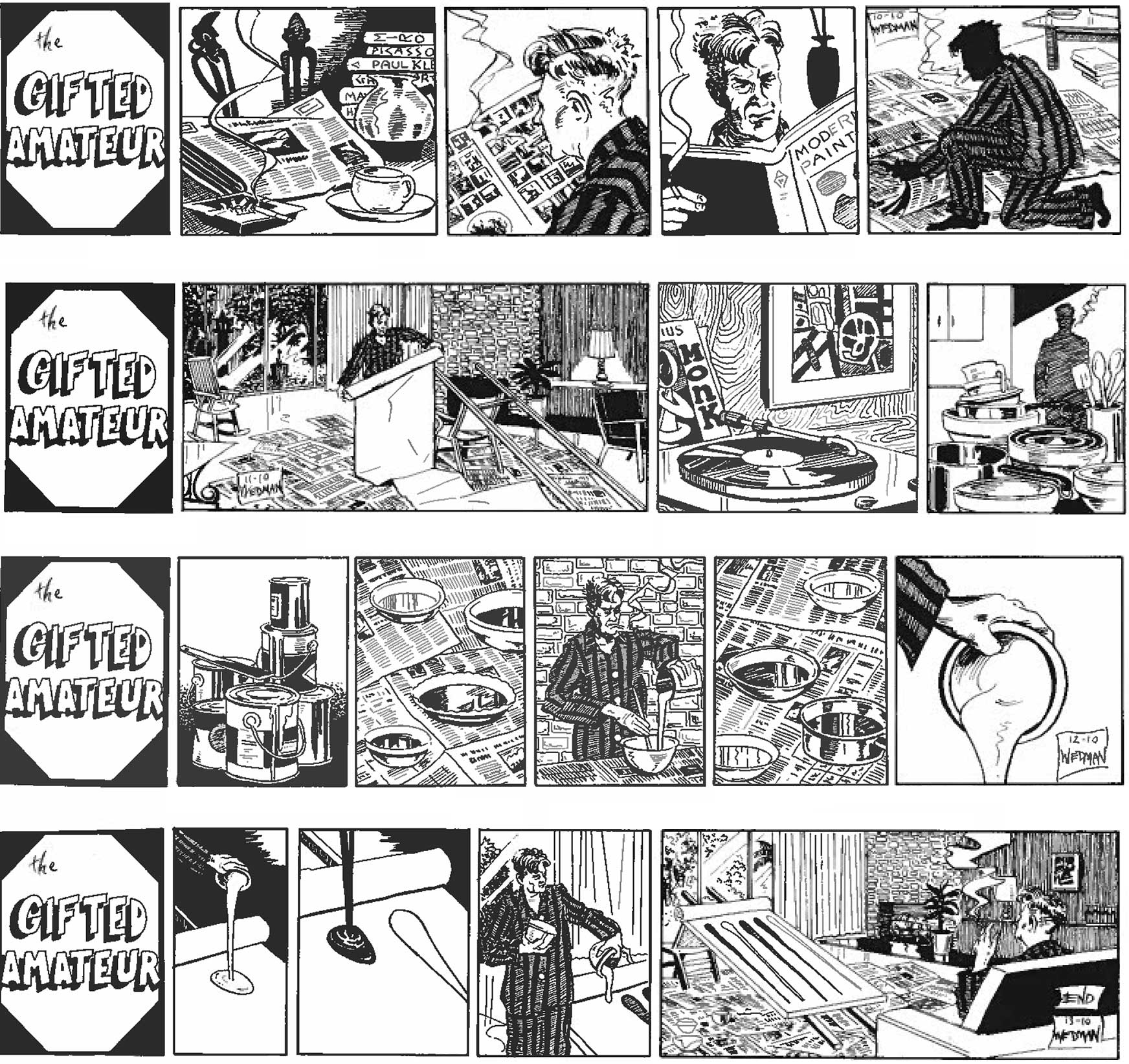
This submission is from when Rodney hired me to make a set of four comic strips sequencing an invented narrative for The Gifted Amateur. I had for reference a smaller reproduction of the principal image of the fictional artist at work, as well as video of some black and white footage of Rodney in character as the pyjama-wearing amateur reading, thinking, smoking, and listening to music. That short, improvised film was immensely useful in plotting the course of the comic strips. I roughly based the drawing style of the comic on Kerry Drake, a syndicated strip that would have been in wide circulation in the early sixties when the subject was set. My strip was published in a daily newsletter for Frieze Art Fair, around 2008, I think. The fair was for four days and one new episode of The Gifted Amateur appeared each day.
Patrik
“Just sayin’ live and let die… Im thinking, some people never die”
— Rodney Graham Band, “Old Pine Casket,” from Gondoliers, 2017
I met Rodney in 1990 through my friend and artist Shannon Oksanen, his future wife. At that time I was already quite a big fan of his work having discovered his book The System of Landor’s Cottage (1987) included in a show at the Perel Gallery on Hastings Street. I would later learn that it was in this very same building that he used to rehearse with his friends in their post-punk band the UJ3RK5. By the time I got to know Rodney as a friend he had shifted gears and was more focused on classical music. He was just completing Verwandlungsmusik (Transformation Music) (1991), a CD with excerpts from his monumental Parsifal (1882–38,969,365,735) (1990), a work that characterises his extraordinary ability to situate himself between positions of deconstruction and reconstruction of modernist tropes by interpolating himself into their structures, creating ambiguity around authorship and using repetition, looping and other methods to focus attention on the edges of modernism.
Not particularly fond of Wagner, I found the very idea of using rigorous math to extend his score billions of years into the future both mind-boggling and hilarious. Not only was this the first of many CDs to come — albeit more pop and rock in the future — but it was also the first time he would include his own image in his work with a commissioned portrait by Neil Wedman in the style of a young classical composer circa 1950.
At a time when everyone was positioning themselves as forward thinkers by calling themselves modernists or postmodernists, Rodney took a hyper-modernist approach. He was a time travelling rambling man who studied the philosophies and art of the past so closely that he found in its details what Feurbach once called its entwicklungsfähigkeit — its capability to be developed and be relevant. With intellect, a lot of style and humour, Rodney made us pay attention to aesthetics and the footnotes of history. While I spent over a decade studying art history at colleges and universities, it was Rodney who got me into art. Through him I learned to travel in the world of art, literature, music and theory. I have never taken this generosity and his friendship for granted. Just as the Parsifal score extends for 38 billion years, so will Rodney’s impact on all of us.
– Patrik Andersson
John
When Austin Powers: International Man of Mystery first hit theatres in 1997, I was skeptical without even knowing much about it. Rodney had seen it though, and while we drove from Kerrisdale to downtown Vancouver, he spent a good 20-minutes going over his favourite scenes and gags of the movie. He loved the highbrow/lowbrow attack: James Bond stars in Blow Up. Following that conversation, I did see it, and was able to appreciate that silly movie as the result of Rodney’s priming.
I returned the favour a year or so later. One night, Rodney called me from a hotel room in Chicago, distraught about the TV programming options available in his room. He read the list of shows available to me, and when he got to the pay-per-view section and The Waterboy, I stopped him right there and told him his troubles were over. Like me with Austin Powers the year before, he had his doubts about this Adam Sandler movie. After much convincing, he decided to give The Waterboy a chance!
Later, he told me that it really did the trick, and it made me so happy that I still think about it 20 years later.
– John Collins
Robert
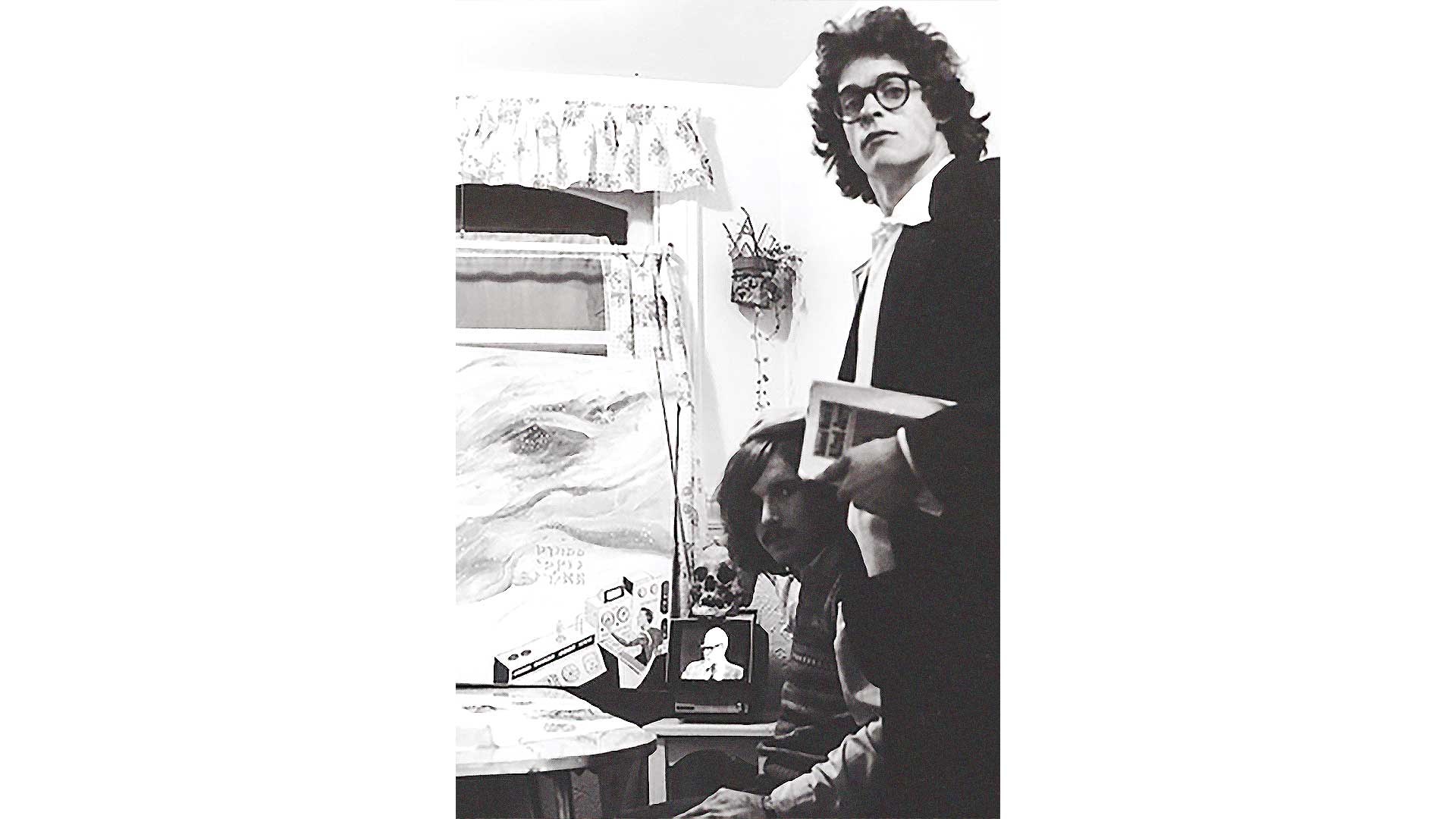
A grainy old photo, one I took and printed myself, shows the young Rodney Graham and Frank Johnson posing before one of Frank’s ‘hyper-banal’ paintings. Frank, later the frontman for UJ3RK5, introduced me to Rodney in 1969 in the Fine Arts library at UBC, our haunt between classes. Rodney nestles a copy of Ubu Roi which, along with Impressions of Africa and The Prince of Homburg, founded his early art-thinking. A surrealist leaning, which never left Rodney’s work, was cooled by the conceptualist influence of Ian Wallace whom Rodney and I often visited. Rodney and Frank had both been Ian’s students, he set them on the modernist path, unlike me who wandered into it after an encounter with the work of Art-Language.
From those shining days on, Rodney was the friend with whom I could have intense conversations on whatever we liked, from jazz, which he knew very well, to mathematics which I had studied prior to architecture (particularly number theory in which Rodney too took a deep interest) and of course literature, preferably fantastical, and film, preferably black and white. We took some of the same courses at UBC (film history, structural anthropology, a studio with Tom Burrows) and dropped acid together with Frank and dawdled about the city in Rodney’s ancient Austin, registering the landscapes of our artistic imaginary — construction sites, decaying houses, empty swimming pools. We were roommates for a couple of years and I discovered that Rodney did not know how to wash dishes. For a brief period, before I ran off to Italy, Rodney and I sported identical Saint Laurent trench coats like Lemmy Caution, and we both had Leica Minilux cameras and enjoyed palindromes.
When Rodney stayed with me in Rome, his Leica was stolen, so he concocted pinhole cameras out of matchboxes and junk, then set off in search of the uncanny. His ingenuity in rising above the occasion, in floating just beyond the necessary, is precisely what he’s left us as an example of being in the world. As Ian Wallace says, Rodney was a genius; yes, undoubtedly so, much like another Canadian savant Glenn Gould — original spirits in the true sense of the word.
– Robert Kleyn
Myfanwy
Rodney and I first met in the mid-90s under what I would describe as awkward circumstances. At that time, he was an already well-known artist, and I was a recent art school grad. The Or Gallery had asked me to donate to their auction, and I chose a suite of watercolour portraits of the infamous ‘Vancouver School’ that included Rodney, which I irreverently titled, All You Need Is Love. At the party later, I was anxious about how he would react, but to my surprise and relief, he took it with grace and humour.
Rodney’s ability to not take himself too seriously made me a lifelong fan, but his generosity made me grateful to be his friend. He would always say YES to everyone and everything. He hired me as his studio assistant even though I had absolutely no skills. The years I spent working for him and his partner in crime, Shannon Oksanen, taught me so much about the kind of artist I wanted to become!
His largesse was most apparent in his artistic practice; nothing was beneath his regard. We both shared a love for popular culture, and his breadth of knowledge was astounding and, at times, intimidating. But it was the pure goofiness of some of his ideas that I appreciated most. Once, when I struggled to develop an idea for an exhibition, he suggested a sculpture based on the mask from the Broadway hit The Phantom of the Opera. Rodney claims that the inspiration for the Spinning Chandelier (2019) was an experiment conducted by Isaac Newton; regardless, I suspect it was, in fact, the chandelier in Phantom.
The list of Rodney’s accomplishments, achievements and talents seemed endless and was matched only by his modesty. When I once referred to his songwriting as poetry, he humbly corrected me, stating that it was only doggerel. Still, no one is perfect, and although he excelled at so many things, he was a truly terrible driver, honestly terrifying. But he was an amazing passenger, and we can be thankful for that.
– Myfanwy MacLeod
Ian
I think about Rodney every day since he passed away on October 22, 2022. He was a dear friend for more than 50 years. We partied together, played music together, shared a house, made art, shared highs and lows, and we had many friends in common.
I first met Rodney when I was an instructor in art history at the University of BC in 1970 when he was a student in my lecture class. I was only 27 and he was about 21. He was the kind of student that a teacher can learn from and I learned a great deal. I don’t use the term “genius” lightly, but Rodney was a true genius. He always had the most informed, original and uniquely personal approach to every topic of the day: not only of intellectual issues but also of pop culture. He loved to entertain and enchant an audience, to introduce them to whatever stimulated his imagination, but never to intimidate them with his intelligence.
In the late ’70s we formed a band called U-J3RK5. He was a very talented musician and songwriter and he followed up the U-J3RK5 project with the Rodney Graham Band. His artwork was always at the forefront of the very best of contemporary art. From his earliest works in the ’70s such as Illuminated Ravine (1979) and Camera Obscura (1979) through to his later videos such as Vexation Island (1997), he stood out as a unique and inspiring artist not only of personal and aesthetic originality, but also of philosophical importance. In my opinion, the most engaging work that revealed his ironic, self-deprecating sense of humour were the late large-scale back-lit photographic transparencies.
At the end of his life, while he was recovering from his illness, Robert Kleyn, who was also a long-time close friend, and I would regularly visit Rodney in his backyard for gin and tonic and conversation. We were to meet in that last week of October 2022, when he cancelled our visit because he had to return to the hospital. He passed away soon after on October 22, 2022. Since then, I have been thinking of Rodney every day.
– Ian Wallace
John
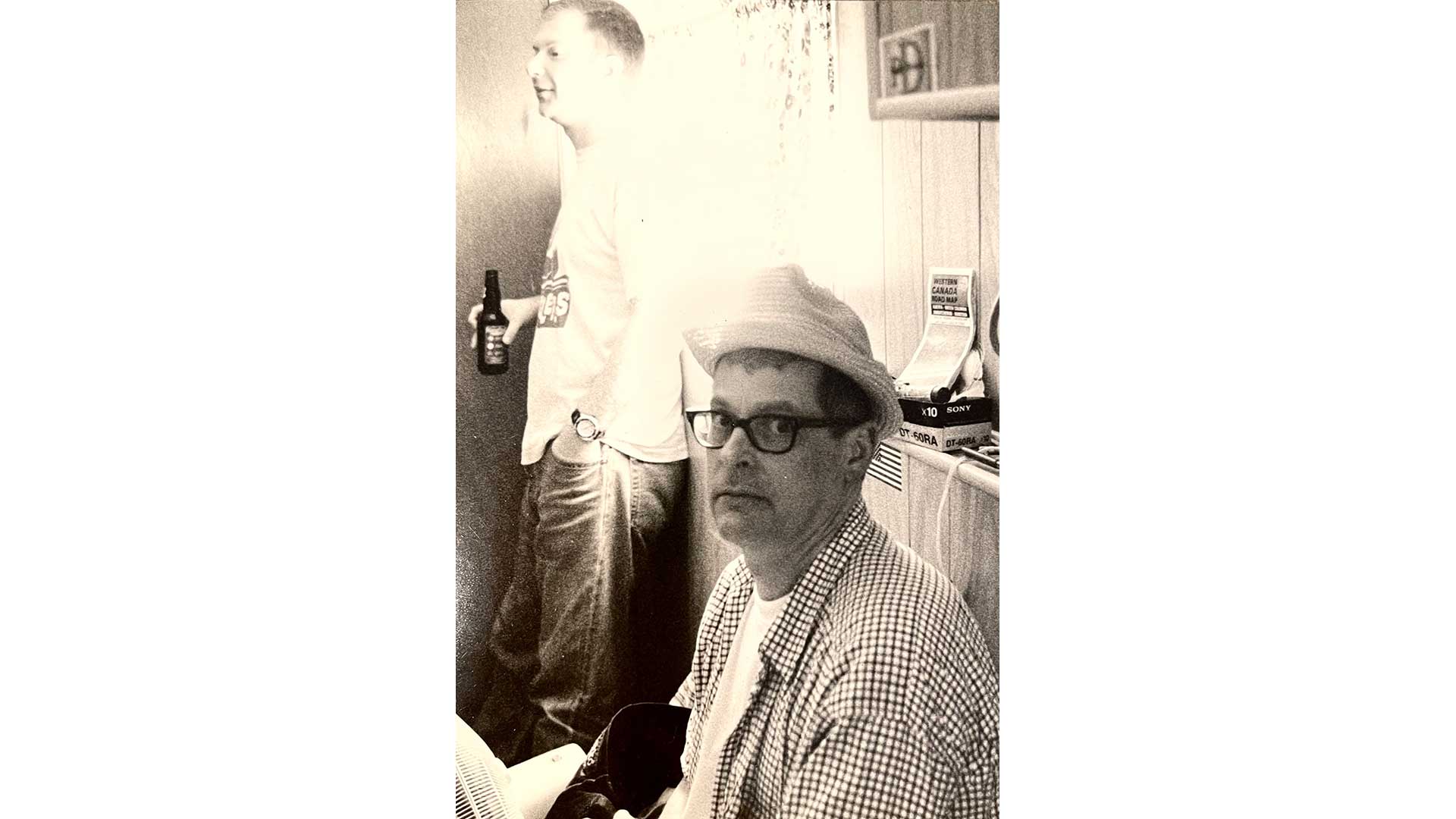
In May 2000, I was sitting in the passenger seat of a taxi, with my sister, Rodney, and Dan Graham in the back. Rodney and Dan were good friends, and Rodney cherished and looked up to Dan a bit, but I think generally they saw each other as equals. We were en route to an afterparty following the opening of Rodney’s DIA show with Bruce Nauman, …the nearest faraway place…. During the ride, Dan came clean at one point, admitting that he didn’t quite see what Rodney was trying to achieve with How I Became a Ramblin’ Man (1999). “What’s the point of it?” was his basic question.
After a short pause, Rodney simply said, “I just wanted to do a piece about ramblin.'” It was awesome.
– John Collins
Jenifer
Rodney’s many masculine guises catalogue the perversity of the cis-male ego. The duality of parody and exposure is a sharp line through Rodney’s photographs where he transforms himself into a myriad of middle-aged white male characters. These archetypes include: a blank faced poker player,1 an aging and pensive drywaller,2 an exhausted sous-chef,3 or an ardent outdoorsman4 to performing caricatures that hover closer to his professional experience via his representations of the uptight and meticulous male gallerist5 or his portrayals of the lone male artist as painter in the gallery, home and studio.6 or instance, in the photo diptych Media Studies ‘77,7 Rodney captures the hubris of the macho college professor in mid-lecture. With the black board scrubbed clean and the television monitor blank, the posture and elaborate dress of the teacher is not only the subject of the artwork but also the topic of the imaginary lesson being taught.
As Rodney ridicules the photo’s subject, he also exposes how the authority of cis-male knowledge is reinforced. At the base of Rodney’s critique of the white male ego is a reflection on individualism: its solipsistic propagation as a moral and justifiable way of existence that is inextricably linked to the rise of the neo-liberal agenda. His ability to capture so succinctly the identities of white masculine stereotypes and deliver them as affecting parody work to underwrite and overturn the reign of the white man’s centre of dominance, flipping the narrative away from the self into a collective derision, and ultimately into an understanding of interdependence.
Even though Rodney is most commonly the solo actor in these photos, the illusion of a singular vision is simply that: an illusion that unravels with the hilarious debunking of the phallocentric cis-male lead. I was fortunate to befriend Rodney, and more intimately his inner circle, including my dear friend artist Shannon Oksanen who is often cited as Rodney’s muse, but should be more rightly be credited as collaborator; and the musician Scott Livingston who, with Rodney and Shannon, ran an artist studio that facilitated the complexities of collaboration wherein the intricacies of the characters acted by Rodney were devised, and the elaborate settings constructed for the calcitrant male ego to exist were staged. Rodney as a singular artist is a construct linked to his performance of the artist.
I use this body of work to illicit Rodney as a critical thinker, collaborator and person, but also as a series that will circle Rodney back to life with the sardonic irony to which his gaze is steadily fixed. The artist as genius isn’t real. That figuration isn’t needed or wanted. It is a conceit that bolsters singularity and individualism, and because it is a persistent myth it is in constant need of unravelling. This reading gives an understanding into who Rodney was and how he operated in the world. As an artist, he created in relation to a tight group of thinkers who worked collectively and in sync. When Rodney passed in late 2022, the word generosity was used to describe him in commemoration more than any other, and I place this generosity at the heart of his artistic production – one that mocked the ruse of the singular artist and welcomed collaboration of vision and a life of connections.
– Jenifer Papararo
Kathy
The last time I saw Rodney was a warm afternoon in early August, 2022. We sat in his back garden, and he made me a gin and tonic with pink tonic water. Reading from his phone, he gently recited the lyrics from “A Strong Sweet Smell of Incense,” a new song he had written. His voice was soft and raspy. The song was based on Richard Hamilton’s Swingeing London ‘67 (1968–1969), a collage made of newspaper clippings from the Redlands trial, the Stones’ 1967 drug bust trial. From Hamilton’s collection of news reports, Rodney selected descriptions of what Mick, Keith, and Marianne Faithful wore during the course of the trial and composed them into this gorgeous sartorial rock star poem of a song. It was truly great. There will never again be anyone like Rodney.
– Kathy Slade
Notes:
- Good Hand Bad Hand, 2010, two painted aluminum lightboxes with transmounted chromogenic transparencies, 35¼ x 29¼ x 7 inches each.
- Smoke Break 2 (Drywaller), 2012, painted aluminium lightboxes with transmounted chromogenic transparencies, diptych 3680 × 3040 × 180 milimeters.
- Betula Pendula ‘Fastigiata’ (Sous-Chef on Smoke-Break), 2011, painted aluminum lightbox with transmounted chromogenic transparency, 95⅝ x 71⅝ x 7 inches.
- Paddler, Mouth of the Seymour, 2012–2013, three painted aluminum lightboxes with transmounted chromogenic transparencies, triptych 304 x 554 x 18 centimetres each.
- Vacuuming the Gallery 1949, 2018, four painted aluminum lightboxes with transmounted chromogenic transparencies, 119½ x 71½ x 7 inches each.
- My Late Early Styles (Part I, The Middle Period), 2007–2009, chromogenic photograph; 186.4 x 247.6 centimetres; The Gifted Amateur, Nov 10th, 1962, 2007, three painted aluminum lightboxes with transmounted chromogenic transparencies, 286.1 x 556 x 17.8 centimetres installed; Pipe Cleaner Artist, Amalfi, ’61, 2011, painted aluminum lightbox with transmounted chromogenic transparency; 230.3 x 181.9 x 17.8 centimetres each.
- Media Studies ‘77, 2016, two painted aluminum lightbox with transmounted chromogenic transparencies, 232.4 x 375.9 x 17.8 centimetres installed.