“It is easier to imagine the end of the world
than it is to imagine a world without prisons.”1
– Jackie Wang
The Dispossessed
Two children are exposed to the idea of prison for the first time one day in school. They have never heard of prisons before because prisons don’t exist on their planet, and they are curious as to why one person’s freedom would be deprived by another. As an experiment, they lock one of their classmates up in a make-shift cell, finding themselves becoming increasingly violent with the power they now possess over this individual. After thirty hours, the boy in the cell is unwell, curled up on the ground and physically ill. The children abandon the experiment deeply disturbed by the state of their prisoner and the power imprisonment wields. This scene is from Ursula K. Le Guin’s 1974 sci-fi classic The Dispossessed, a novel within which the anarchist planet Anarres has eliminated prisons and punishment in a rare depiction of an abolitionist future. In the realm of moving images, very few artworks have taken up the imaginative thinking needed to undo carceral structures and envision such post-prison futures. To do so calls for an abolitionist aesthetics: an entirely new visual language that must represent, in carceral geographer Ruth Wilson Gilmore’s words, the “fleshly and material presence of social life lived differently.”2 As a filmmaker, I am interested in how an abolitionist aesthetics could create a radically different visuality to bring about these new worlds.
The state of things / abolition now
Since George Floyd’s murder in May 2020, a powerful and sustained people’s movement has risen up in the context of long-standing anti-Black racism and police brutality in the US and Canada.3 The organizing of Black Lives Matter, allies and accomplices has resulted in the dissolution of the Minneapolis police department, and increased pressure to defund police and hold law enforcement accountable across numerous cities. The concept of police and prison abolition has since been mainstreamed in a way that many abolitionists never thought they would see in their lifetime.4 Decarceration with the aim of abolition has never been more relevant, as the incarcerated battle constant COVID outbreaks and organize recurring hunger strikes in protest of dire prison conditions.5
Black women, including Angela Y. Davis, Miriame Kaba and Ruth Wilson Gilmore, have long led the abolitionist cause. Many of them point to the modern penitentiary and its relatively recent (as in late 19th century recent) invention to demystify it as a socially constructed system that we have the power to unmake.6 Gilmore further argues that abolitionism is not simply about the destruction or absence of the prison, rather it is about building the presence of infrastructures of social equality and care.7 As she explains, abolitionists do not expect prisons to disappear overnight, but instead recognize that nothing will change if incarceration continues to be offered up as the only solution. Expanding on the ideas of the abolitionist W.E.B. Du Bois, Gilmore believes that “abolition is a theory of change, it’s a theory of social life. It’s about making things.”8 As image-makers, we should consider this a call to action.
I consider here an emergent abolitionist aesthetics in non-fiction film, in response to the carceral aesthetics at work in documentary media. I focus on this genre in order to challenge its far-from-objective claim on capturing ‘the real’ and its role in upholding certain social logics, and also because I am a documentary filmmaker committed to the abolition of the prison industrial complex. The elements of carceral aesthetics are outlined and contrasted with the visual strategies in documentaries like Brett Story’s The Prison in Twelve Landscapes (2016) and Garrett Bradley’s Time (2020). Story and writer Pooja Rangan have recently troubled the ‘the new true crime’ genre and advocate for documentary work to take up abolitionist politics. In response to their call, the abolitionist aesthetics outlined below should be taken as just a few methods by which documentarians can dismantle the ‘truths’ of the carceral images that appeal to the white imaginary and cooperate with and/or legitimize state violence.9 Abolitionist documentary must then be invested in supporting forms of transformative justice that reckon with these institutions of white supremacy, in order to create new imaginaries for a police- and prison-free future.
Carceral aesthetics
Carceral aesthetics refer to the status quo images of our current prison-industrial complex: images of police violence and the horrors that take place behind bars, largely subjected upon racialized individuals. These are the common prison documentaries like The House I Live In (dir. Eugene Jarecki, 2012); The Central Park Five (dir. Ken Burns, 2012); Into the Abyss (dir. Wernor Herzog, 2011); and the wildly popular true crime documentary series such as Making a Murderer, Cold Case Files, and Cops to name a few. Images in these works naturalize prisons and police in our visual landscape and project criminality onto bodies made vulnerable by systemic racism and inequality — without questioning where that vulnerability stems from in the first place.
One of the first films to emerge in this genre was Frederick Wiseman’s seminal direct cinema work Titicut Follies (1967), which asks the viewer to bear witness to the shockingly inhumane treatment of those incarcerated at the Bridgewater State Hospital in Massachusetts. It would become the forerunner of the ‘humanizing’ prison film, built on the conceit that the audience needs to see the violence of carceral institutions, because “if only the public actually knew what was going on” then things might change.10 The magical thinking of such films reinforces a reformist visual strategy, just like the reformist policies often proposed by politicians that abolitionists advocate against (i.e. police body cameras, citizen review boards).11 Relying on viewer empathy, carceral aesthetics point to the system’s horrors and at most, demand incremental changes within existing institutions. ‘Humanizing’ prison stories lean on hollow gestures like firing ‘bad apple’ officers or getting rid of private (but not public) prisons, which become temporary fixes within infrastructures designed for violence.
Story and scholar Pooja Rangan together write about ‘the new true crime’ documentary phenomenon as a troublingly effective extension of the criminal justice system.12 This truth-seeking genre pursues justice for the innocent, and in doing so reifies the social truth that guilty = bad/immoral, and punishment via law-and-order = good/natural. Series like The Jinx (HBO, 2015) have filmmakers so actively involved in these pursuits that they become unofficial arms of the law, managing to obtain the guilty confession that evaded authorities. In these story arcs, state violence via police and prisons, is portrayed as deserved and is thus legitimized. Guilty pleasure binge watching then releases audiences from having to confront the wider injustices at the root of these crime dramas. As Rangan and Story put forth, abolitionism disputes the false equivalence between committing a crime and causing harm: as a socially constructed category, “crime is a lie” and non-fiction media must challenge claims to (harmful) carceral ‘truths.’13 In response to their call for documentary work that enacts abolitionist politics, the visual strategies in the films below are part of the emergent abolitionist aesthetics that embody these principles.
Strange-making Landscapes
As poet/abolitionist/dreamer Jackie Wang notes, we have a serious problem when our strategies “reinforce a framework that renders revolutionary and insurgent politics unimaginable.”14 Carceral aesthetics frame the symptoms of a deeply unethical system, but do little to ask if this system could ever look like anything else. Abolitionist aesthetics instead dislocate the carceral by demanding a different visuality, a new set of images for an entirely reimagined set of relations. The most appropriate piece to examine here first would be Story’s documentary The Prison in Twelve Landscapes. Writing about her film, she discusses the dangers of other prison films naturalizing violent images which in turn reproduce the order of the prison and the logic that prisons keep us safe from ‘dangerous criminal elements.’ She argues that rather than asking audiences to passively bear witness, as films like Titicut Follies do, our cultural work should aim to ‘make strange’ the normalized imagery of the prison in order to question its legitimacy.15
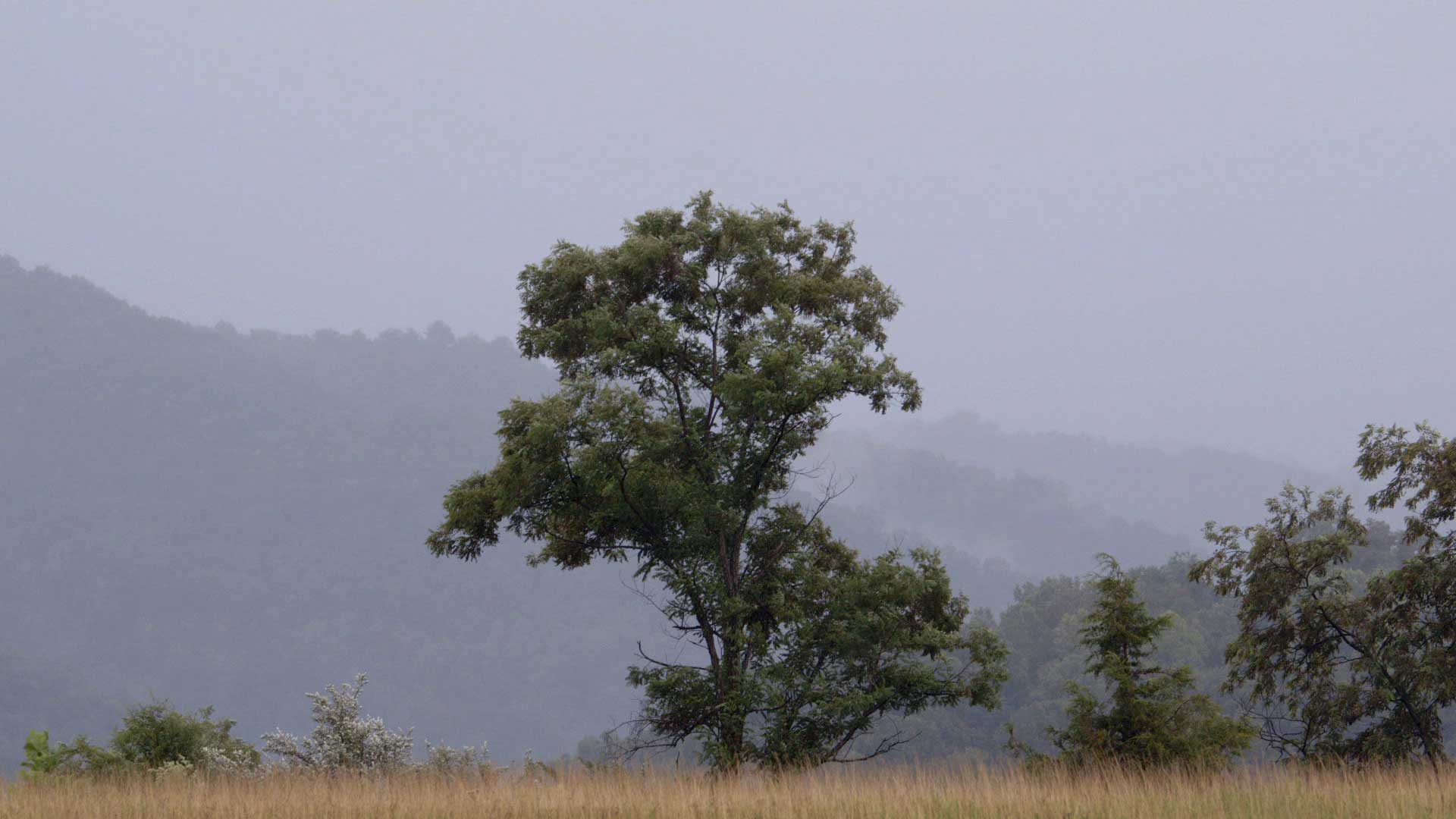
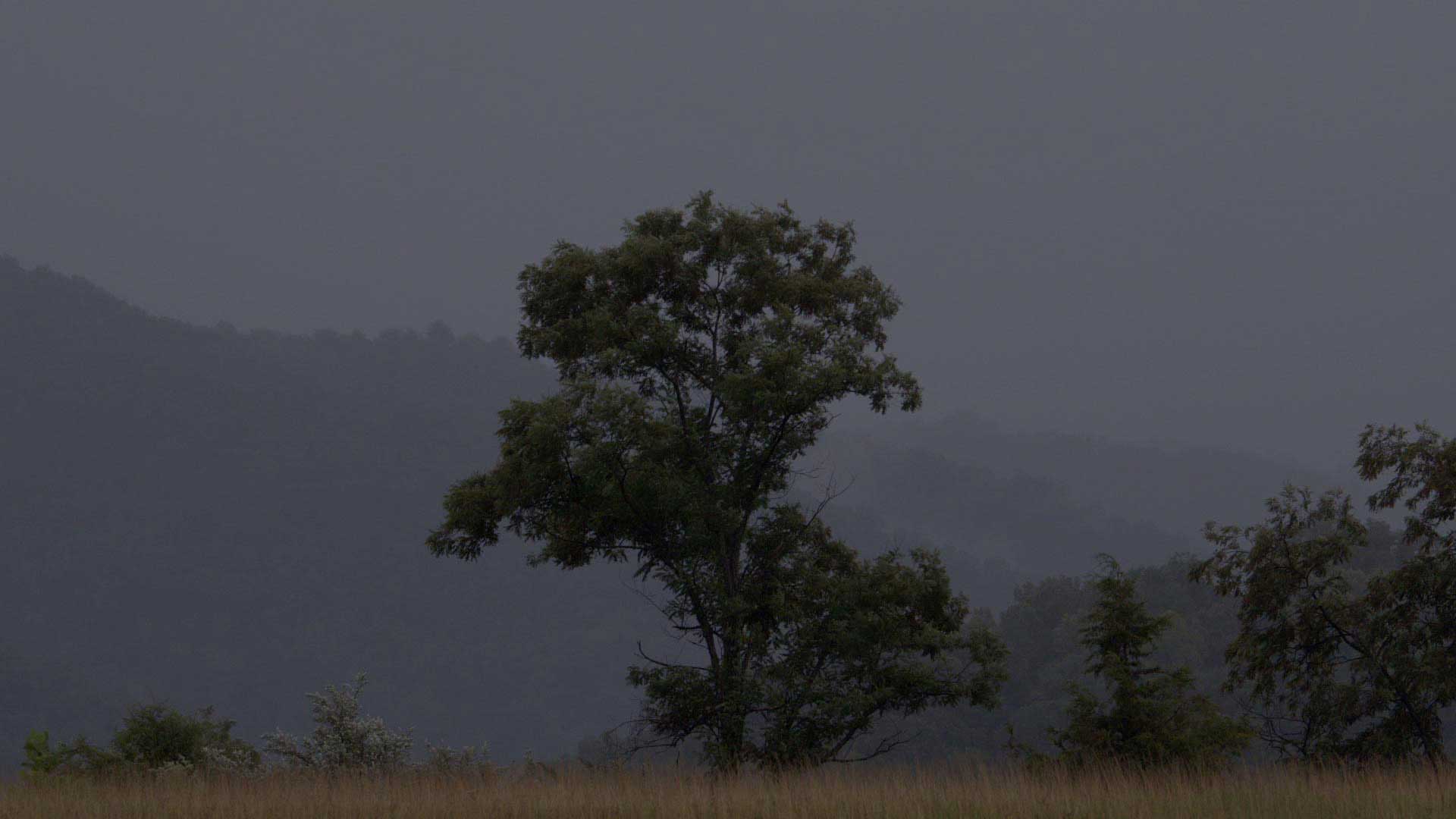
By focusing on twelve scenes of carceral power quietly at work in American society, Story’s film exposes the diffuse extent of the prison system’s violence. The associative vignettes, in which we (almost) never see a prison, speak for themselves by sharing glimpses into the lives of affected individuals in each landscape: from the absurdity of a woman who served jail time due to fines over an improperly secured garbage lid, to an overly-eager PR person giving an enthusiastic tour of the new hyper-securitized Quicken Loans headquarters in gentrified Detroit. We watch an outdoor chess game in Washington Square Park where one skilled chess player shares that he and many players have honed their chess game in prison. In the final scene, the prison at last appears: the camera glides in slow-motion through unassuming trim-lawned suburban roads until a fortress-like structure gradually enters the frame. By making strange the familiar tropes of American incarceration, the violence of the prison is revealed to be all around us, made visible in ways carceral geography seeks to obscure.
Beyond Innocence
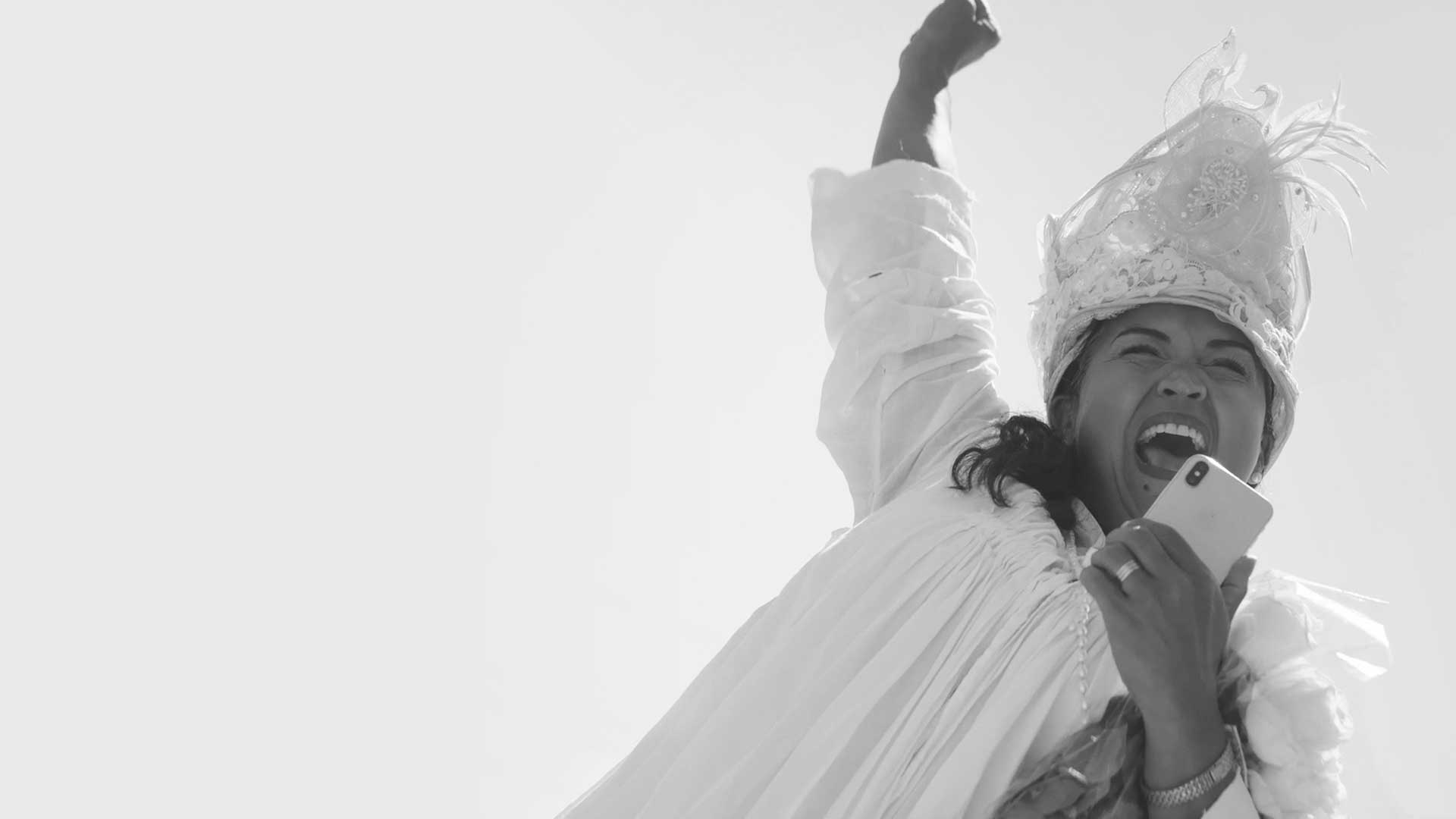
Time is a film that disrupts the innocent/guilty narrative and the validity of the prison system itself. The doc tells the story of Fox Rich, a self-identified abolitionist, throughout her pursuit to get her husband out of prison. The film does not dwell on the couple’s crime from twenty years ago, nor are they ever pictured behind bars. Instead, director Garrett Bradley emphasizes Fox’s struggle to free her husband from his sixty-year sentence, positioning both of them as survivors of the incredibly racist and dehumanizing prison system. Bradley deploys a striking visual strategy: shot in black and white, featuring cinematic Dutch angles and slow zooms that convey an emotionally compelling (but not overly-dramatic) affect, mixed with remarkable DV-cam home footage shot by a young Fox, sent as letters to Robert in prison. As filmmakers and collaborators, both Rich and Bradley actively resist carceral aesthetics. Instead they foreground intimate scenes of deep love between the couple, and the family’s shared joy and celebrations, buoyed by Rich’s enduring emotional strength.
We also witness the immense reproductive and emotional labour placed on Rich’s shoulders via the carceral state. Ruth Wilson Gilmore notes that “prisons wear out places by wearing out people, irrespective of whether they have done time.”16 The daily and almost mundane toll taken on Rich via the prison is revealed in the emotional arc of one scene in which she speaks on the phone with a judge’s office, waiting to hear back about her husband’s potential release date. Her tone cycles from polite patience, to exasperated laughing at the clerk’s rejection, to shouting in pure frustration at the indignity of the system, then returning calmly to the work in front of her. In Time, Bradley exposes how deeply punitive and harmful the prison industrial complex is to the incarcerated and their families every single day — regardless of guilt or innocence — bringing new meaning to ‘time served.’
Solidarity > empathy
It is important here to address empathy as a cinematic tactic, usually stirred up by an individual’s struggle that begins and ends inside the theatre. Movies, as the oft-repeated Roger Ebert quote tells us, are empathy machines: the viewer bears witness to the protagonist’s story that often emphasizes pain or loss, identifies with it from their own experience and the filmmaker’s duty is done.17 Scholar Robin D.G. Kelley notes how this tactic often relies on “the problem of innocence” as described above, fostering empathy for the ‘innocent,’ and rarely for the ‘guilty’ as Time does.18
Expressions and representations of solidarity, connected to IRL organizing, move beyond individualistic empathy and can be called abolitionist aesthetics. The Prison in Twelve Landscapes includes striking shaky-camera clips of solidarity protests in the streets of Baltimore after Freddie Gray’s death by police in 2015. The shared rage and pain is palpable; these images, put in contrast with those of a zealously militarized police force, serve as a powerful rebuke of the police state’s legitimacy. Similar scenes are echoed in the documentary Whose Streets? (dir. Sabaah Folayan & Damon Davis, 2017) about the Ferguson uprising after Mike Brown’s death, told from first-hand experiences of activists on the ground. Recently, the hybrid doc The Infiltrators (dir. Cristina Ibarra & Alex Rivera, 2019), features a powerful display of solidarity: a group of young undocumented immigrant activists purposely get detained by ICE in order to organize and free other detainees from the inside.19
Robin D.G. Kelley argues that solidarity, not empathy, is a more powerful and mobilizing connection for political change. Solidarity does not demand recognition of one’s self within the other, instead it comes from “the people you don’t recognize. The people who you don’t see yourself in.”20 Fred Moten builds off of this distinction of solidarity as “fundamentally a modality of selflessness,” and a call to be in constant struggle with each other based on a recognition of every person’s dignity and humanity.21 In other words, empathy goes nowhere unless directly connected to collective action for systemic change.
Abolitionist dreaming
How else could moving images connect to and enact solidarity? This is an open-ended question that deserves further consideration and exploration. We should also consider how our artistic practices behind the camera could be organized to build solidarity and connect to an ethics of care (possibly by using methods of participatory cinema as Time does). Abolitionism is a revolutionary strategy that requires mass solidarity for wholesale social transformation. A movement’s images then cannot be built on the tenuous heartstrings of empathy alone — the images must be situated within the revolution itself.
Recalling Le Guin: does it still seem so impossible that incarceration could become a completely alien idea to future generations? (Is it really that much harder to imagine than the end of the world?) Miriame Kaba tells us that finding an alternative to prisons and police will not come from a single great plan or person — abolition is a collective dreaming process, in which all kinds of art-making play an important role.22 The abolitionist aesthetics outlined here offer a few possible methods to disturb and unmake the carceral space in our collective imaginary. As image-makers, we ought to turn to formerly and currently incarcerated people, artists, activists, workers and thinkers to collaborate on the radical dreamwork needed to see these abolitionist futures into being.
Notes:
- Jackie Wang, Carceral Capitalism, (South Pasadena: Semiotext(e), 2018), 297.
- Clément Petitjean, “Prisons and Class Warfare: An Interview with Ruth Wilson Gilmore,” in Verso Blog, August 2, 2018, https://www.versobooks.com/blogs/3954-prisons-and-class-warfare-an-interview-with-ruthwilson-Gilmore
- In Canada, this includes the police-involved murders of Regis Korchinski-Paquet, Chantel Moore and most recently Kuya Chester in “Vancouver” on January 5, 2021.
- Abolition in this sense is a call to end all carceral systems, including police and prisons, as they function as infrastructures of colonialism and white supremacy premised on the continued harm and deaths of Black people, Indigenous people and people of colour.
- Outbreaks remain active and there are over 5,000 COVID-19 cases in jails and prisons across Canada since the start of the pandemic. See: Alyshah Hasham and Akrit Michael, “Maplehurst’s 130 active COVID cases make it Ontario’s worst jail outbreak of the pandemic,” Toronto Star, January 25, 2021, https://www.thestar.com/news/gta/2021/01/25/maplehursts-130-active-covid-cases-make-it-ontarios-worst-jail-outbreak-of-the-pandemic.html
- ‘Relatively’ as in coming out of the earlier 19th century. See: Rachel Kushner,“Is Prison Necessary? Ruth Wilson Gilmore Might Change Your Mind,” The New York Times, April 17 2019, https://www.nytimes.com/2019/04/17/magazine/prison-abolition-ruth-wilson-gilmore.html
- Rachel Kushner, “Is Prison Necessary? Ruth Wilson Gilmore Might Change Your Mind.”
- Clément Petitjean, “Prisons and Class Warfare: An Interview with Ruth Wilson Gilmore.”
- Story was my MFA thesis supervisor and her thinking on prison films was influential in my own development as a filmmaker; my most recent short documentary “The Garden Collective” is about the Prison for Women Memorial Collective, a group of formerly incarcerated women, working to build a memorial on the former grounds of the Prison for Women in Kingston, Ontario.
- Brett Story, “Against a Humanizing Prison Cinema: the Prison in 12 Landscapes and the Politics of Abolition Imagery,” in Routledge International Handbook of Visual Criminology. Routledge, eds. Michelle Brown and Eamonn Carrabine, (New York: Routledge, Taylor & Francis Group, 2017): 455.
- These are often referred to as “reformist reforms” as opposed to “non-reformist reforms” aka abolition. See: Critical Resistance, “Reformist reforms vs. abolitionist steps in policing,” 2020: http://criticalresistance.org/wp-content/uploads/2020/08/CR_NoCops_reform_vs_abolition_REV2020.pdf
- Pooja Rangan and Brett Story, “Four propositions on True Crime and Abolition,” World Records, no.5 (2020): https://vols.worldrecordsjournal.org/99/02
- Ibid.
- Jackie Wang, Carceral Capitalism, 264.
- Brett Story, “Against a Humanizing Prison Cinema,” 456.
- Ruth Wilson Gilmore, Golden Gulag: Prisons, Surplus, Crisis, and Opposition in Globalizing California (Berkeley: University of California Press, 2007), 17.
- Roger Ebert, “Video: Roger Ebert on Empathy,” Rogerebert.com, April 4, 2018, https://www.rogerebert.com/empathy/video-roger-ebert-on-empathy
- Robin D.G. Kelley, Jack Amariglio and Lucas Wilson, “Solidarity is not a Market Exchange: An RM Interview with Robin D.G. Kelley part 1,” Rethinking Marxism, 30:4, 568–598, accessed through
https://black-ink.info/2020/01/16/solidarity-is-not-a-market-exchange-an-interview-with-robin-d-g-kelley/ - The Infiltrators was discussed as an abolitionist film in Brett Story and Pooja Rangan’s talk, “True Crime & The Case for Abolition Documentary.”
- Robin D.G. Kelley, Jack Amariglio and Lucas Wilson, “Solidarity is not a Market Exchange.”
- Fred Moten and Stefano Harney, “Wildcat the Totality – Fred Moten And Stefano Harney Revisit The Undercommons In A Time Of Pandemic And Rebellion (Part 1),” July 4, 2020, Millennials are Killing Capitalism, podcast, mp3 audio, 01:01:54, https://millennialsarekillingcapitalism.libsyn.com/wildcat-the-totality-fred-moten-and-stefano-harney-revisit-the-undercommons-in-a-time-of-pandemic-and-rebellion-part-1
- She points to Monet’s Water Lilies as a point of inspiration for her work. See: Emily Breidenbach, “Envisioning an Abolitionist Future,” Sixty Inches from the Center, February 20, 2018. https://sixtyinchesfromcenter.org/envisioning-an-abolitionist-future/