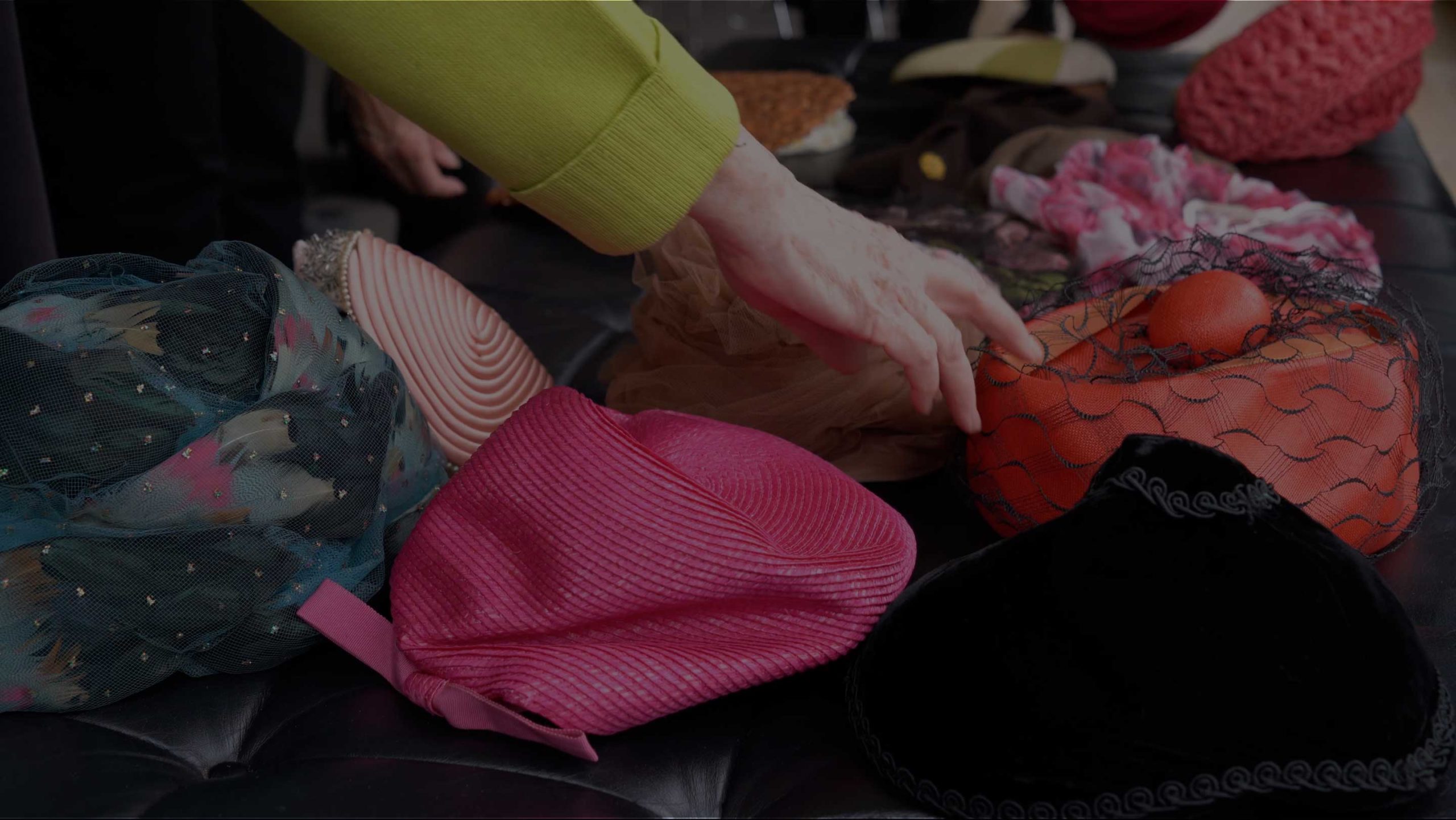
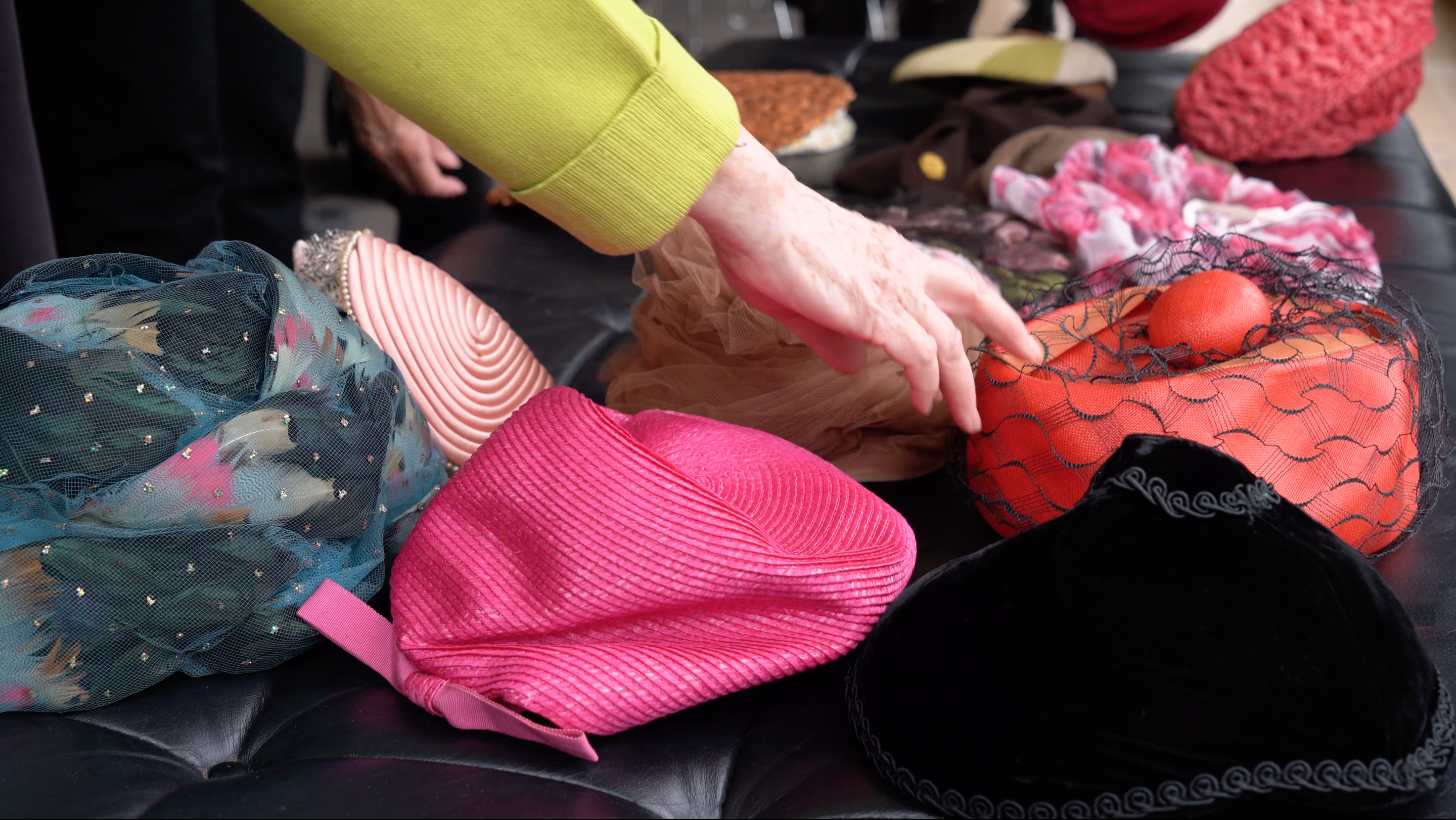
The room: long tables, chairs set out in a circle. A small table with tea, cups, water, and a plate of cookies. Large floor-to-ceiling windows. Some bags and coats piled by the door. A rolling cart full of hats of varying style and vintage. Another rolling cart filled with objects hidden from view by a piece of canvas fabric. People — some in chairs, some moving about operating cameras, some by the door welcoming newcomers. A 4-month-old, Bruno; a ninety-seven-year-old, Jean, and many others between. All told, the room held Bev, Jean, Elisa, Jane, Beryl, Tiziana, Megan, Abner, Margaret, Bruno, Odessa, Gabi, Bérangère, Sharon, Clemencia, Isabelle, Kyra, Danielle, Alan, Alexa, Emily, Shayla, Jenni, Alana, Jamie, and me, Claire. From October 2 to November 20, 2019, this intergenerational group met weekly at the Museum of Vancouver (MOV) for all the things in the room: a workshop series developed by Elisa Ferrari and as a partnership between the Contemporary Art Gallery, MOV, and South Granville Seniors Centre. Through a series of sensory-driven workshops led by Tiziana La Melia, Jane Ellison, Megan Hepburn, and Elisa herself, all the things in the room used somatic methods of learning to come to know a selection of objects from the museum’s collection. Most of the objects we worked with were in the MOV’s “teaching collection” – in other words, objects that members of the public are allowed to touch.
Prioritizing lateral motions, our object interactions were rooted in a body’s ability to “absorb and amplify,” forgoing drawn conclusions in favour of affective experience.1 In Dylan Robinson’s concept of “hungry listening,” settlers have a habit of listening in a “goal-oriented”2 way — to grasp, contain, and own information — while failing to consider how our positionalities change what we are able to hear. Robinson writes that “hungry listening prioritizes the capture and certainty of information over the affective feel, timbre, touch, and texture of sound.” Critical of “single-sense engagement,” Robinson identifies Western music ontologies as part of a process “that renders listening as a process of the ear rather than of the body.”3 While Robinson writes about the way we consume music, a similar critique can be made of seeing within the context of art, particularly in museums. Reinforced by the museum’s proclivity for taxonomical arrangements, plexiglass vitrines, and refusal of touch, our eyes are hungry for recognition and identification. all the things in the room resists the assumption that these are sufficient forms of engagement, implicitly asking how we can access and inhabit “non-hungry” perception, and what it might mean to interact with a museum collection this way.
As a participant for all eight weeks, I noticed a slow shift in relationality amongst the participants take place. Some became more social with each other, chatting on their way in and out. Others, like me, became devoted to a French exit, losing track of the norms of social language as I attuned more deeply to my other senses. I felt dissonance as my social voice on the phone with a friend became so different from the rare and quiet one that presented itself in the room. In one of the first workshop sessions, Tiziana, though facilitating, spoke minimally. She explained afterwards, “I’ve noticed this happens to me, sometimes at the full moon I lose language.” That phrase, “I lose language,” stuck in my head, forming the ground for a question about speaking and relationality.
Pauline Oliveros, whose work on “deep listening” informs Elisa’s approach to collective listening, proposes non-verbal meetings for her Sonic Meditations, suggesting they “intensify the results of these meditations and help provide an atmosphere which is conducive to such activity.” Oliveros’s “results” include “heightened states of awareness,” “relaxations which gradually become permanent,” “a tuning of mind and body,” and members of the group gaining “greater awareness and sensitivity to each other.”4 While non-verbal meetings were not in the scope of our workshops, it is telling that for Oliveros, deep listening both requires and results in a shift in normal relations (i.e., non-verbal meetings result in greater awareness of each other). In the context of the workshop, using the methodologies of deep listening to shift the way we normally engaged in relations — both between each other and between ourselves and objects — allowed us to meet the objects as other beings. We gained “greater awareness and sensitivity to each other” in the sense that “each other” came to include the other things in the room.
Robinson, too, suggests a shift in the social scaffolding of listening spaces is required for non-hungry listening to come into play as a decolonizing practise: “What happens when we change those sites of listening to include intimate spaces of one-on-one listening, spaces in relation with the land, spaces where audience members are not bound by the particular kinds of attention these spaces assert?”5 Located in the museum’s back rooms, all the things in a room shifts the site of perception away from visual displays and didactic language to places that foreground perception as a process of the whole body. It’s not surprising that speaking became a less-prevalent form of connection, as turning toward the objects meant attuning to the ways in which they were able to communicate — through their sounds, scents, weight, and visible and tactile surfaces.
Weeks One and Two: “a hat is a magical object”
To me a hat is a magical object, writes Alice.6 It has a life of its own. I must have over 20 hats at home and had the opportunity to wear many many more as an opera singer.
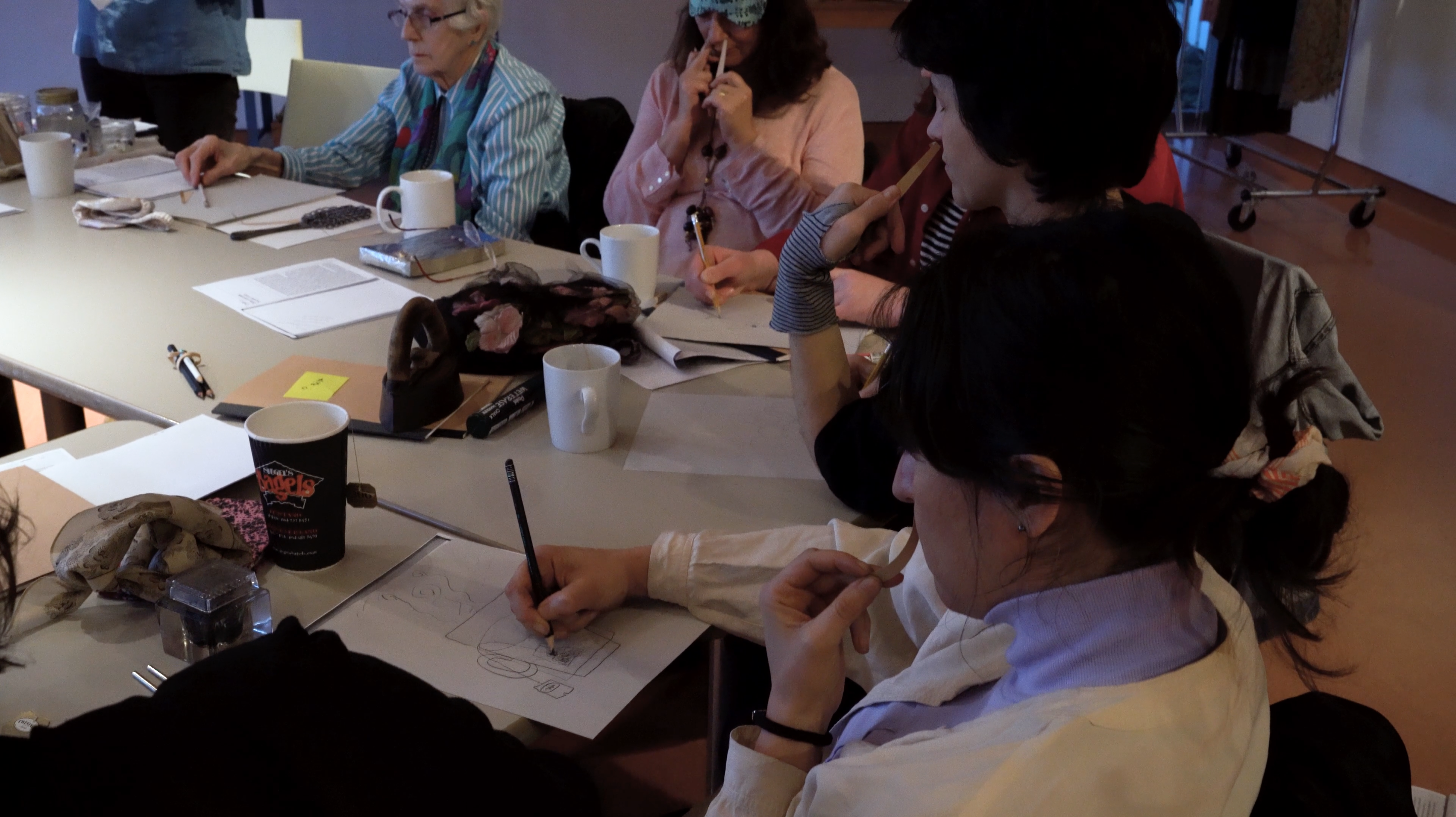
In the first two weeks, Tiziana introduced us to “transmitting-receiving.” Half of the group was sent downstairs to one of the MOV’s collection rooms; these were the ‘transmitters.’ The other half — ‘receivers’ — remained upstairs with pencils and paper, or thick-tipped water soluble markers for drawing on the room’s large windows. Transmitters chose an object to mentally send to their partners upstairs, who concentrated on receiving and translating it to images and words.
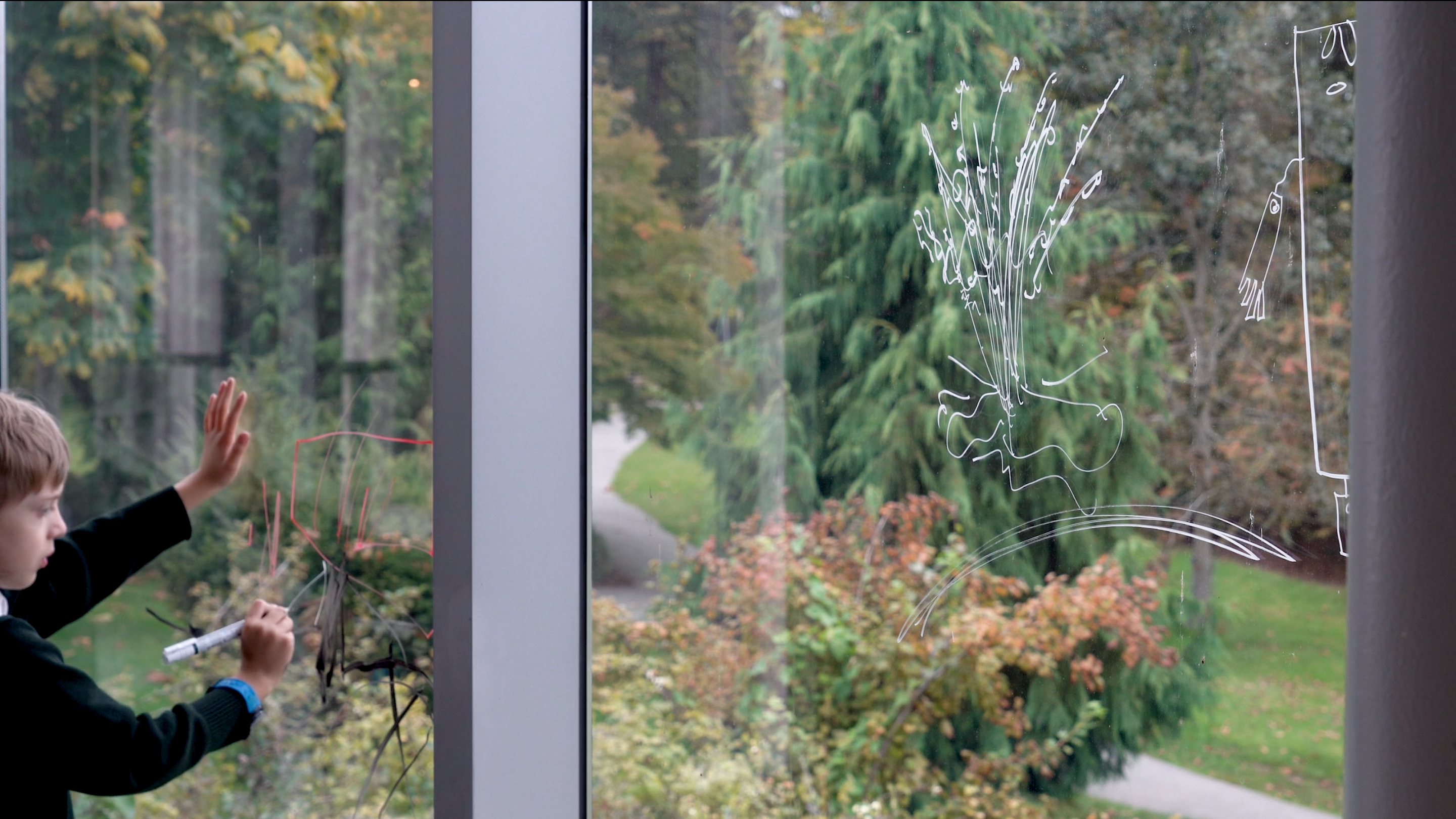
Probing at the possibilities for collaborative looking, this exercise opens us to forms of perception we’re not normally positioned to take seriously. Elisa made several beautiful, patterned sleep masks, and Tiziana offered the option of wearing them as ‘aids’ in this unfamiliar type of perception. By the end of the workshop, the windows were decorated with resonant forms — images of the objects formed through intuitive perception and psychic reception.
These windows look onto the area behind the MOV, what is now called “Vanier Park” and beyond that, “False Creek.” This is the site of the ancestral village of Sen̓áḵw, which for thousands of years was a shared summer village for xʷməθkʷəy̓əm, Sḵwx̱wú7mesh, and Səl̓ílwətaʔ nations. Abundant in food and medicines, Lee Maracle writes that it was known as the “supermarket of the nation,”7 and T’uy’t’tanat Cease Wyss discusses the past presences of large camas beds, garry oaks, and buttercups in the area.8 Between 1913 and 1916, the land was illegally sold, its residents forced to move, and the village burned down to be replaced by colonial settlement and industry. After decades of legal battles, in 2000 a small portion of the land (4.7 hectares) was returned to the Squamish Nation, and any claim to the rest of the area was forfeited for a settlement of $92 million. Maracle recounts this history in the autofictional story “Goodbye, Snauq,” which we read as a group during all the things in the room.
Looking at an object with the intention of sending it to a partner upstairs, an imaginary triangle grows as I activate the line between my body, my partner upstairs, and the object. Vividly aware of these distances, an awareness also grows of my presence on the land, and the object’s weighty self on the museum shelf. As I think myself into an antenna, feeling my follicles lift towards a destination, the object remains robustly in place, where it has been put by a museum worker with the authority to touch it.
Weeks Three and Four: “OBJECT: Do I select you? Do you select me too?”
I am given — writes Beryl, — I know not what — 2 wooden objects, dark brown stained wood, with 5 rounded holes each. They are sock shaped. I get no message from them, they do not tell me anything, no message.
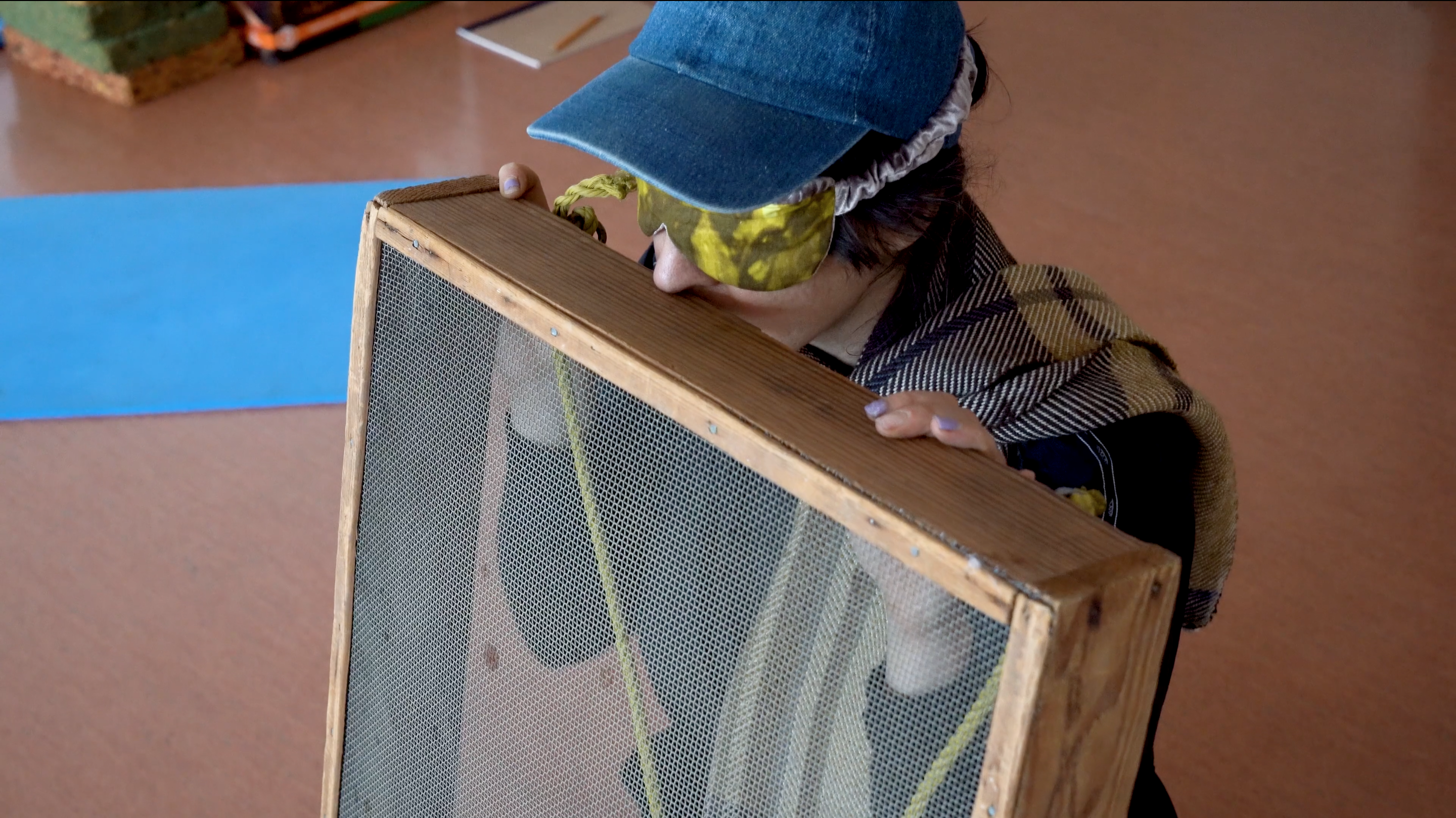
In weeks three and four, Jane guides us through a series of embodied object interactions and outdoor walks. Drawing on Austro-Hungarian dance theorist Rudolf Laban’s notion of the kinesphere,9 we are provided sleep masks and instructed to explore, with movement, the sphere of space we can reach while one foot remains in place.
Something is handed to me. About the size of my palm, it is heavy for its size, and has curved sides, a flat surface, and a small interior. A protruding piece that jiggles and makes a noise. I hold this piece and feel the object’s other surfaces with my legs, face, arms, front and back of my body. There are grooves and I push my fingers into them, finding out where they were a few times over. I shake it — the noise happens, louder.
Jane stops us. I put the object down. Sleep mask still on, I kneel and wait while a new object is placed in front of me, the other one passed to someone else in the room. I slowly reach out and down. My hands touch something incredibly, unexpectedly soft. The sensation — or maybe the object — sends a flood of joy through my limbs.
When I remove the sleep mask, someone new is in the room. We make eye contact and laugh. My shirt is covered in grimy marks from pressing the first object all over me, which I see now was an iron. I look around for the soft object, but nothing looks like what I felt — the closest thing is a brown fur shawl.
In her notebook, Kyra has written, OBJECT: Do I select you? Do you select me too?
Weeks Five and Six: “A chain was being yanked”
“Where does the sound reside in your body?” Elisa asks. “Is there a way to listen through time?”
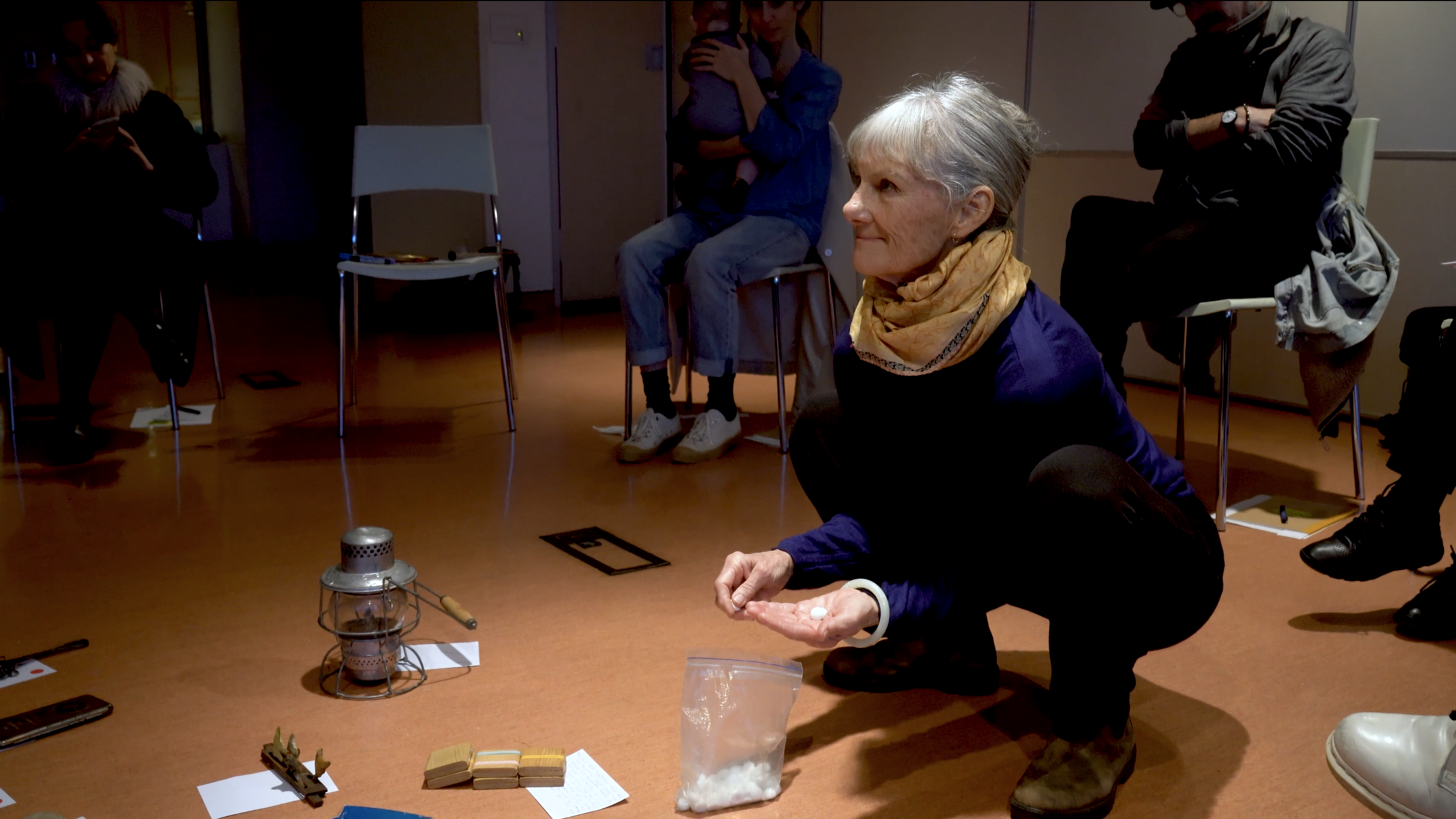
Sitting in the shape of an audience, we listen to recordings Elisa has made of objects we have not yet seen.
A chain was being yanked, Alice writes. I could feel tension building up in my jaws. Then as the yanking continued and intensified the tension became almost painful. Then it went down choking me at my throat. I felt like a dog trying to escape the hold of the damned chain. Then it went down to my heart. It felt like something was trying to get out of a bag.
I feel late for something, writes Odessa. Small items/trying to pick up a handful → now
Electric wind chime/gong – down my spine → future
I felt this sound flicking down the sides of my head, from above my ears to the bottom of my neck, writes Alana. Later I felt a sound spraying across my face back and forth, so the combination was like an H shape being traced over and over. I felt that these early sounds were ones that had to be dredged up from the earth with a lot of force. I felt they had travelled from afar. The later twinkling sound made my skin light up and pay attention, especially all along my arms. That sound felt younger to me, maybe from the future.
Hearing before seeing, the objects’ vibrancies are clear in what participants write. Alice, the opera singer, quickly makes a narrative. Odessa gathers urgency and makes comparisons, finding sonic relatives. Alana locates the sound in their body, time, and space, hearing them as entities that have to be taken up from the earth.
With their focus on object conservation, museums are not generally set up to support the touch required for embodied research. While the teaching collection allowed us to explore the sounds of some objects through touch, Elisa also brought us on sound walks through the museum’s exhibition spaces and collection stacks, where touch was prohibited.
What we heard inside the museum was the shifting hum of lights and climate control fans from one room or corridor to another. After getting to know the teaching collection objects through somatic embodiment — listening with touch and the sounds created by touch — we now perceived a lack. One participant called the shelves “objects put in quarantine.” This was pre-COVID, before most of us knew somatically what “quarantine” really meant. In retrospect, the description is all the more apt — the objects remain inside, protected from the danger their social lives present, but lose the sounds and touch that activate their material vibrancy.
Weeks Seven and Eight: “AMBERY, AQUATIC, ANIMALIC, ACERBIC, ACIDIC, AGRESTIC, BALSAMIC, BITTER, ABRUPT”10
During Elisa’s workshop on sound, we performed a score inspired by Candice Hopkins and Raven Chacon’s “Score for Marginal Objects.” In Chacon and Hopkins’s score, participants each bring “things relating to, or situated at a margin or border; not very important; very slight or very small”11 and recite associated memories, stories of how the objects were acquired, and write and perform instructions for arranging the objects. In the workshop we completed the exercise with objects from the museum’s collection, including a pair of wool carding tools.
Begin with the two objects lying prong-side up on the floor (or other surface). Place one hand on each prong face and experiment with pressure. When you are ready, remove your hands from the prongs and take hold of the handles. Place the prong faces together and make them feel what your hands felt.
Shayla performed the score. When we talked together in reflection, she said how her mother was a wool-worker whose carding tools carried the distinct and familiar scent of lanolin. Shayla expected and looked forward to smelling the lanolin when she brought the objects close to her face, but these carders were devoid of the scent, smelling instead of “dust and old basement.”12
The last two weeks of the workshop were centred on scent and taste. Much like the others, Megan began her workshop by instructing us to smell and taste a selection of items without first identifying them. Again making use of the sleep masks, we began from a place of not-knowing, so that we could come to know through a sensory process. Unlike the others though, Megan brought her own foods and essences for these activities — perhaps because, as Shayla noticed, many of the objects’ scents had been subsumed by the museum.
Redressing this lack, Megan led us in the final weeks in making perfumes for pieces of clothing from the museum’s collection. Megan described perfume as a narrative: top-heart-base notes as beginning-middle-end. We each chose a garment to make a perfume for, building a scent narrative for its imagined wearer. Our collection of named perfumes resulted:
Blue Silk Citrus
Brown Dress Hay-Horse-Fire-Vanilla
Wild Cowgirl
Summer Kitchen Rising Bread
Not As Innocent As She Looks
Green Velvet Lady
Vancouver City Dark
Vagina Cloud Pockets Business w/ Furry Hat
Lady In Pastels
Allspice Jean
Golden Spicy Hue
Green Jacket
—
Something I thought about frequently during the time of the workshop was how I always gleaned more from processes of making art than seeing the finished work. I wanted to learn how to bring audiences into the meaningful parts of making that were harder to access once the work was made — but I couldn’t say exactly what they were. In Hungry Listening, Robinson writes that non-hungry listening means not that settlers listen without intention, but that “the work of listening is not predicated on use value or the drive to accumulate knowledge.”13 Artistic processes often (not always)14 involve a slower, more embodied interaction with objects, materials, words, and places. In a gallery, the words “get it” or “don’t get it” suddenly seem relevant — phrases which demand the acquisition of knowledge. all the things in the room reoriented audience-artist relations, bringing all members of the group into the process of making, or a slow engagement with concepts and materials not predicated on use value or what we would “get” from the work. The artwork instead was a process of coming to know, reorienting our relations with objects, people, land, histories, and the institution — in other words, all the things in the room.
Notes:
- The notion of “lateral motions” and “absorb and amplify” are taken from the website for Elisa Ferrari’s project lilithlithlithlithlith.
- Dylan Robinson, Hungry Listening: Resonant Theory for Indigenous Sound Studies (Minneapolis: University of Minnesota Press, 2020), 58.
- Robinson, 38-41.
- Pauline Oliveros, Sonic Meditations: March – November 1971 (Baltimore, MD: Smith Publ. American Music, 1974), 1.
- Robinson, 61.
- Each workshop participant was provided a notebook to use throughout the workshop. Elisa lent them to me before writing this piece; I quote from them throughout.
- Lee Maracle, “Goodbye, Snauq,” in Read, Listen, Tell: Indigenous Stories from Turtle Island, ed. Sophie McCall, Deanna Reder, David Gaertner, Gabrielle L’Hirondelle Hill (Waterloo: Wilfrid Laurier University Press, 2017), 110.
- Cease Wyss under the Burrard St Bridge and at Trout Lake, video for the project FOUNTAIN by Laiwan, (YouTube, 2019), https://www.youtube.com/watch?v=jeO43hdtrOM&t=79s.
- Rudolf Laban (1879-1958) was an Austro-Hungarian dancer and theorist whose work laid the foundation for Laban/Bartenieff Movement Analysis (LMA or LBMA), a method for describing, visualizing, interpreting, and documenting human movement. Laban defines the kinesphere in his book Choreutics as “the sphere around the body whose periphery can be reached by easily extended limbs without stepping away from that place which is the point of support when standing on one foot.”
- Scent adjectives from Alice’s notebook.
- Raven Chacon and Candice Hopkins, “Score for Marginal Objects,” 2014. spiderwebsinthesky.com/wp-content/uploads/2017/12/Score-for-Marginal-Objects-copy.pdf
- From Shayla’s notebook.
- Robinson, 72.
- I don’t want to suggest all artists are non-hungry listeners, or have a decolonial approach to perception, because they definitely don’t!