An inheritance bonds those who came before and those who receive, intimately connecting the past and present through acts of passing down and receiving. Curated by Kate Henderson, Inherit considers inheritance beyond material objects, instead focusing on the stories, experiences, memories, and losses that are passed down and held by later generations. It invites us to witness the complex and nuanced range of inheritances that can, but do not necessarily, entail a choice or gift, especially in diasporic narratives and colonial histories.
The gallery begins on the windows of the Lafarge Lake–Douglas SkyTrain station, where Angeline Simon’s All that we can carry (2021) is on display for commuters. Simon’s collages of her Malaysian Chinese and German family weave together historical and contemporary photographs. Using Photoshop’s algorithm to determine what is included and excluded, Simon allows chance to play a role in her creative process, resulting in haunting compositions of black and white archival photos overlaid with recent, coloured images. The temporal spaces of the past and present are united in each collage, as most of the collages feature figures from old family portraits as mere silhouettes replaced by present landscapes, or occasionally scenes of black and white faces staring back with coloured images creeping into the scenery.
Looking at a winter lake layered on top of four bodies in Simon’s across the lake, beyond the pines (2018), I wonder if the ghosts of my ancestors also occupy my contemporary landscapes, waiting to be noticed. I am overcome with a surge of grief and mourning for my unknown ancestors, lost in abandoned archives, lost to the chance of what the mind remembers or forgets and the dominant narratives that dictate what is kept or erased.
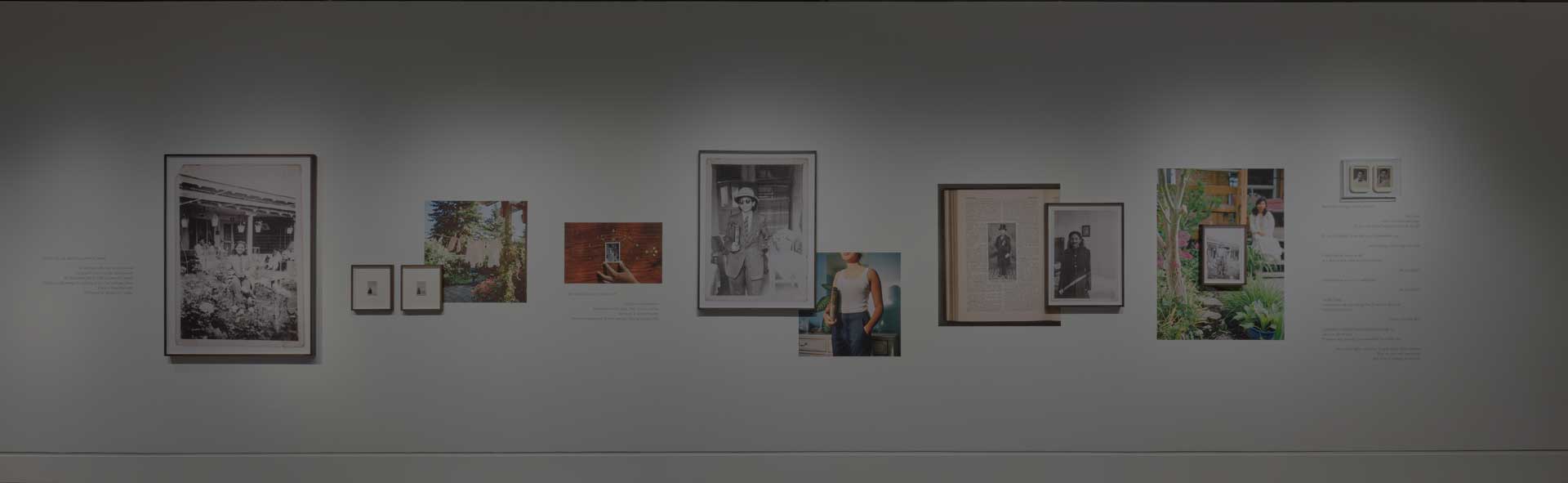
It is under such a context that I enter the Art Gallery at Evergreen. The word “Inherit” stands boldly against a deep plum-coloured wall, as the space opens up to walls of photography and a diorama at its centre. Sprawled across the wall to my immediate left is Zinnia Naqvi’s series Dear Nani (2017-), an intriguing combination of images of and based on Naqvi’s grandmother. Small original photographs are shown alongside much larger reproductions and captions that create dialogue between grandmother and granddaughter.
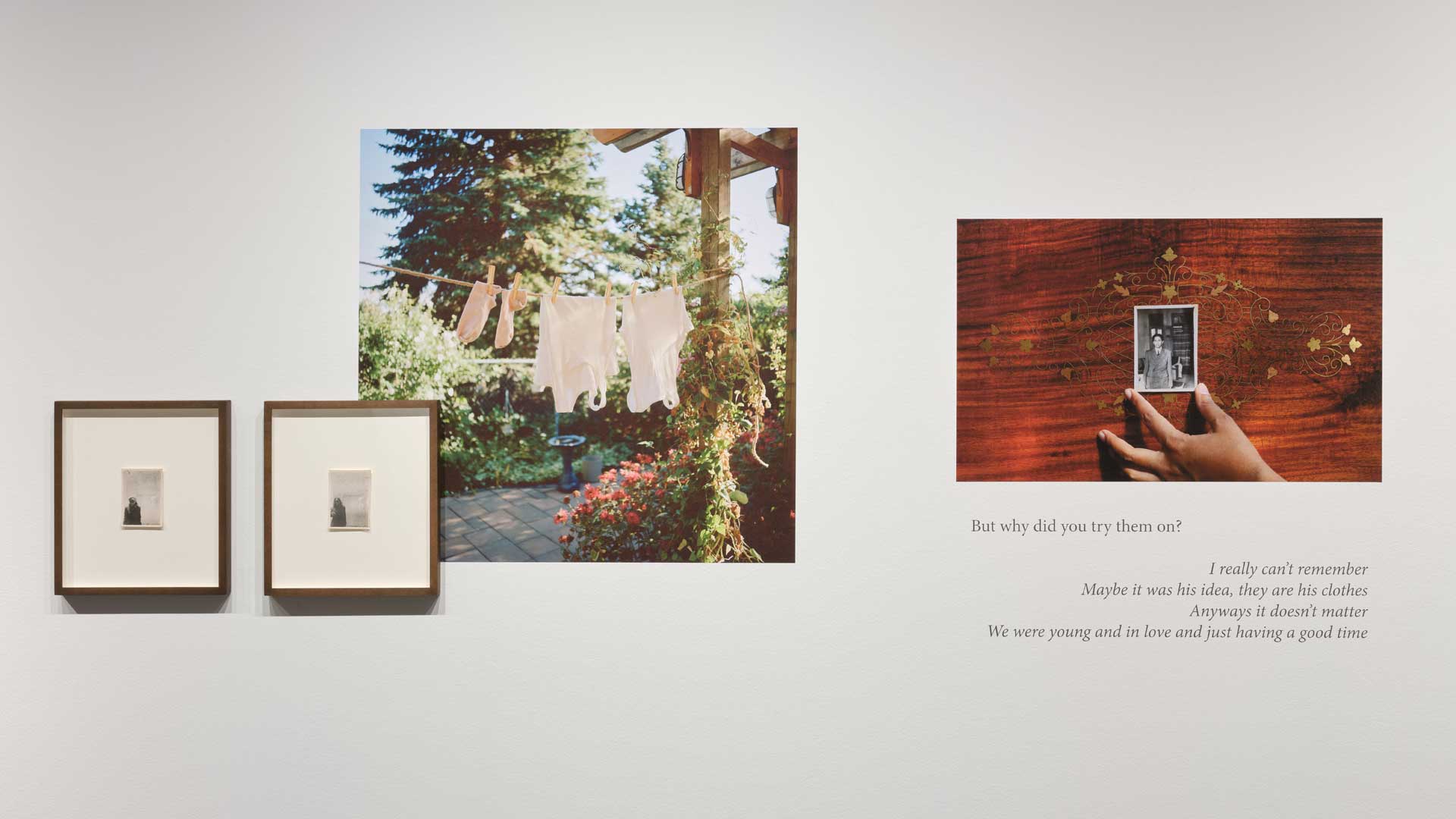
Taken in Pakistan, 1948, the images of Nani depict her dressed in her husband’s outfits during their honeymoon. Placed next to an image of a page from The Children’s Dictionary, defining “Occident” and “occidentalized,” Nani with Moustache (1948) features Nani standing stiffly in western, educated, male clothing with a fake moustache. Her eyes gleam, betraying suppressed laughter. Two generations later, unable to ask her grandmother directly, Naqvi imagines conversations with her, printed as text captions on the wall: “I put myself into the unanswered questions. I try on the role of Nani.” She pictures Nani explaining, “We were young… and just having a good time.” By including these archival family portraits, Naqvi honours Nani’s overlooked form of resistance: her playfulness and joy in the face of British colonialism. Instead of upholding the Occident’s constructed prestige and colonial gender norms, Nani mocks and subverts them by performing what was not meant for her. Nani’s photos are healing and heartwarming; it makes me happy to see Nani happy, and in turn I wonder what brought about mischievous grins for my own ancestors.
There is a similar sense of different time periods and generations, black and white versus coloured, brought into one space as in Simon’s series. However, while Simon’s collages render past and present inseparable, melded together within the same frame, Naqvi distinguishes past and present while connecting them, as her grandmother’s photos are framed and overlap those of her own, which are printed directly on the gallery wall. Naqvi’s own photos include a self-portrait and shots of a garden in which she re-enacts Nani’s pose and outfit, revitalising her family archives. Yet, none of the photos reveal her face. Her anonymity allows space for the faces yet to come, who will inherit the same stories — a promise of bodies that inherit and ancestors who reply.
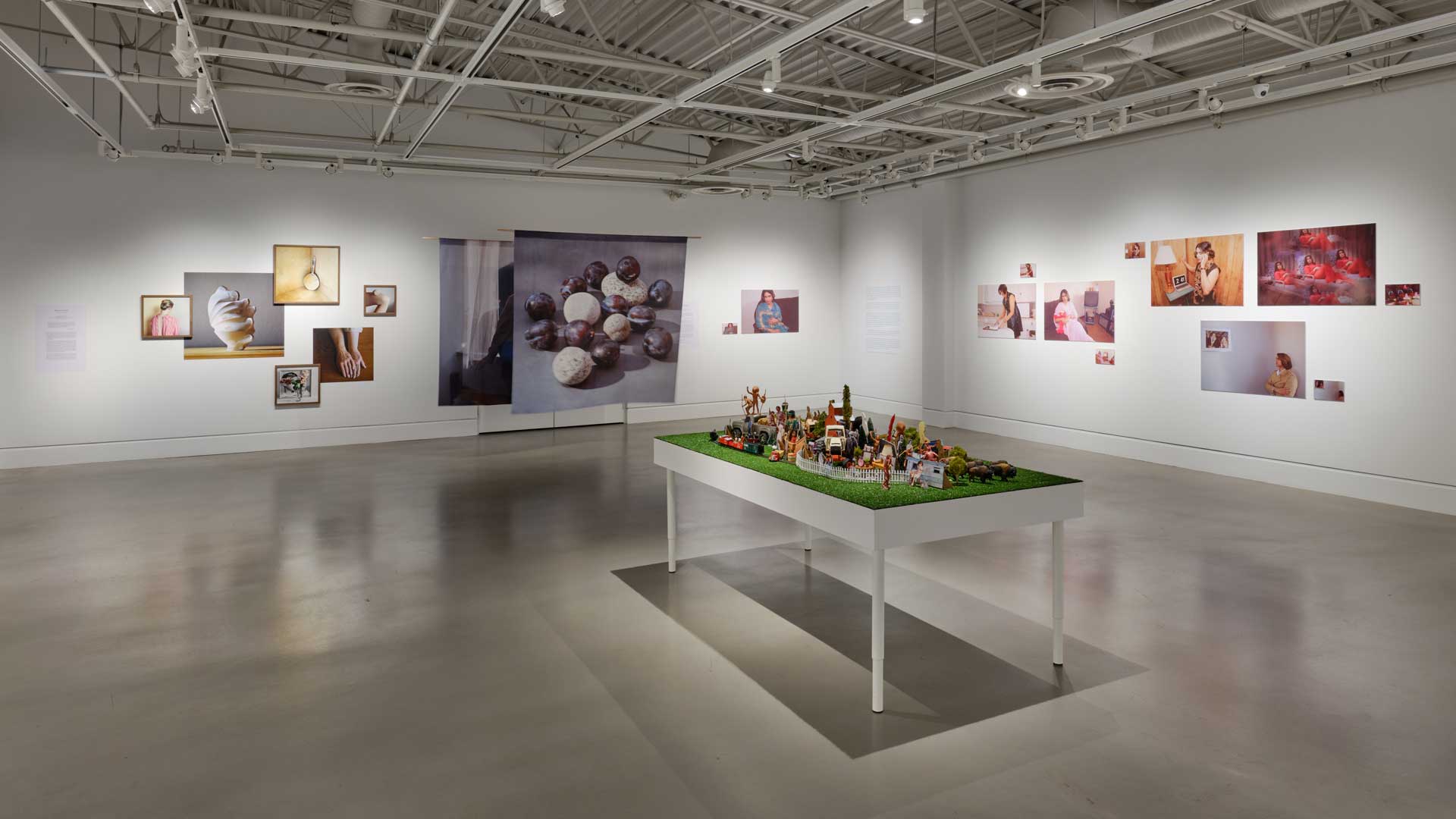
In the series Trisha (2016), Vivek Shraya recreates old photos of her mother, but her series is both ode and lament. As a trans woman, Shraya inherits her father’s physique and her mother’s femininity and gender.1 Shraya also discloses in an exhibited letter to her mother that her mother wanted either two sons or a daughter named ‘Trisha,’ suggesting that she also inherits the shadows of her mother’s unfulfilled desires. In the letter, Shraya reflects that the photos taken before her birth reveal a new side of her mom: “I remember finding these photos of you three years ago and being astonished, even hurt, by your joyfulness, your playfulness. I wish I had known this side of you, before Canada, marriage and motherhood stripped it from you, and us.” In each image, the way Shraya’s mother holds herself appears valiant and graceful, with the slightest mischief; the viewer can understand the qualities of her mother that Shraya aspires to embody. By dressing as her mother, she enacts what she interprets as her mom’s playful past as a young woman free of familial responsibilities and simultaneously embraces her own journey of gender identity and contemplates both the beauty and socialised pressures of womanhood.
In a set of two photos, Shraya’s mom speaks on the phone next to an analogue clock, in stark contrast to Shraya’s recreation of the photo and the jarring “2:41PM” on her laptop, emphasising the incongruity between mother and daughter, despite their parallels. In another pair, Shraya’s sorrowful gaze at her parents’ wedding photo, compared to her mother’s scornful expression at the same photo, poignantly captures the nuances and shifts in desire and perspectives between just one generation, heavy with the weight and complexities of an immigrant family’s experiences.
Both Naqvi and Shraya use reenactment and clothing to refuse the respective losses of their grandmother’s and mother’s stories to diasporic journeys in an attempt to recover their maternal figures and resist erasure. Unlike Naqvi’s use of anonymity, Shraya asserts herself in each photo, mirroring her mother but emphasising their differences; it is a powerful proclamation of her own personhood, womanhood, and queerness in what I can imagine and can relate to as an enduring tension between her mother’s and her own desires and definitions of happiness, and in the face of intergenerational trauma.
Inherit brings into fruition the potential that art spaces offer for revisionist storytelling and history making. The exhibition honours the past through the present, shedding light on often untold histories while amplifying contemporary voices that enrich narratives of diaspora. Moreover, the expanded off-site installation, beginning from the SkyTrain station to the window display, moves art into the world at large, a strategic community engagement tactic and effective attempt at making art more accessible.
As I leave Inherit wearing my mother’s leather jacket, purchased after immigrating to Canada in the mid-90’s, I cannot imagine it upon her now-shrunken frame. I have vague memories of photo albums I found as a kid, treasures encompassing my young mother wearing floral skirts and pastel colours, hair styled in a fashionable bob. The mom I know wears hand-me-downs and cotton that favour housework and keep her lower back warm. She rarely takes photos, but I can tell she secretly enjoys it when I stand her next to the springtime’s cherry blossoms, directing her to pose and smile — a slight glimpse for me of my mom not as mother or wife, but simply as herself.
With the wrinkled leather resting on my skin, I embody both first-generation Chinese Canadian and my imagined memories of my mom — of both her youthfulness and pain. The jacket embraces me with the faint presence of its previous owner and sits on my shoulders with the heaviness of her immigrant experience. There is not much I know about that time in her life, and I am hesitant to ask, afraid of discovering the joyous and carefree versions of my mother in the ‘before-times’ and of mourning the experiences that slowly eroded or concealed them. I yearn to know my mother, my ancestors, and consequently, myself — but asking these questions of inheritance feels daunting. For the time being, I continue to daydream about all the lives my mom has lived that I do not know of, imagine the questions I would ask like Naqvi, draft and revise letters of unspoken sentiments like Shraya’s, and explain in response to each compliment that with my leather jacket, I carry my mother with me.
Inherit continues at the Art Gallery at Evergreen through April 24 as part of the 2022 Capture Photography Festival and features work by Joi T. Arcand, Zinnia Naqvi, Birthe Piontek, Carol Sawyer, and Vivek Shraya. See gallery hours.
Notes:
- An excerpt from a letter from Shraya to her mother reads, “You had also prayed for me to look like Dad, but you forgot to pray for the rest of me…When I take off my clothes and look in the mirror, I see Dad’s body, as you wished. But the rest of me has always wished to be you.” See: https://vivekshraya.com/projects/visual/trisha/