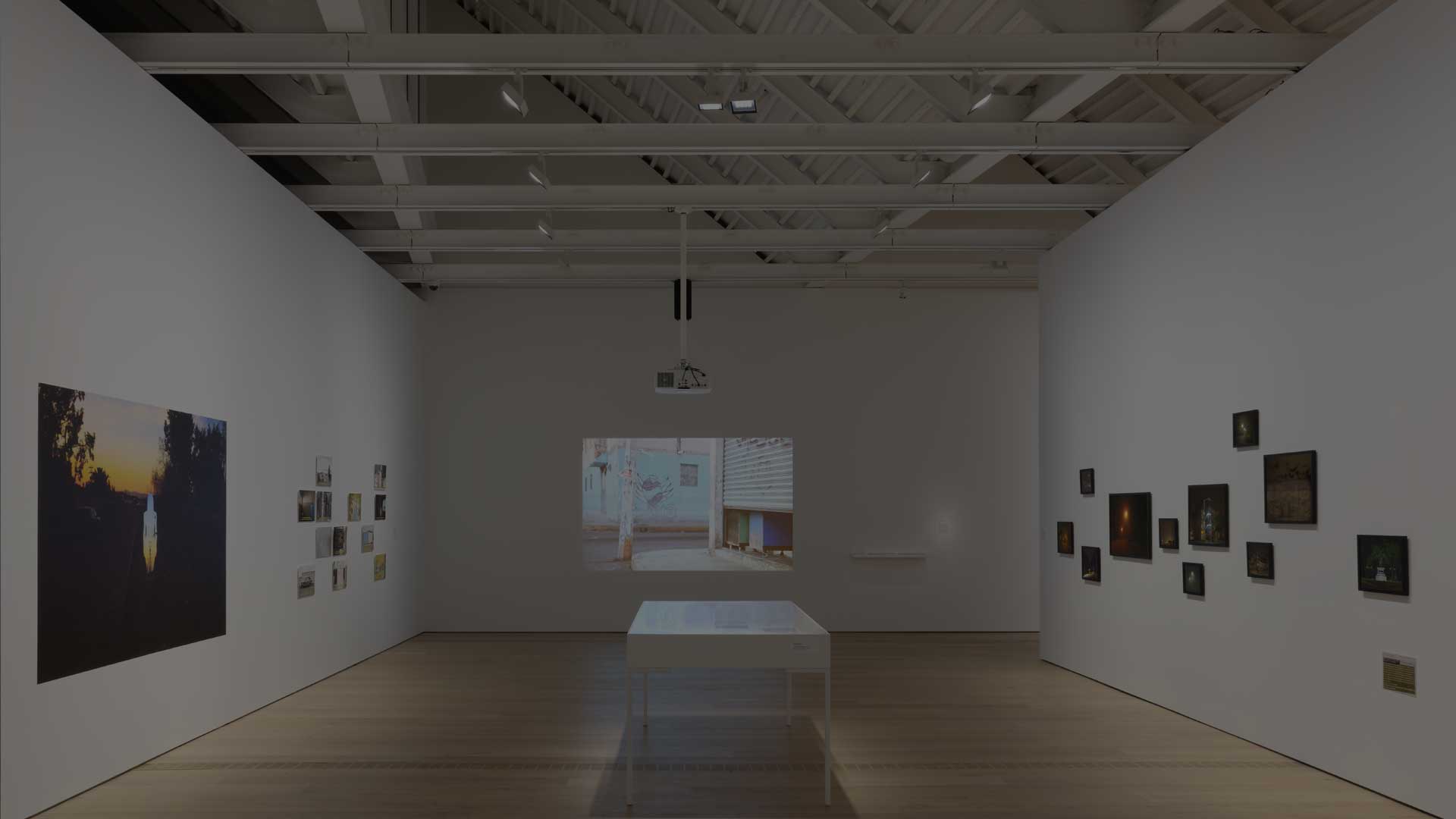
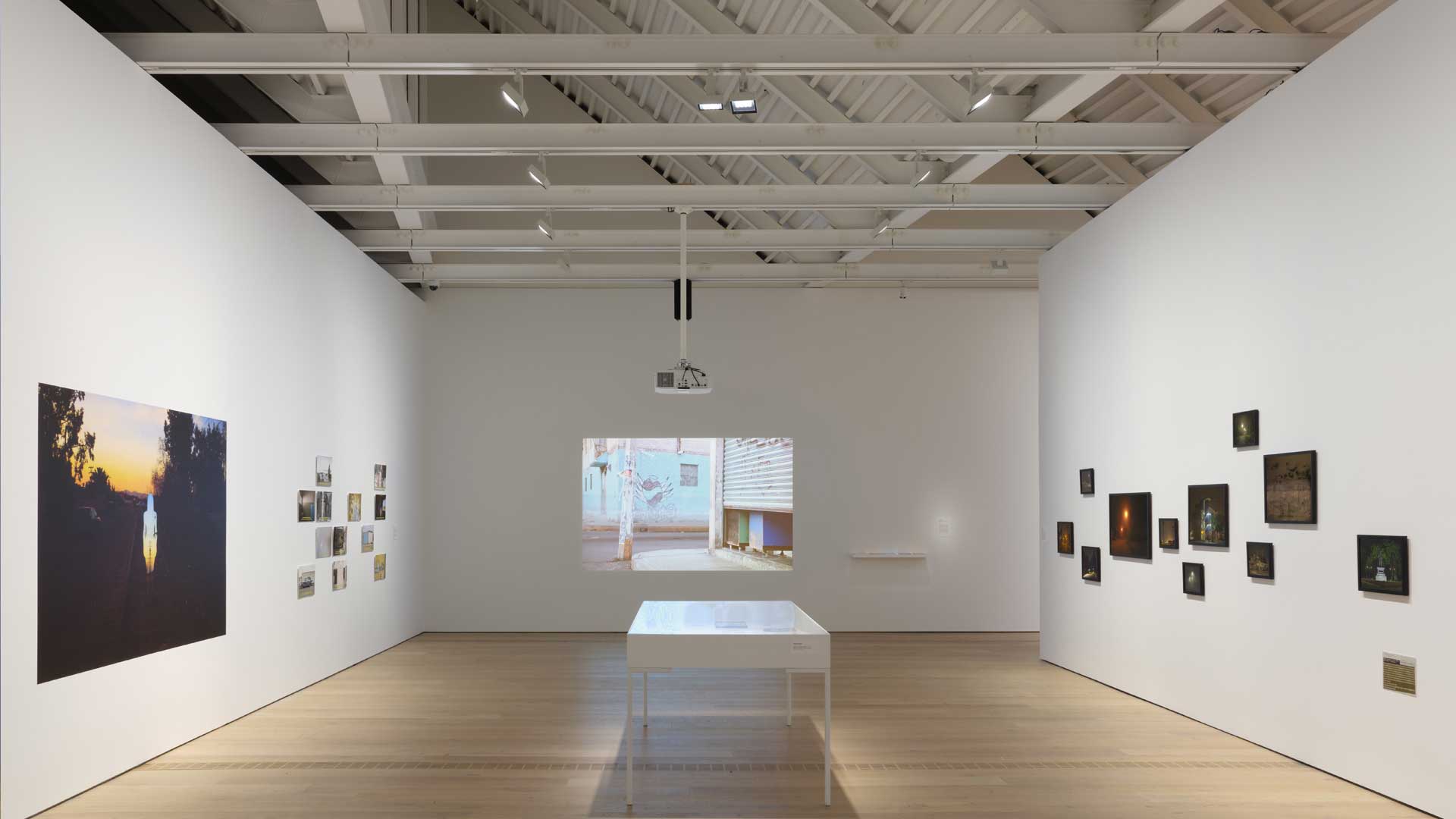
Upon ascending the flight of stairs prefaced with a huge colour photograph of cellophane wrapping material (Christopher Lacroix’s We all know [OR/or] [Y/y]ou can tell [you’re you’re]) and a looming photo-collage (Elizabeth Zvonar’s Photography is Hard), I enter the glass doors of the main gallery, divided into three exhibition spaces by movable walls. Welcomed by a large installation of deflating balloon letters — clearly, the party is over — I turn left and face Miradas Alternas, a group show of five Mexican women artists: Juliana Alvarado, Alejandra Aragón, Koral Carballo, Mariceu Erthal, and Sonia Madrigal, curated by Andrea Sánchez Ibarrola. Condensed into a section less than a quarter of the gallery’s square-footage, Miradas Alternas, or ‘alternative gaze,’1 features lens-based work that responds to the “media saturation of morbid imagery”2 throughout the war against drugs in Mexico over the past two decades. Drawing a connection between the ongoing violence and the advancements made in mass communication technologies, the exhibition asks viewers to pause and consider the biases behind these technologies driven largely by capital.
While the photo-documentation of violence is a necessary tool as ‘evidence’ within judicial systems across the world, Sánchez writes in her curatorial essay that the forensic gaze as practiced through the evaluation of such evidence resonates “with a traditional rhetoric of photography as a purveyor of realism and truth.”3 Although this traditional rhetoric is true enough within the context of forensic science, once these images enter mass media through news, journalism, social media, and the like, “visual language common to documentary and press photography [becomes] one that re-presents, and thus reifies trauma.”4 By incorporating an assortment of representational strategies that bracket notions of truth, Miradas Alternas presents us alternative entry points into how violence (specifically, violence towards women in Mexico during the drug war) is systemic, ongoing, and all around us in ways we may not have before considered.
Three walls are all filled with photographs of various sizes; the east wall plays a projected video by Sonia Madrigal, titled You, (Te in Spanish), next to a stack of postcards as keepsake offerings. Madrigal’s video, along with her photographic series, Death Rises in the East, depict a discrete and sinister urbanity that runs through the exhibition. Along with the other serial image clusters by Juliana Alvarado (Name Them — derelict roadside diners named after women), Koral Carballo (At the Wrong Time — night photographs taken by breaking curfews set by criminal organizations), and Mariceu Erthal (Letters to Gemma), the misogynistic psychogeography of a city is laid out quietly, plainly, and clearly. Erthal’s collaborative photo-essay with the family of Gemma Mávil, a victim of an enforced disappearance from 2011, is haunting ‘proof’ of the aftermath of such violence on those who must continue to live with the trauma. What is the worth of a picture, of 1000 words, in this context?
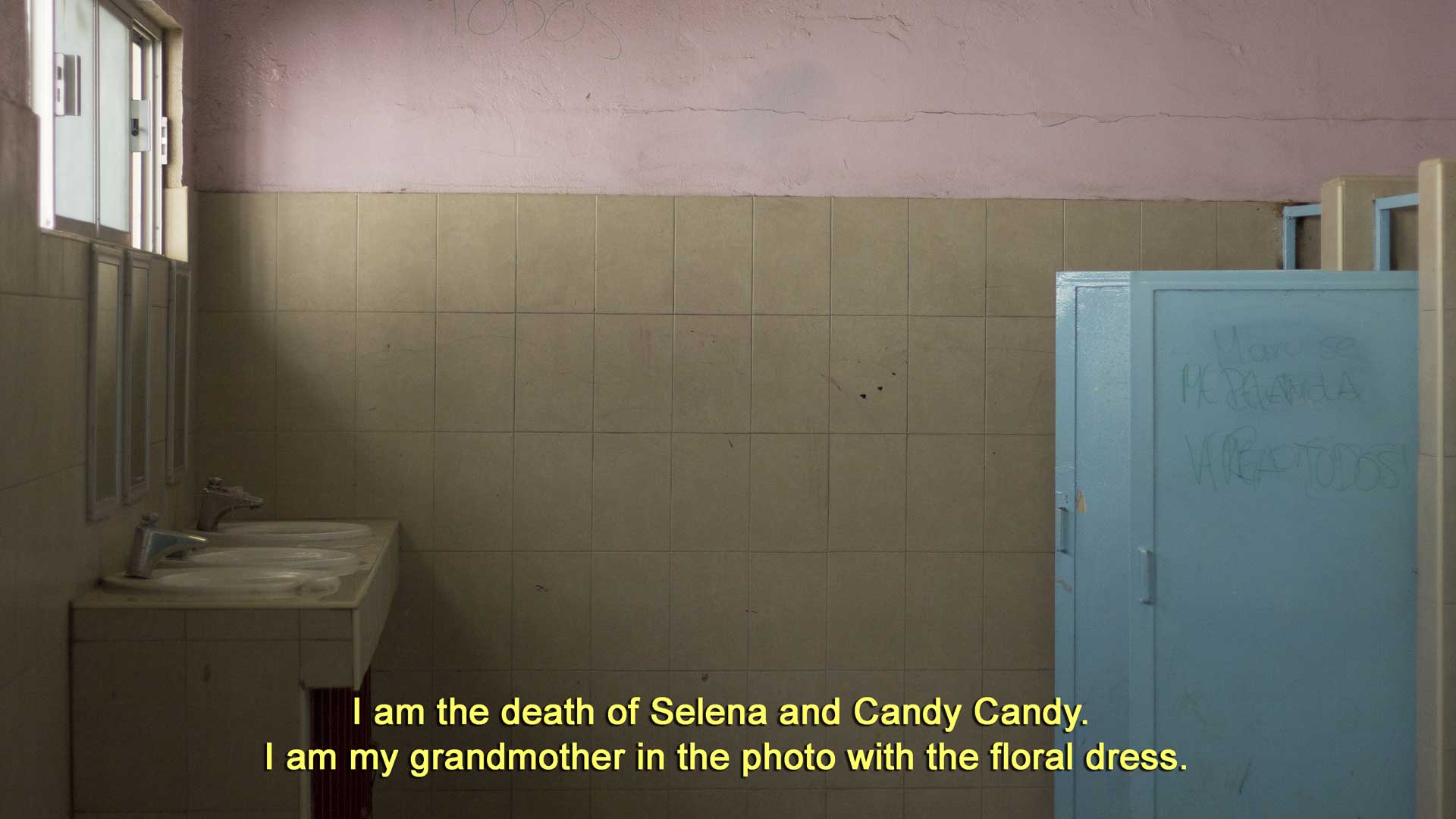
Centering the exhibition is Alejandra Aragón’s Premonitory Self-Portrait, a series of inkjet prints, and a display table in the centre of the room filled with printed matter, collected ephemera, a QR code that leads to a Spotify playlist, a speculative map of sorts, and two books, Marguerite Duras’ The Lover, and Elena Garro’s Recollection of Things to Come, from which passages are photocopied and highlighted. Aragón’s wall-mounted prints are photographs one might take on a dérive (through the city of Ciudad Juárez in Aragón’s case), overlaid with text that could be film subtitles. Each photograph carries with it a sentence beginning with “I am…”, each completed by an event positioning the “I” as a female protagonist who experiences both personal and mediated violence. Whether “I am the Pink Power Ranger…”, “the bus [to] Juarez-Airport…” or “Smashing Pumpkins’ ‘1979,’” Premonitory Self-Portrait stirs the viewer’s positionality, inviting one into and through the space of the self-portrait, to pass through the “I” and “You” as ‘We,’ if for a moment.
Along with the reflexive presentation of everyday ephemera, Aragón’s work activates the alternate gaze in a way that relocates the viewer; by placing me between the backdrop and yellow subtitles of each photograph, I am then returned here to the gallery, in the context of North Vancouver, on unceded Squamish and Tsleil-Waututh territories. It goes without saying that violence (self-directed, interpersonal, and collective5) ripples through the histories of colonial enterprises from which some benefit and some suffer. As I slowly walk out from the grim, confined intimacy of Miradas Alternas and step into the much more spacious and relaxed neighbouring exhibitions, I wonder about the intentionality of such a contrast.
Notes:
- In Ibarrola’s curator’s essay, she explains the nuanced translation of the title as: “mirada feminine noun ‘look,’ ‘gaze,’ describes both the act of looking and a way of looking; and alterna feminine adjective (derivative of alternativa) ‘alternative,’ available as another possibility, an action that is different or independent from official or hegemonic models.”
Andrea Sánchez Ibarrola, Miradas Alternas, (North Vancouver: The Polygon Gallery, December 2020), accessed February 12, 2021, https://thepolygon.ca/wp-content/uploads/2020/12/MIRADAS-ALTERNAS.pdf - Ibid.
- Ibid.
- Ibid.
- According to the World Health Organization, these are the three types of violence. “Violence Prevention Alliance,” World Health Organization, accessed February 12, 2021, https://www.who.int/violenceprevention/approach/definition/en/