Trapline (1976), the debut film of Alberta-born, British Columbia-based artist Ellie Epp, is my favourite Canadian cinematographic work. Its images are indelible, elegant scars I run my mind across when a balm for ugly things is needed.
Shot on 16mm in the historic Silchester Road Public Baths in Kensington, London upon news of the century-old facility’s impending demolition, the experimental film comprises twelve unbroken, fixed-position long takes, each separated by varying lengths of visible black leader that underscore the materiality of the work’s analogue substrate. Its delicate visuals, articulated with painterly attention to shape, colour, and composition, present fragments of everyday occurrences at the Victorian swimming pool — occurrences made exceptional by the artist’s attention to them, by being seen and set to film. In one episode, white light dances on the surface of rippling water, its hypnotic, ethereal beauty reminiscent of Jean-Luc Godard’s portal to the cosmos by way of spiralling coffee crema in Deux ou trois choses que je sais d’elle (1967). In another, sky viewed through angular glass gently expands as the camera zooms in, with Michael Snow’s immortal Wavelength (1967) a forebear if only in formal resemblance. Often Epp’s camera is trained on water, softly disturbed by swimmers heard but unseen. Indeed, the soundtrack is alive with invisible bathers — talking, splashing, breathing, existing, their human acoustics (recorded on location) giving sonic shape to a cohesive, tangible space only gestured at in the elliptical imagery. When bodies materialize — as when paddling children cross the frame, or ghostly reflections betray figures offscreen — they are but brief interruptions in a study otherwise absorbed by the minutiae and memory-making of place, not people.
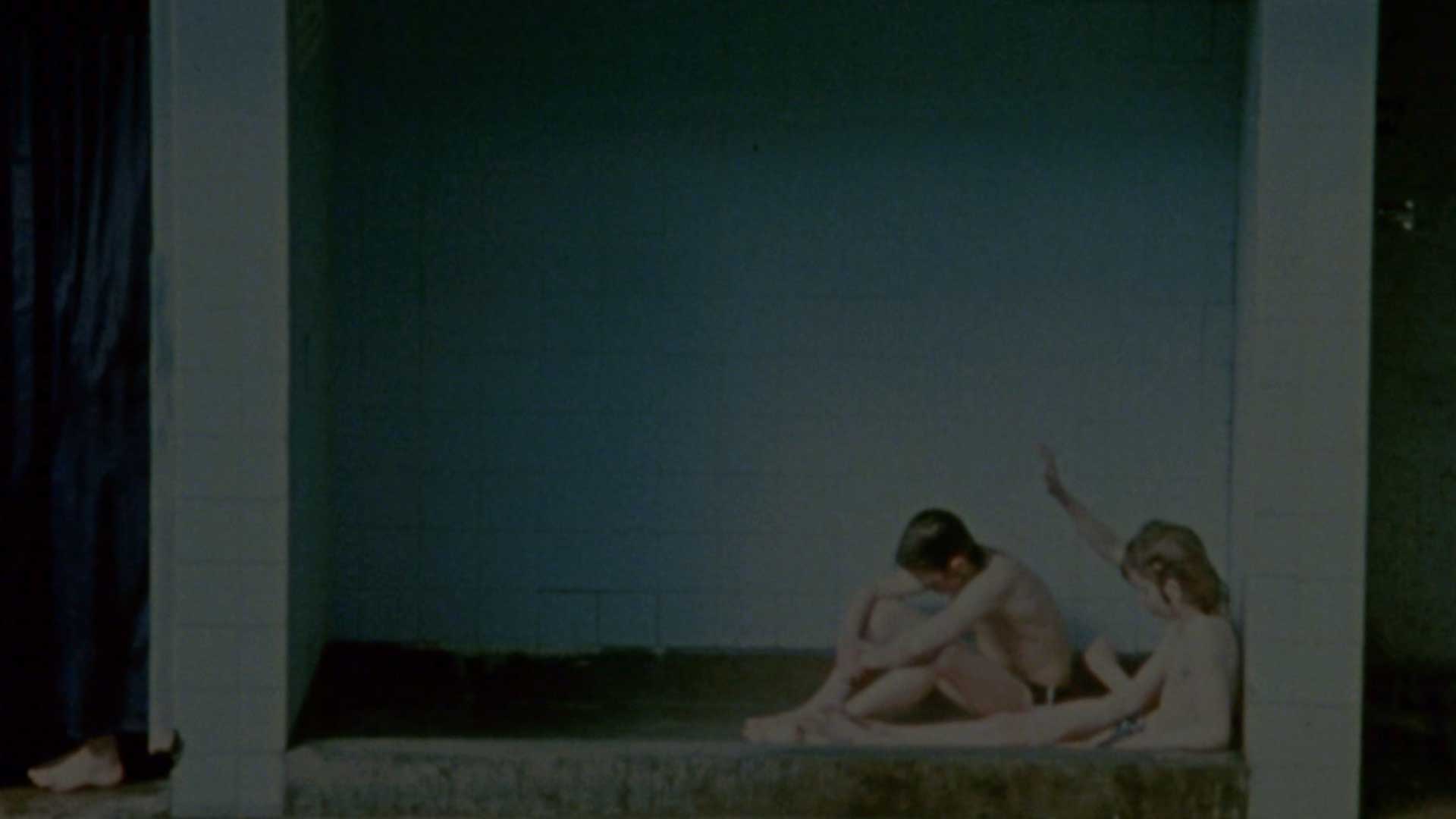
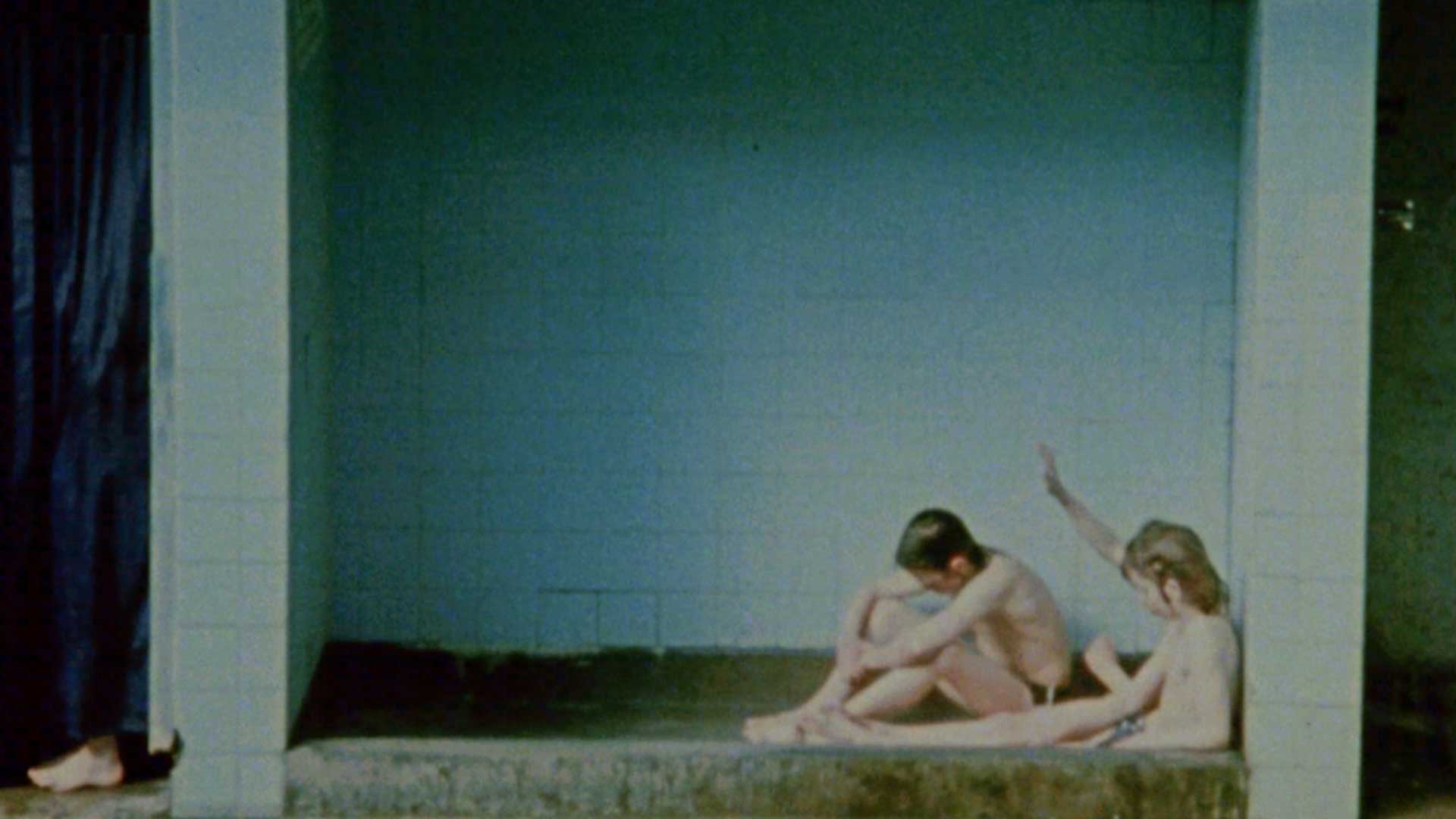
The exception occurs in the film’s final shot, “which has the kind of heart-quickening beauty that makes you want to stop a screening and be alone for the rest of the day”(James Quandt).1 It features three boys huddled in a shower stall, engrossed in unheard conversation. Adjacent to them, a small change room with its curtain drawn. Beneath the curtain’s hem, the feet of a child hidden from view. It is the only scene in Trapline where sound is absent from image, and the only one organized around visitors to the soon-to-be-shuttered bath house. In its simple observance of life’s ephemeral, minor moments — the sort that go unrecognized and, thus, unremembered — it floods me with emotion for reasons difficult to pin down.
Ellie Epp’s unassuming (and heretofore unknown to me) film felt like an outlier and a revelation.
I watched Trapline for the first time at The Cinematheque in 2016, four decades after it premiered at the same Vancouver film institute (née Pacific Cinémathèque Pacifique) in 1976. It was exhibited in its original 16mm print in the context of a showcase devoted to West Coast experimental cinema housed in the organization’s treasurous film archive.2 Amid a flurry of pyrotechnic works from the architects of Vancouver’s first wave of avant-garde filmmaking in the late 1960s and ’70s — David Rimmer, Al Razutis,3 Gary Lee-Nova, Peter Lipskis, Kirk Tougas, Tom Braidwood, all operating in a structural-materialist mode — Ellie Epp’s unassuming (and heretofore unknown to me) film felt like an outlier and a revelation.
It is, on the surface, a structural film. The orderly framework (12 discrete shots), austere formalism (no camera movements or continuity cuts), asynchronous sound, and built-in visual absences (black-leader spacers) all suggest an adherence to the aesthetic devices and ideological sensibilities associated with structural film art, especially in Vancouver. Yet Trapline runs afoul of the mode’s anti-illusionist credo by inviting the viewer to fall in love with the image, through the radical beauty that the image relays. “The film represents a battle between structuralism and beauty,” acknowledged Epp, “because, at the time, there was a great mistrust of beauty.”4 Couched in techniques designed to demystify the cinematic apparatus, Trapline nonetheless complicates a materialist reading by refusing to deny, or disrupt, the efficacy of its documentary footage. In truth, it is precisely the fragility of its camera-witnessed nonevents — the bending of light in water; the anatomy of a now-vanished place; the small moments of childhood — that sets the film apart.
“…as a female with no reputation there was no way to join on equal terms … so I worked on my own.” –Epp
It would be reductive to assume that a female gaze is responsible for the uncommon beauty and tenderness found in this remarkable moving-image work. But there’s no denying that Epp, a Vancouver transplant in 1975, was a rare woman filmmaker navigating a scene overrun by men. “When I came to Vancouver the film scene was dominated by Al Razutis and David Rimmer, and it seemed that it was hardly worth even joining it, because as a female with no reputation there was no way to join on equal terms … so I worked on my own” (Epp).5 In London, Epp was a postgraduate student in Film Studies at the Slade School of Art, and later, a member of the London Film-Makers’ Co-op. As a ravenous cinephile, it comes as little surprise to learn that her influences fell outside the hegemony of male directors. She recalls the galvanizing effect of seeing Chantal Akerman’s Hotel Monterey (1973), a beguiling documentary whose glacial deconstruction of a Manhattan hotel offers a more illuminating model for Trapline than the structural cinemas of compatriots Rimmer or Snow. Likewise, it was lessons learned from the narrative-film experimentations of Marguerite Duras, particularly Nathalie Granger (1972), that demonstrated to Epp the capacity for motion in a film image to articulate the motion of the film itself — a visual synecdoche, if you will. Trapline, by example, features a shot in which the duration of a ripple cresting over water serves to acclimate the viewer to the “rate of flow” of the entire film. If anything, the ravishing originality of these artists’ subversive (i.e., non-male) voices lit a path for Epp, which she followed gracefully.6
Although the reception of Trapline was, at the time, rather muted (“a very quiet acclaim,”7 as the artist puts it), the work has steadily gained favour over the decades, and in 2017, via a nationwide industry poll conducted for the “Canada on Screen” project,8 it was recognized as being among the greatest experimental films ever produced in Canada.
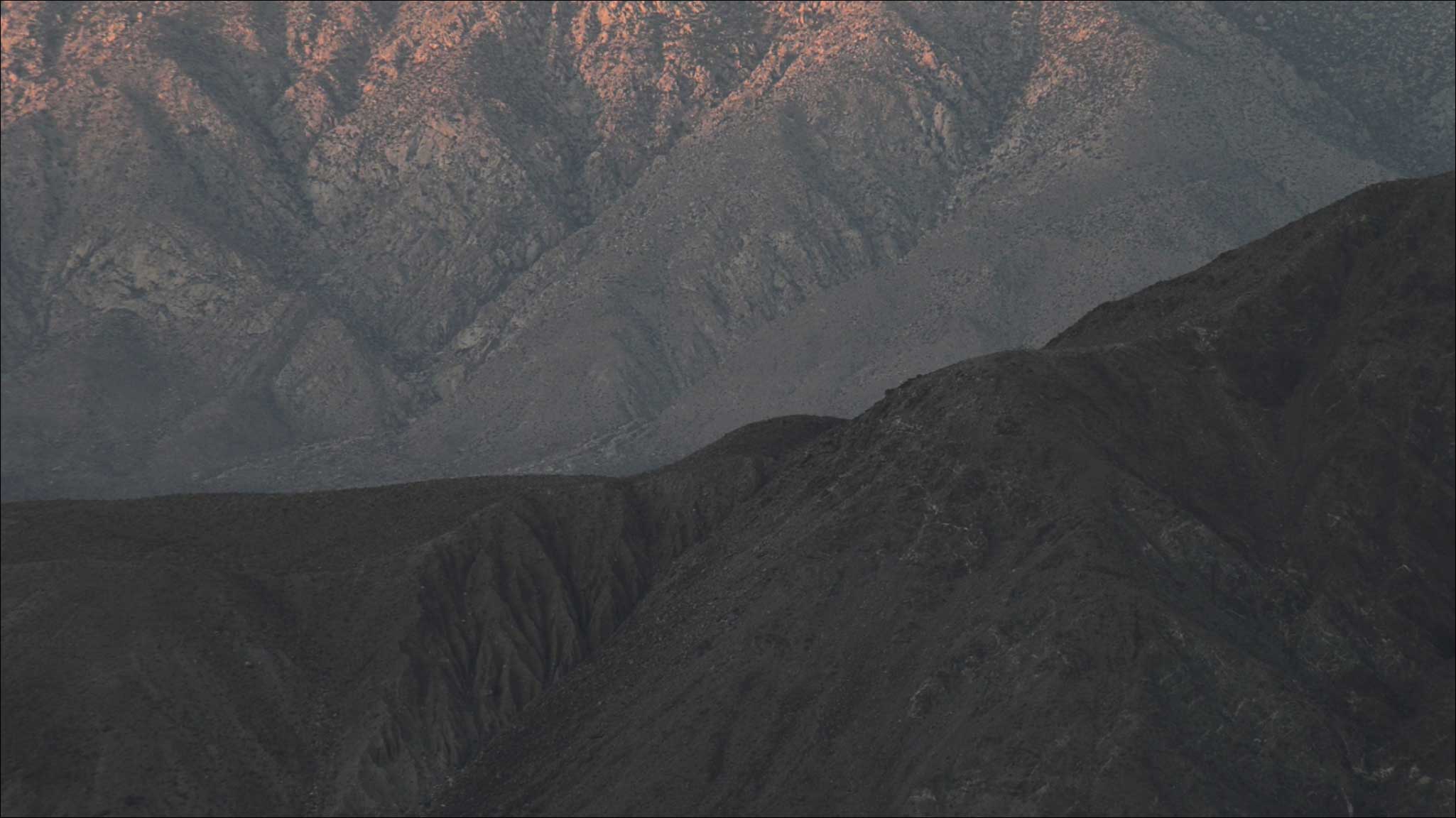
To date, the slim oeuvre of Ellie Epp consists of only nine exhibited works, five of which materialized in 2015 after an almost twenty-year hiatus from moving-image making. (Epp completed a PhD in neurophilosophy in 2002, and taught interdisciplinary arts at Goddard College in Vermont from 2002 to 2013.) Her suite of recent works, all shot in digital HD, reprises many of the perceptual intrigues that Epp first explored in her debut — not least of all, the transcendental allure of undulating water. But it is her seven-minute musing on dusk and duration, last light (2015), that is, in my estimation, the most persuasive instancing of the artist’s undiminished talent and intellect. It was filmed in Borrego Springs, California in the autumn of 2013, and consists of a single, static shot of a mountain range at sundown. Depth is accentuated by a saddle in the mountain, which separates the barren landscape into foreground and background. Gradually, as time elapses, the waning sunlight dims the ridge in the distance, until the dimensions of the image collapse into a single, darkened plane. It is an open-air study of almost imperceptible change, a slow-motion film in real time. Although you are cognizant in the moment of the subtle shifts in colour and contrast, it is not until the end of the cycle that you grasp the transformation that has occurred. Yet it is also, like Trapline, a record of small, anti-spectacular events, peripheral to the conceit but carrying with them unobvious beauty and emotion: a stray bird flitting by; the soft distortion of desert heat; the faint chiming of bells nestled somewhere in the soundtrack. It demonstrates the profundity of Ellie Epp’s art, now as then. I would be content to watch it, and Trapline, for the rest of my days.
Ellie Epp is now based in Merritt, British Columbia.
Notes:
- Quandt, James. Canadian Federation of Film Societies Newsletter, September, 1989.
- Though shot in London in the winter of 1973–74, Trapline was actually finished in Vancouver, where a 30-year-old Epp relocated in 1975 using British Arts Council funding earmarked for the film’s completion.
- It was students of Razutis, in fact, that snuck Epp into the editing suite at Emily Carr College of Art after hours to cut footage on the sly.
- Hoolboom, Mike. Inside the Pleasure Dome: Fringe Film in Canada. 2nd ed. Toronto: Coach House Books, 2001.
- Hoolboom, Mike. Inside the Pleasure Dome: Fringe Film in Canada.
- I also like to believe that Epp’s camera, a Beaulieu 16mm borrowed from fellow Co-op member Sally Potter, future director of the feminist masterwork Orlando (1992), imbued Trapline’s footage with some auspicious feminine vibrations.
- Hoolboom, Mike. Inside the Pleasure Dome: Fringe Film in Canada.
- “Canada on Screen” was a major retrospective of Canada’s moving-image heritage, occasioned by the sesquicentennial in 2017 of Canadian Confederation.