“I Almost Ran Over Liza Minnelli Today”: Colin Campbell and Lisa Steele in L.A., 1976–77, currently on view at Or Gallery, records a seminal and intensely productive sojourn in two Canadians’ careers. I encountered the title of the show just after returning from my own first-time trip to L.A., during which I rendezvoused with two fellow Canadian artists and became obsessed with Liza’s 1989 pop-album Results. Learning about the exhibition, which presents video works by both artists alongside ephemera and a historical and critical essay by curator Jon Davies, it resonated as an ambiguous but striking coincidence requiring immediate investigation.
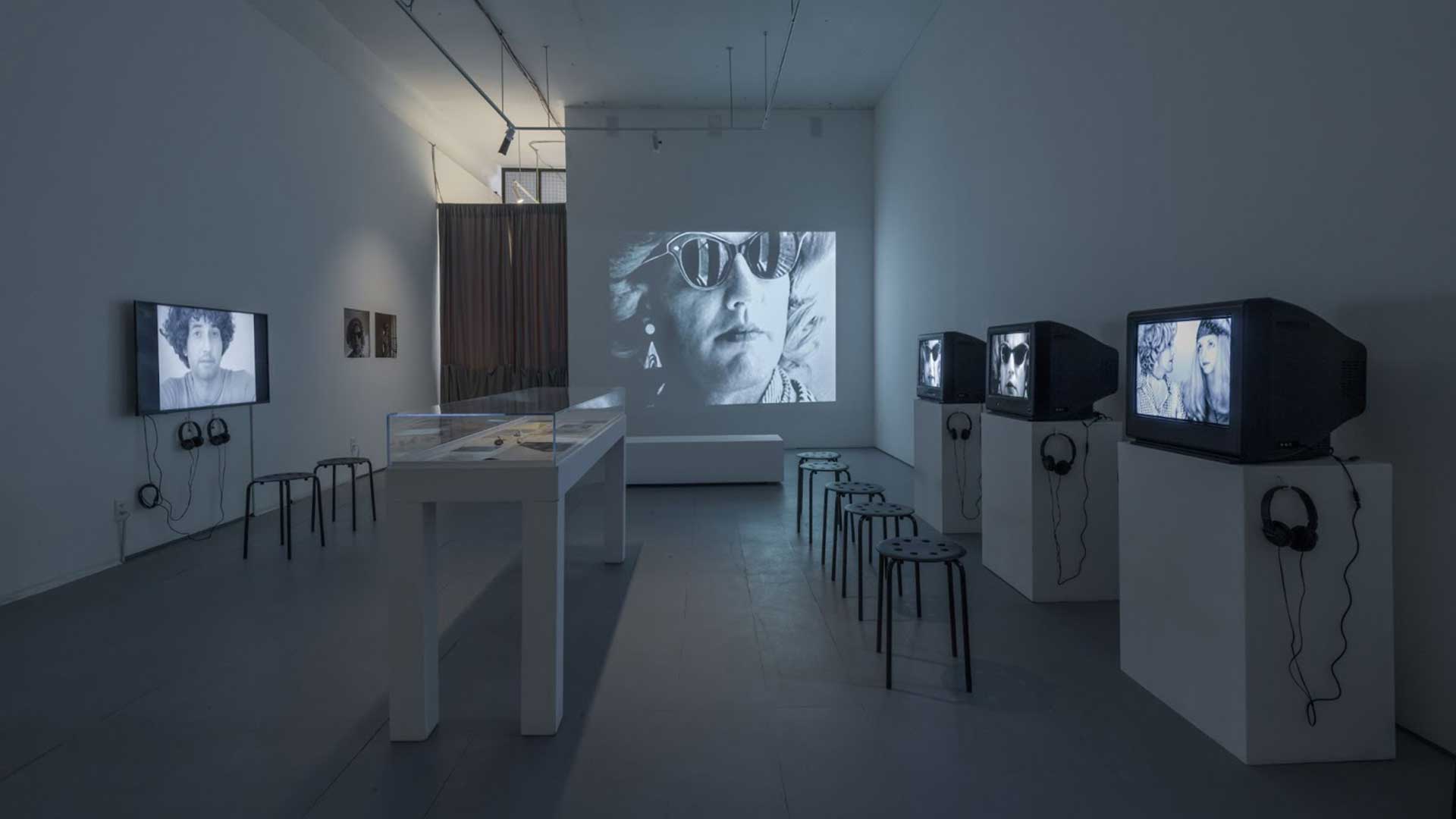
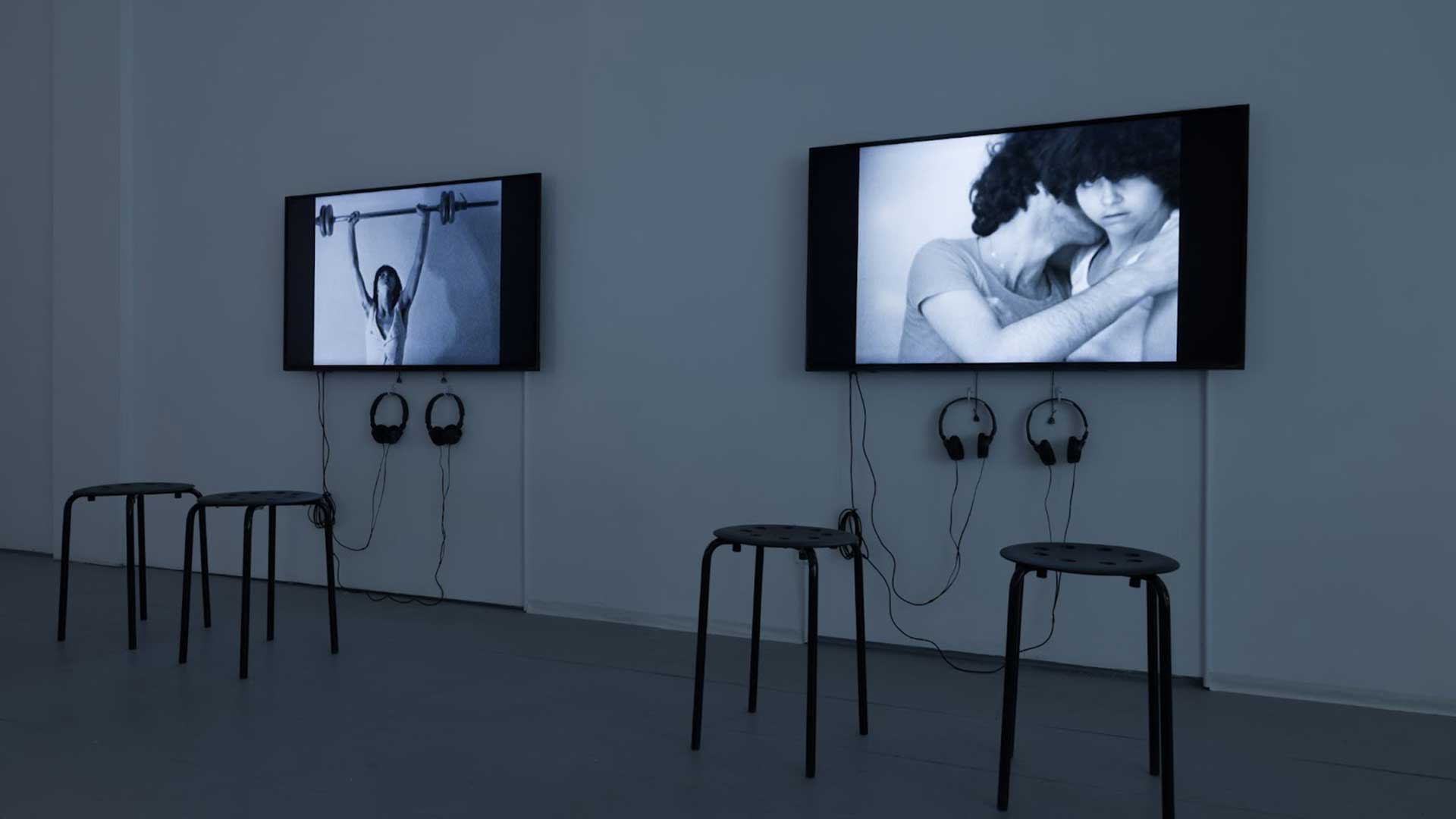
Inside the gallery space, the artists’ faces peer out from three CRT TVs, two flatscreens, a projector and several production stills applied to the walls. Headphones are provided but do not prevent an intermingling of audios, of music and monologue and psychobabble, contributing to an experience that is at times both hopelessly overwhelming and pleasantly immersive. There are nine black and white videos to take in, some over an hour in length, all filmed with an economy of stationary or slow-moving shots. With the notable exception of Lisa Steele’s Waiting for Lancelot (1976) — with many exterior shots teeming with insects and fantastical tableaux — shots are usually of a seated character monologuing in a sparse interior, resembling either a screen test or footage from a deposition. In the six videos comprising Campbell’s The Woman from Malibu series, (1976–77), interludes of the desert, motor vehicles and close-ups of window coverings break up the character’s listless testimonies of bereavement and fear, evoking film noir. While the unhurried, languid videos demand an investment of the viewer’s time and patience, Davies’ dense curation offers much to ponder in return.
A central vitrine of ephemera — including scripts, photographs, jewellery, Campbell’s MFA certificate, etc. — grounds the video chaos by putting it, lovingly, in context of a compelling narrative central to Davies’ exhibition essay: two Canadian artists, lovers bonded by a shared medium, set out for Los Angeles with nothing but Canada Council for the Arts grant money and their talents for observation, landing in Venice Beach where a rented house becomes a “home/studio hotbed” for the proliferation of work on display to us now. This origin story imbues the videos with the charm of starstruck Canadians encountering Southern California for the first time, that mythic frontier land of Hollywood and desert, sunshine and noir. The videos document the couple’s shared dream of artistic endeavour nourished and sustained by intimacy, the key to a romantic, uncitable optimism in the room. In my conversations with people about the show, several commented that it made them want to make video art, which I understood partly as an expression of appreciation (possibly envy) for the amatory ethos of collaboration on display.
Then again, they might have been inspired by the apparent ease with which Campbell inhabits his recurring character, a stereotypical bourgeois “Woman from Malibu.” In Hollywood and Vine (1977), he applies her signature light make-up, acrylic earrings and Liz Tayloresque wig. Seeing Campbell’s transformation into her orderly mannerisms, the studiously graceful handling of her cosmetic objects, prepares us for the character’s detail-oriented approach to storytelling. In Last Seen Wearing (1977), she recalls her daughter’s outfit on the day of her disappearance, and dwells on the embroidery of her daughter’s “Western-style wash-and-wear leisure suit that she bought in Arizona” and the picture of the Rocky Mountains that was embossed on her purse. In The Woman from Malibu (1976), she punctuates the story of her husband’s death on a Himalayan mountaineering expedition with precise measurements of the distances he fell. The character’s tendency to fixate on the minute details of tragedy is less a trauma-induced tic or coping mechanism than an incisive metonymy for a lifeworld indexed by movie premieres, commodity fetishism and dinners hosted by the Women’s Committee for the Democratic Party. As you spend more time watching her elegant face, wig-framed and bug-like behind shades when it periodically fills the screens, she becomes endearing. I related to her admitted lack of self-assuredness, shaky memory and difficulty sleeping, and was distressed to hear about her problems with sexist telephone harassment and the paranormal. In the brutal and hallucinatory Culver City Limits (1977) we get a glimpse of what must be her vision of heaven or purgatory: “Everyone is dressed in snow white for the premiere. I don’t understand why.”
If the woman from Malibu’s malaise derives from the city’s suburban and celebrity cultures, Lisa Steele’s four-part odyssey, The Scientist Tapes (1976–77), coalesces around the aerospace and academia industries. Steele and Campbell star as lovers, the former a clinical microbiologist heading to a laboratory in the Nevada desert, the latter a recombinant DNA researcher bound for a genetic engineering conference at UCLA. With grandiose seriousness, they discuss the risks and implications of their research and plan the minutiae of travel itineraries over coffee and mutual heavy petting. Six years later and the couple are in “L–5,” an ecologically self-sustaining space station equidistant between the earth and its moon. In zero gravity they invent “unknown sexual activities” and float with droppers and test tubes in their mouths. The pair either miss or ignore an urgent transmission warning them of an imminent “unscheduled reentry” into the earth’s atmosphere. Naked and floating on the triumphs of technoscientific rationality, they are unphased by any impending danger. Is this what California is like?
When Steele’s microbiologist asserts that “Everything I do must be observable,” she suggests that the conditions of total observation appropriate to laboratories might be extended to everyday life. And indeed, this is exactly what has happened. If Hollywood was once popularly imagined as an epicentre of American narcissism and an industry built on the transmutation of the personal into public spectacle, that situation has now become an all but mundane condition of living with social media. In those videos where they mingle the personal with character or anthropological work, Campbell and Steele come across as light-years ahead of their time, experimenting freely with substrates of identity in the controlled space of their extended vacation.
“I Almost Ran Over Liza Minnelli Today”: Colin Campbell and Lisa Steele in L.A., 1976-77 runs until January 28, 2023. For more information, visit the Or Gallery website, here.