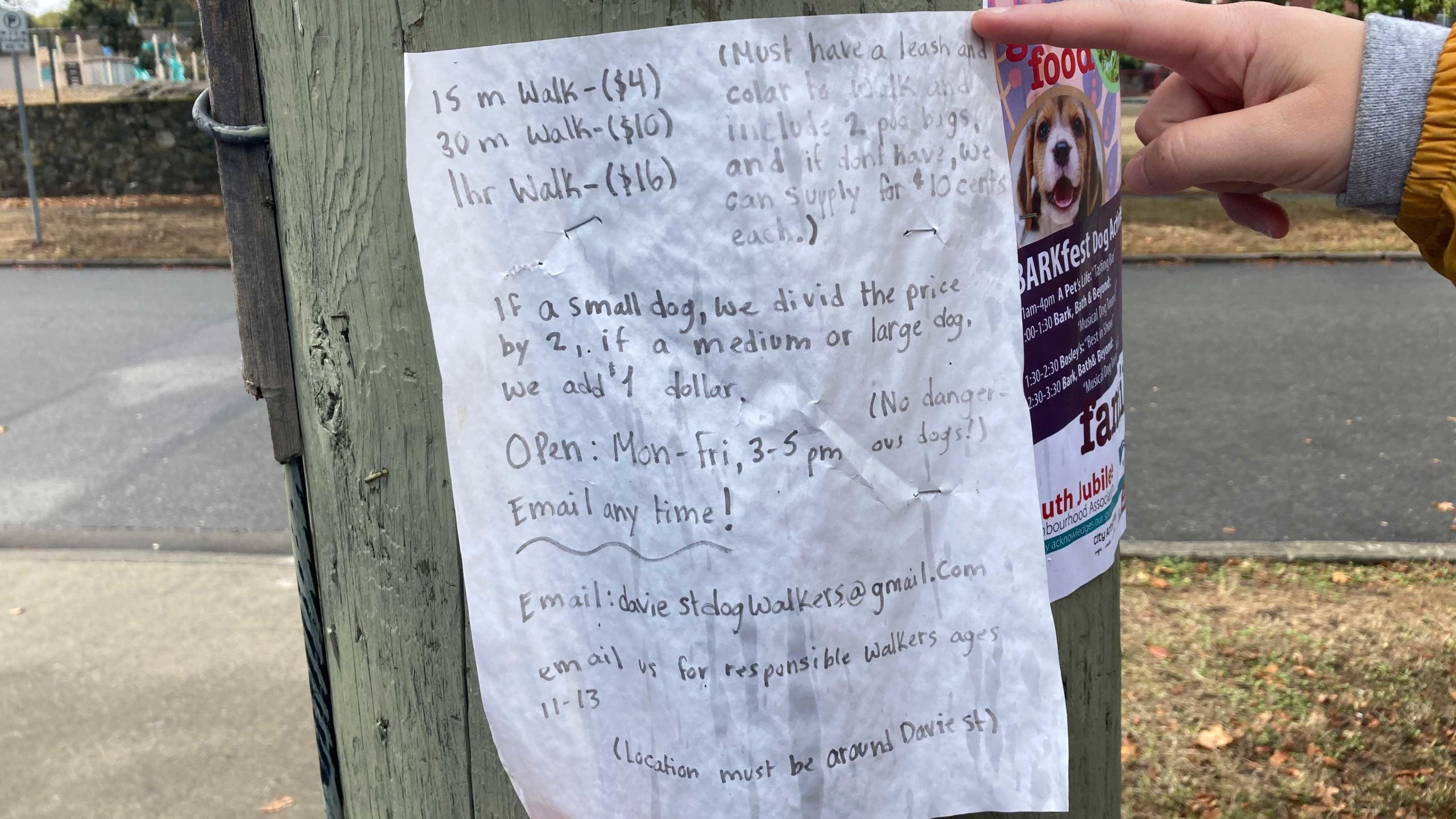
It’s September 2021 and posters for real, live events are finally beginning to reach my small Victoria neighbourhood. For months and months it’s been nothing but children’s dog walking offers, missing cat posters, and tree removal notices, pasted over and over, crackling in the heat. Now there are Fringe plays, jazz shows, queer skate meetups, and a burlesque tribute to Tom Waits. In a matter of weeks, the quiet pleas of children looking for dogs has been overpowered by these — the equivalent of a street-hawker’s shouts of step right up!
Despite the signs of movement, the return of the first drops of rain in months, back to school hubbub, and the (for-now) security of being double-vaccinated, there’s an emptiness I feel when I step outside I can’t escape. Downtown, my eyes are full of empty storefronts where things have closed or moved in the past year and a half — gaps in the frontispiece of commerce where life used to live, where it has left, and where, still, nothing has come to take its place. Though sad, it’s a kind of comfort to see physical spaces that hold true to the personal experience of loss I feel in my days — like the city, they are also riddled with holes, papered-over windows, dust, and uncertainty.
*
We are, at present, swimming in a sea of grief. That sea includes death, but it is also so much larger, encircling all sorts of sorrows. In a better world, many of these disappearances would be avoidable, even unimaginable. For now, given the loss-filled waters we inhabit, how to better navigate through them, and without drowning? How to shift course, veering closer to a more humane self and society?1
These questions open Rebellious Mourning: The Collective Work of Grief, a book that found me a year deep into a morass of loss and grief, turned towards these same concerns. Edited by Cindy Milstein and featuring essays and contributions by organizers and writers worldwide, Rebellious Mourning centers around the idea that “the work of grief, and spaces for it, […] similar to water and libraries, should be freely, healthily, and publicly available to all.”2 What we need, the book contends, for our social movements and our survival, is to recover a space for grieving: as Milstein writes, “we can better bear our manifold unnecessary losses when they are worked through in common, on commons: spaces that we create and sustain to use, share, and find comfort in, but also spaces that are ours to self-determine.”3 The book follows experiences of public and shared grief through the formation of Black Lives Matter; the disappearance of the forty-three students of Ayotzinapa, Mexico; the memorialization of murdered trans women, and many other stories of collective attempts to mourn unjust deaths.
These are big, collective griefs with big, political ramifications. In the past two years, many such losses have been felt across North America, and the globe, from the murder of George Floyd to the bodies of Indigenous children uncovered at residential schools across Canada. Though public gatherings have been few during the pandemic, those that have persisted despite the complications of gathering in public have been either in protest or in mourning; protest, in turn, has come to feel synonymous with mourning. The occasions for grief are innumerable and, it feels, rising. As Terry Tempest Williams writes about the ongoing forest fires that tore across so much of the continent this past summer and the summer before, so much is going on “with such velocity it is melting our capacity to feel the full magnitude of what is happening.”4
At the same time, it feels as though the surface of our grief almost two years into a global pandemic has barely been scratched. Although I know five people who died this year, I’ve yet to attend a funeral. Though these are small in comparison to the monumental collective losses around us, I have felt each life on its own as a loss that shakes the core of those around them and continues to reverberate. The global number of recorded COVID-19 deaths is now approaching five million,5 a number so large and yet so simple as to resist understanding. Yet in considering it still I can only think to make it bigger, to consider how many more people died non-COVID deaths could not be grieved collectively.
While many communities are facing what is only the latest in the ongoing series of losses wrought by the violence of the settler colonial state and white supremacy at large, the injustices magnified by the pandemic have brought grief ever more to the forefront. Reckoning with my own grief this past year has me questioning whether I have inherited any cultural practices of mourning, or whether it is time to make new ones. Privately, I carry a tally of my losses like a rosary around my neck, touching each one by turn to know that they are with me; I carry them still, even if they are not visible to others or to the distant world around me. Publicly, I am in search of spaces for collective grieving, spaces urgent in their necessity and utility to a grieving people whose grief may not even have reached them yet, which may be, as Cindy Milstein suggests, indiscernible from the water we swim in.
*
I’ve lost more in the past two years than I expected — in none of the ways I would have expected. Hardly anyone I know has contracted COVID-19, nor lost family or friends to it. Throughout the pandemic, the island has faced a lighter caseload than other west coast regions, including Vancouver and the interior, and the mild weather has made outdoor visits possible throughout the most intense social restrictions. And yet, loss has come to feel ever-present, an indelible part of this year.
Last March, four months after sustaining a foot injury that kept me from walking and one week after leaving my job at Open Space artist-run centre in a role that had been integral to my sense of community, Raj Sen, colleague, friend, and director of Open Space, died suddenly. The loss bowled me over, especially after a year where we as a staff had barely seen each other in person, and then, only for a few socially-distanced picnics in the summer. The shock and pain of this loss has become manifold during the pandemic: the gallery had felt like a second home to me. Already the physical space had been taken away, at least for a while, by the suspension of in-person programming, by the absence of people and artists and events. Leaving my role there meant a layer of removal, but not an ending. Raj’s death felt, and has continued to feel, like an incontrovertible fact of how the physical spaces around me have transformed for good during the past twenty months. Even when we can see each other again, we won’t be the same people we were, I reminded myself three months into the pandemic — then six, nine, twelve. And then the truth: we won’t see each other again, not all of us.
*
When I walk around the city, I go with a pain in my foot. The pain is eleven months old. It began with a sprain so bad I couldn’t put weight on it, and has become a persistent reminder, when I am out, that I must not venture too far or tempt even worse pain. The circumference of my walking, therefore, keeps to a bubble around my apartment 5km across — sometimes smaller. After months of this physical restraint on my movement, I cannot distinguish the psychic-emotional impact from the physical. There are things that I carry that will not move.
Collectively, this immobility feels part and parcel of the various stages of pandemic and social restriction we variably find ourselves caught in. Just as often as there are steps forward, there are steps back into the supposed safety of home and private space. But, as Milstein writes, the cruelest part of grief can be “the expectation that pain should be hidden away, buried, privatized — a lie manufactured so as to mask and uphold the social order that produces our many, unnecessary losses.”6 Holding grief on our own, without means of sharing or releasing it, creates such a heavy fog around us it is hard to see a way out — it might, in fact, only be possible to feel our way. As I consider what the arts can offer as we move deeper into the many crises facing us, I find myself looking for practices that are attuned to the beleaguered density of our bodies, that invite us to move and feel and be together.7
*
Throughout the pandemic, arts organizations from theatre companies to major galleries and artist-run centres have made it a central focus in their messaging to emphasize the value of the arts through times of struggle, how now, more than ever, the public’s reliance on television, movies, and books to get through months of isolation demonstrates the necessity of sustaining arts funding and carrying on programming. While I don’t contest the value of the arts in these or any times, as an arts programmer who has seen so much virtual programming fall upon smaller and smaller audiences, I wonder about what is actually reaching people, and what will allow the public at large to engage with the arts openly, when so much grief and unacknowledged feeling stands between us.
As what was once public art has been adapted, through the pandemic, to take the form of an independent and individual experience, the vulnerable space of an arts encounter has shrunk to the size of a laptop screen. While this can offer forms of accessibility and dynamism that in-person events cannot, it misses the physical experience of breathing and feeling in a room with other people. In the face of the shrinking cultural encounter and the shrinking of safety often to the walls of one’s home, it is also clear that we are more accustomed to being with various forms of virtual media than with each other. When gallery visits are mitigated by booking a time slot, wearing a mask, and practicing physical distancing, what kinds of intimate encounters with art can we hope to have in public?
One thing feels sure to me: the connective social tissue formed through conversation, mutual encounters, the friction of finding yourself up against something you didn’t expect, and the practice of thinking alongside and into each other8 continue to be far out of reach. It is this movement, energy, spark that makes the city alive — a movement that, for now, is still stalled.
*
“My job is only to give space to grief, and to try to create as safe of an environment as possible.” I am speaking to my friend and colleague Regan Shrumm about their recent program, a series of ten independent workshop-discussions on grief called Permission to Grieve. Presented through Integrate Arts Society, the former Victoria arts festival and ongoing arts organization, the workshops were held for small groups of up to ten people this past summer over Zoom. As artist-facilitator, Shrumm invites the participants to introduce themselves and share in response to a series of questions about grief. It is a simple premise, and a simple set-up: sit, talk about grief, listen, breathe. Although there are some guided breathing exercises, and some meditative line-drawing activities, Regan sees the project as neither a form of counselling nor art therapy—“for me […] providing the space, having conversations, that in itself is the art.”
I met Regan in the fall of 2017 when I began working at Open Space, where they were the out-going administrator. Through the years, their work as an administrator, a curator, and an artist in the Victoria arts community has demonstrated their unwavering commitment to accessibility and to a community-centred practice that refuses to privilege institutional ideas about what art-making should look like. I was excited, then, to learn about the discussion series, with the hope that it could tend to the gaps I was feeling all around me over a year into the pandemic.
*
I attended a session of Permission to Grieve early in July 2021 from the comfort of my bed. By this point in the year, the losses accumulated both personal and collective gave the feeling that the world had taken to heart the challenge of Elizabeth Bishop’s “One Art,” losing farther and faster with each passing day.9
It was evening, I was drinking warm water with a tea bag in it that didn’t quite pass as tea, having run out of time for the kettle to boil. There were four of us in attendance (five counting Regan), including one participant who never spoke or turned their camera on and one who spoke only once, to introduce herself. Still, the experience was deeply relieving, like opening a pressure valve and watching a glut of built-up fluid stream forth.
To sit and to be listened to was something I had been deeply needing — not another COVID catch-up or distanced walk that attempted to integrate every bad event of the past weeks into a narrative of ongoingness, but a chance to settle in and get right to the heart of what we had lost, the piercing is-ness of what it was we were missing. “One thing I really realized was that everyone needs to be witnessed,” Regan tells me, “and a lot of people aren’t being witnessed.”
After a year’s worth of readings, talks, and artist presentations where the audience had been entirely obscured from each other, or visible only through a scrolling chat alongside the speakers, the call to participate in Permission to Grieve was both refreshing and surprising: using conversation as the medium, it invited the collective creation of the kind of shared intimacy that has been out of our reach for so long.
We spoke of the great ecological grief surfaced through the Fairy Creek blockades, the personal grief of friends dying, the physical grief of inhabiting a body in pain, and the struggle to find people with whom these losses felt truly held and understood. Just days out of the unprecedented heat wave that had engulfed the west coast, ecological grief struck us all as pressing intimately upon us — with the reality of the climate crisis so close, it felt as though we were walking together into what could only be a period of great loss. Still, we were sharing it together, and acknowledging the grief and fear of the losses to come as a central concern allowed us to feel and consider it openly. It was, as Regan said, not counselling, but “a community-based way of supporting each other,” a space formed around sharing, with our difficult, painful, and vulnerable feelings placed at the very centre. With the room offered by this centering of grief, we were able to explore its complexities. “Grief is a form of love,” one participant shared, repeating an idea they had read and been holding onto — an idea that, months later, I encountered again in an essay by Terry Tempest Williams: “Grief is love. How can we hold this grief without holding each other? To bear witness to this moment of undoing is to find the strength and spiritual will to meet the dark and smoldering landscapes where we live.”10
*
Turning our discussion towards the Victoria arts scene, I ask Regan what they think has changed during the pandemic, what has been lost, and what is left. They talk about missing the chance to see the broader arts community that gathered at art openings and events, where opportunities for connection and collaboration felt close at hand: “I haven’t seen those people for two years.” Moreover, “there’s a massive amount of people who either got fired or left because they realized that their workplace was toxic and they wanted to start anew,” Regan says of arts administrators across the city, noting racism and lack of anti-oppression supports as among the myriad challenges facing arts administrators. In the wake of these changes, how will arts spaces take on the challenge of transforming to meet the needs of artists and communities? “More than ever to me [the pandemic] shows that we as a community need to be more experimental in the programming, need to really reflect upon what is happening in people’s lives in the community, because I still don’t think enough [spaces] are reflecting, or being relevant, to people.”
Though it’s clear we’re far from being out of the pandemic, Regan and I both share the feeling that some kind of ritual is needed to mark all that we have been through before we can hope to re-enter public spaces in full. “I feel like we need a giant ceremony,” they tell me, “something that brings us together, and that allows us to either take a deep breath together […] or to celebrate that we’re still here.”
As we begin to try and move through the waves of feeling rising all around us, again I wonder: how will we build a place for our grief?
Notes:
- Cindy Milstein, Ed., “Prologue” in Rebellious Mourning: The Collective Work of Grief (Chico, CA: AK Press, 2017), 3.
- Ibid, 4.
- Ibid, 7.
- Terry Tempest Williams, “The Pall of Our Unrest,” Mountain Journal, Sept 19, 2020. https://mountainjournal.org/terry-tempest-williams-says-it-time-to-rally-for-nature-and-country
- “Globally, as of 4:40pm CEST, 29 October 2021, there have been 245,373,039 confirmed cases of COVID-19, including 4,979,421 deaths, reported to WHO. As of 29 October 2021, a total of 6,838,727,352 vaccine doses have been administered.” from World Health Organization, 29 Oct, 2021. https://covid19.who.int/
- Rebellious Mourning, 4.
- Fred Moten talks about the need for “a renewal of our habits of assembly” after the work of scholar Manuel Callahan and the Universidad de la Tierra in “Robin D.G. Kelley & Fred Moten In Conversation,” saying: “We have to do a better job with regard to the theory and practice of getting together, of being together.” University of Toronto, April 3, 2017. Filmed conversation, 2:13:28. Retrieved 20 Oct, 2021. https://youtu.be/fP-2F9MXjRE
- As Casey Wei writes: “our practices long to chill in conversation with one another.” “In dreams: liquidity, art, and business in the real estate meat machine,” ReIssue, July 21, 2021. https://reissue.pub/articles/in-dreams-liquidity-art-and-business-in-the-real-estate-meat-machine
- “The art of losing isn’t hard to master; / so many things seem filled with the intent / to be lost that their loss is no disaster.” Elizabeth Bishop, “One Art” from The Complete Poems 1926-1979, 1979, (Farrar, Straus & Giroux, 1983) via Poetry Foundation. https://www.poetryfoundation.org/poems/47536/one-art
- “The Pall of Our Unrest,” Mountain Journal, Sept 19, 2020.