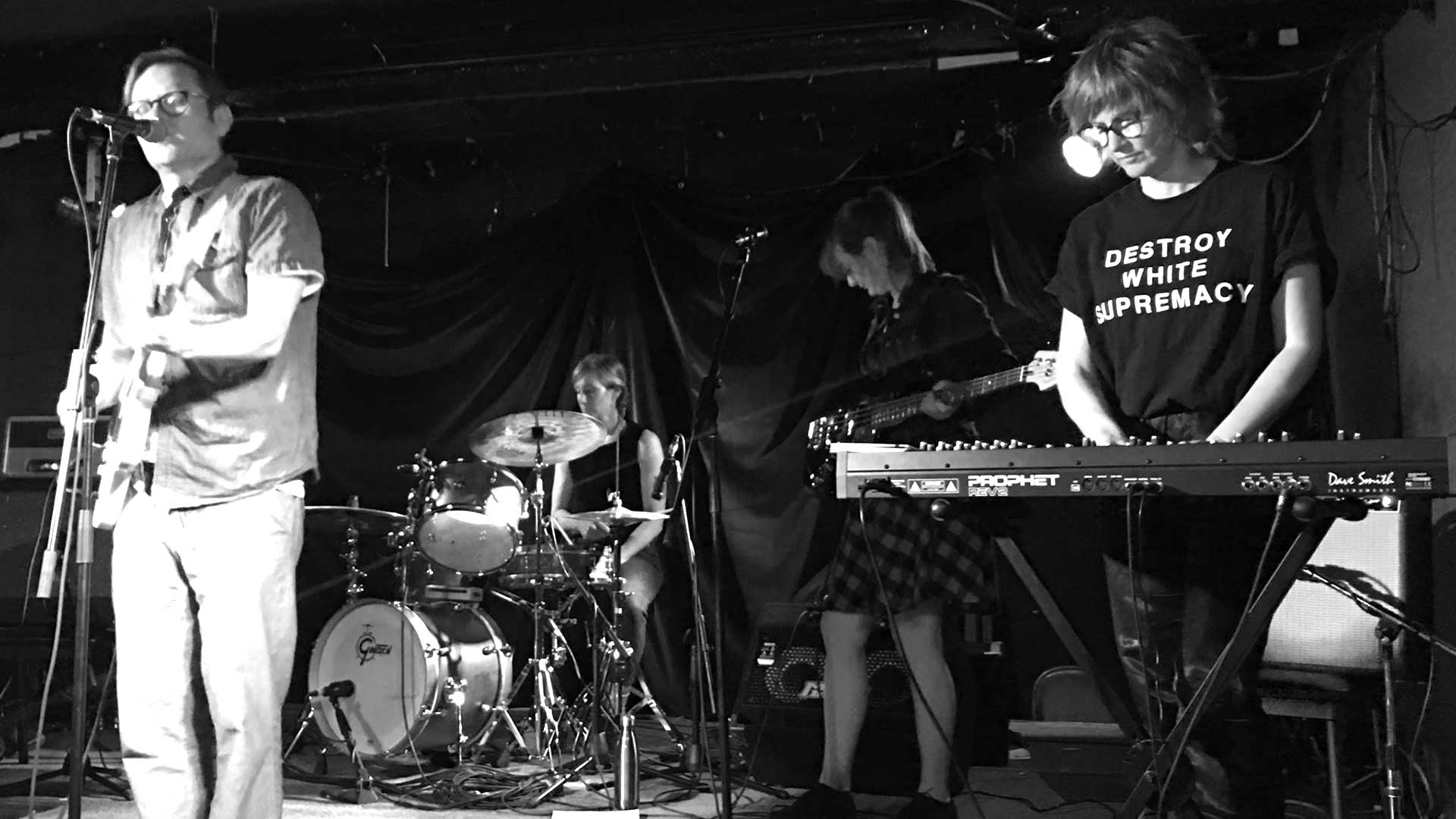
Ten years ago I washed up in Vancouver, and was invited to a surprise birthday party for an old friend at a ‘craft brewery,’ whatever that is. The night wore on and I got to talking to a friend of mine, Shyla Seller (SS). I knew Shyla as a friend, but also as a person who: worked at Arsenal Pulp Press, who seemed to go to every show, even the atonal ones, who was interested in Canadian poetry, who liked art videos and wasn’t solely invested in achieving a life goal of purchasing a townhouse in Langley. In our chatting, it come up that she was the daughter of a piano teacher. I jokingly recommended she watch The Piano Teacher with her mom (and they did), and also asked her if she would ever want to make sounds with my ‘band.’ We have worked together now for the last decade, releasing a fistful of records and books, contributing energy and labour in playing, editing, proofreading, and image layout. The sum of her contributions to the city’s writing, music and visual arts scenes exceeds our word count — to me she is both that archetypal and crucial person whose contributions are ‘behind the curtains,’ and therefore somewhat unsung. Shyla is a really special person when we stop and recognize her work — paid and unpaid — in archives, in music, in preserving weird concerts and maintaining 1980s video decks, etc., speak to and consider the importance of collaboration, lateral thinking, and funding. Our conversation ranges from her work as an archivist, to collecting erasers, to partying at the Sugar Refinery, to digitizing that great Young Marble Giants concert, to missing each other.
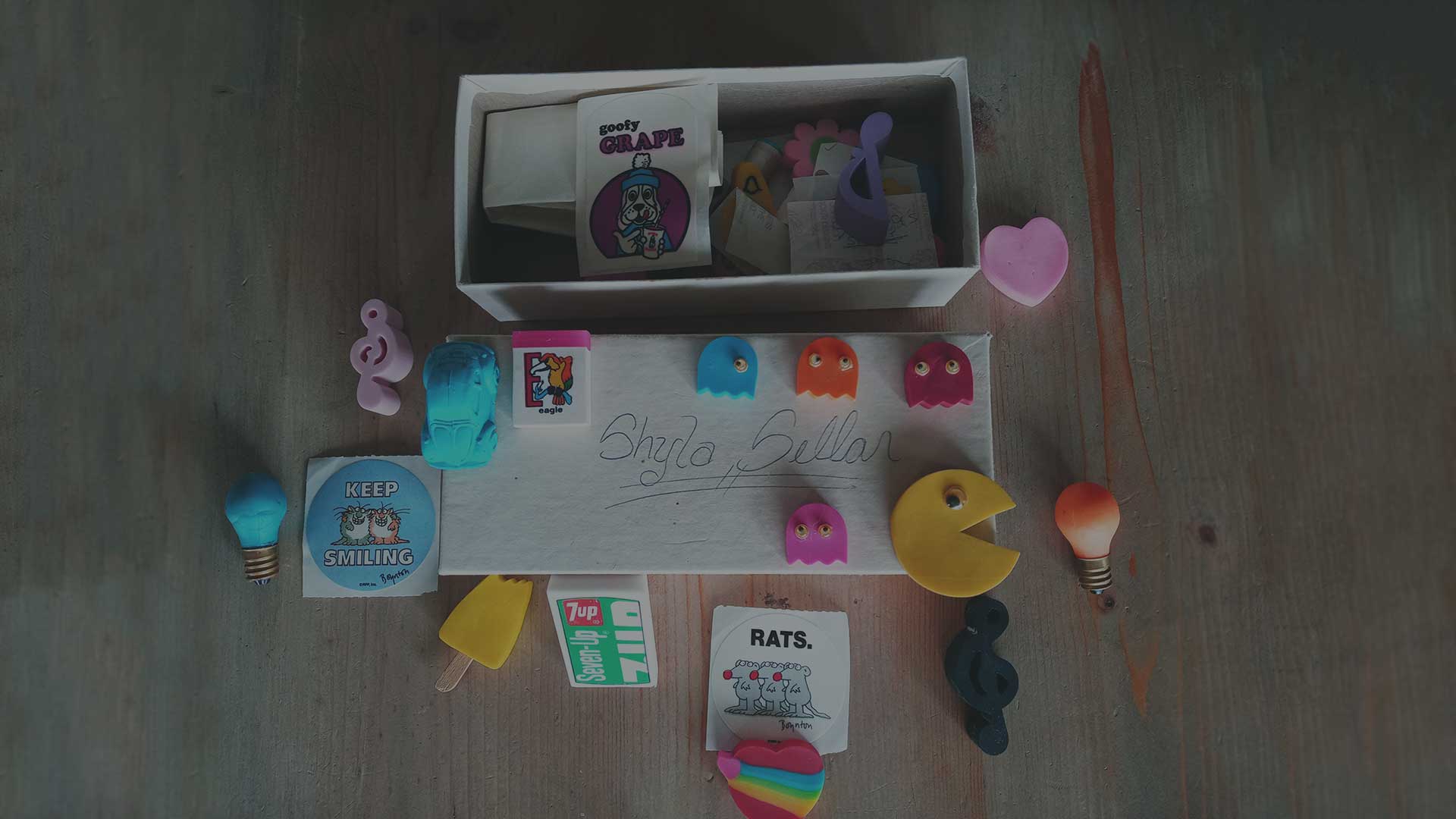
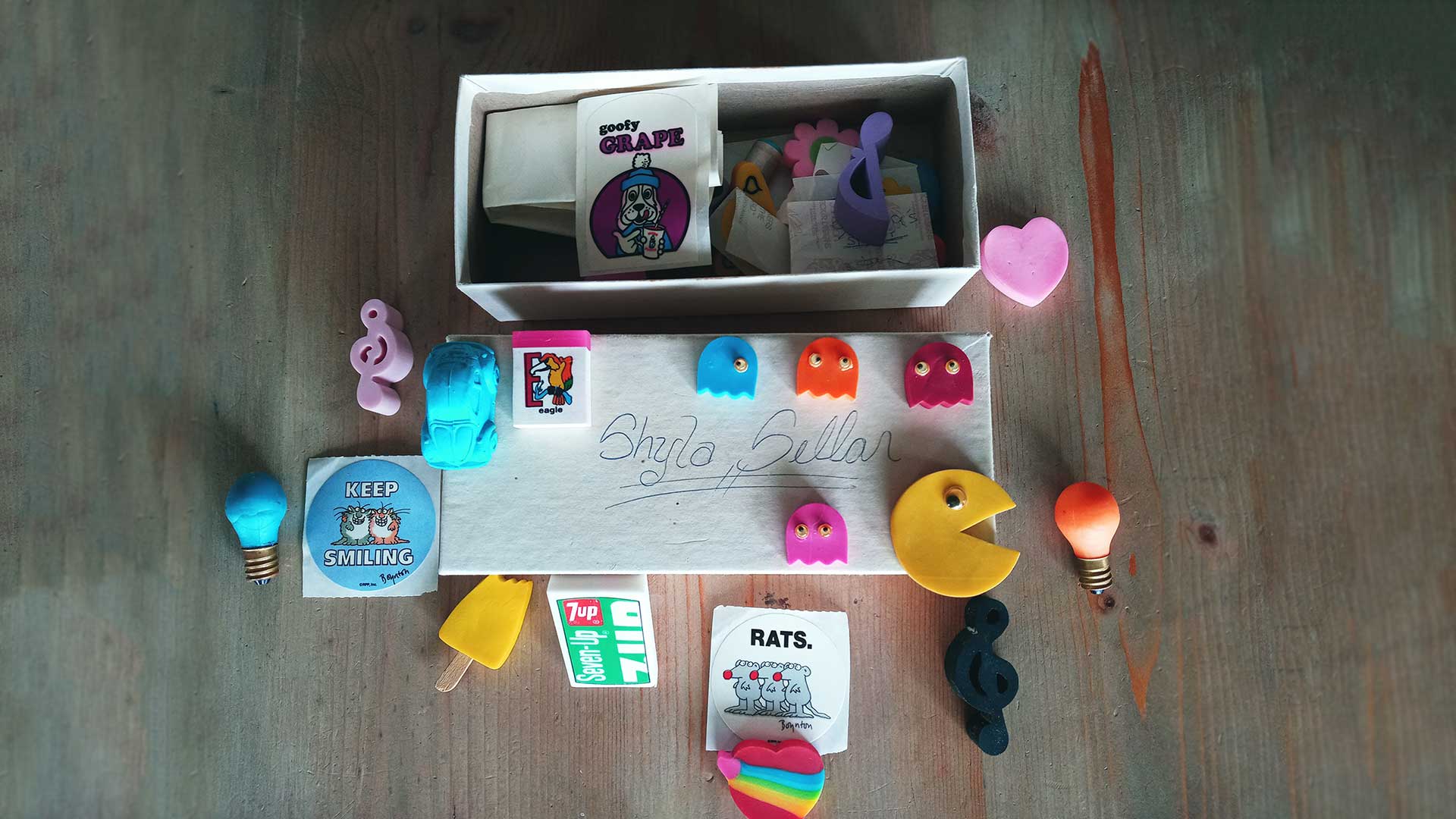
CM: I know you have kept lots of little things from when you were a kid. I know this because you gave my son a box of precious 80’s erasers from when you were, I assume, 8 years old. So I am curious if it is fairly typical for archivists to hold onto boxes of items, ephemera, the detritus that other kids of your age would have not thought to keep?
SS: It was my mother who held onto all of those things from when I was a child! Speaking as an archivist, I consider many of those things as belonging to her rather than me, as I wasn’t key in the circumstances of their creation and use at the time. She made them for me, and later transferred their ownership to me, and by transferring that ownership she also transferred to me the work of deciding whether or not to continue to keep them. Lots of people don’t have space to keep the things which accumulate over a lifetime; stable housing and available space are significant factors that determine personal archives, more so than what your job is, I think.
CM: Do archivists ever become self-conscious about saving their own artifacts? I would enjoy seeing, say, Kafka’s erasers from when he was 9? But you and I were not Kafka, and Kafka, age 9, was not The Franz Kafka yet, and so how would he have known to save his erasers in a sturdy cardboard box and write, in big loopy script, his own name and age on the side of the box?
SS: I try to leave artifacts to museum people and distinguish between archives and museum and library collection holdings, but this is often blurry and confusing. This is a definition of archives I learned in school: The whole of the documents made and received by a juridical or physical person or organization in the conduct of affairs, and preserved. There’s a lot to unpack in that definition, it’s strange. My approach is to focus on unique documents and photographs as evidence of something. For things like that eraser collection, I compiled that out of mass-produced items that are not unique, so I wouldn’t consider it as archival. Also my name is spelled wrong on that box, and I don’t recognize the handwriting. I’m not sure what that box of erasers is evidence of, other than a glimpse of a child’s treasured and kitschy world of things.
“…whether or not I think something is beautifully crafted doesn’t come into play in how I present something in the archives to a user.” — SS
CM: Can you talk about your deliberations when you are archiving art/literature in particular, as opposed to say a family letter or an object like an heirloom violin? I brought up Kafka before, in part because you had sent me some links of the unpublished writing of Mottel Menczer and I found these little stories haunting in the way that Kafka’s parables or Robert Walser’s stories can be startling, all the more so because they are Holocaust fragments, and slightly phantasmagorical in how they refer to the Nazis as The Monsters. They are historical documents, but they are also clearly literature. Can you speak to that process?
SS: Yes, those Menczer stories are haunting and lyrical, even in translation — by all accounts the original Yiddish is more elegant; he is a natural oral storyteller, like you. It was a lot of work to figure those out. The section headers weren’t translated, so we had a wonderful volunteer translate those, and that work made it so I could understand the author’s intentions and order of the stories in that manuscript. I didn’t even know that some pages were section headers until after the volunteer’s work. The originals and translations were filed together in one file folder, and I had to match each translation to each Yiddish-language original, by trying to recognize the shape of the letter forms.
The VHEC has a number of memoirs, diaries and journals, but this manuscript is extra special. I am a big reader and like hearing people’s stories, so this collection was a real pleasure to work on, even though the language barrier drove me a bit nuts, and even though stories are deeply sad.
When I’m working with archival material, I try and understand what something is, what is its form, how was it created and used, and then clearly convey that information to the user of the catalogue. It’s a very precise and pared-down form of writing; I try to avoid misrepresenting the things and misleading researchers. So whether or not I think something is beautifully crafted doesn’t come into play in how I present something in the archives to a user, but later, I can highlight an extra special thing to a curator, or to other potentially interested people, and see where they take it.
CM: When you worked at the Western Front you found a video copy of a Young Marble Giants concert, right? How did you find it? I know you are a fan — I like the idea of you just thumbing through the stacks of weird and antiquated tapes and asking yourself, “Could this one, labelled YMG, be what I think it is? Could you give us the blow by blow of how that amazing concert was preserved and then digitized?
SS: That’s pretty much how I found it — looking through the videos (U-Matics, some open reel) on these shelves, and reading the spines. Though now that I think about it, I’m pretty sure I heard a staff rumour about the existence of that tape, and kept my eyes open for it. The curator at the time, Pablo de Ocampo, was also a fan; I’d found the band on Facebook, and messaged Stuart Moxham, the bass player, who was excited about seeing the recording. So one day, close to the end of my time there, I digitized it, and sent the band a copy.
There are so many performances held at the Front I wish I could have seen in person. Like David Rosenboom, for example; I digitized one of his concerts for an exhibition of his work on brainwave music at the Centre Pompidou. There is an amazing performance with him and George Lewis, as part of SFU’s summer music intensive program, that made me wish I’d kept studying music so I would’ve ended up in SFU’s music program. But as a teen I was convinced I wasn’t talented enough of a player to continue — it was so much work to keep up technique and learn these difficult classical pieces. I guess I was a bit lazy, but also shy, mopey, and not confident in music as a future for myself.
CM: You are a piano player, taught by your mother, whose occupation was a piano teacher. How did she come to music? And was it a given that you would learn too? I ask because we grew up in opposite environments — my dad refused to teach us or encourage us to learn how to “read” music. He wanted us to not know anything about music. Was it part of the weave and fabric of your young life?
SS: My mom first learned piano as a child; growing up Mennonite in southern Manitoba, she would accompany people singing in church. She can accompany anyone still — Christmas carols, etc., her hands automatically know what to do and how to keep up, where to go. She started studying piano again in the lead-up to her divorce, in order to earn an income. As a single mother, she passed the Royal Conservatory of Music ARCT exam, which qualifies you as a teacher. Then from 3:30 until 8:30 every weekday evening she would teach private lessons and I would watch soaps or music videos or do homework upstairs. She booked half an hour off for dinner, so we all got really good at eating and cleaning up super quick (I still eat embarrassingly fast). But she refused to teach me piano — she didn’t think I would listen to her.
CM: Can you talk about the different competencies between say, playing a piece of solo piano music at someone’s wedding (a noble action), and playing a synthesizer with a band? Have there been inspirational and/or aspirational moments for you, seeing someone play, that directly impacted how you approach your instrument?
SS: Playing together in a band is so different; sharing the creation of sound between you, rather than all the spotlight being on one person in a quiet room. I like hearing how things mesh together, and feeling the music, surrounded by loud amps, the volume and electricity. One aspirational moment was seeing Wayne Horvitz play from the Snowghost Sessions in Bellingham. This was the first time I saw him incorporate electronics and pedals, along with his exquisite piano; it made me want to try and explore my own version of electronics in music, learn the synth better, the envelopes, modulations and effects. Also, I’m a terrible sleeper, usually stressed out, and somehow deep long drones with weird sparkle and pattern make me feel calmer than anything else. For a while I got into musicians like Eliane Radigue, Laurie Spiegel, Luc Ferrari, Jon Hassell — and was inspired to try a solo synth performance as part of Musicircus, organized by the Polygon Gallery in 2019. I then explored this more in a collaboration with Jenn Pearson, in which I created soundtracks for short videos that she had shot on her phone.
(But maybe a better inspirational moment to mention is the second-ever Frog Eyes show at the Sugar Refinery. I helped load your gear into the van after the show, crammed in with all our friends to go to an afterparty somewhere, to celebrate until the early morning hours…)
“The great need for volunteers reflects the state of not-for-profit arts funding in Canada — no one has enough money to pay people for all the work that is behind music, art and literary projects.” — SS
CM: Speaking of the synthesizer, didn’t you help with the archiving of Martin Bartlett’s work at the Western Front and SFU Archives? I was just reading about Computer Music Cabaret, concerts he gave with Don Buchla.
SS: I love Martin Bartlett’s work — and have been lucky enough to digitize both video and audio recordings of his performances. He would bring in people like David Rosenboom, George Lewis, Don Buchla, Pauline Oliveros, etc., for concerts and workshops. He is also partly responsible for bringing gamelan to Vancouver. He built his own synthesizer, the Black Box, which is now in SFU Library’s Special Collections and Rare Books. I worked there briefly when Luke Fowler and Allison Collins were doing research for Fowler’s film Electro-Pythagorus, and prepared some materials for their visit. But I would love to spend more time with Bartlett’s archives one day. The Western Front continues to be one of my favourite places in the city to see a concert, and this is in part because of what he started there, as one of the original founders.
CM: We’ve talked about your paid work a bit, at the Western Front and the Vancouver Holocaust Education Center. Can we talk about archival, layout or editing projects that you do for free? I thought about this interview as focusing on someone who contributes a lot behind the scenes. You rarely step out and deliver the soliloquy, (though if you did it would be awesome), but without all of your unpaid labour, a lot of works wouldn’t have appeared, at least in their finest, shiniest, grammatically precise duds. Do you actively volunteer for projects? Are you known as a person that helps, and people come to you?
SS: I started volunteering for Songlines Recordings in 1998, and basically never stopped. I volunteer with Archivaria, the Journal of the Association of Canadian Archivists, to give back to my professional community a bit, and am an occasional courier for Everybody Is In. Sometimes I write unpaid reviews for Archivaria and Geist. But the most volunteering I’ve done is for friends or colleagues who’ve asked me. For a while people would say: You should do this for free because it’ll look good on your resume. Then they would tell me I should do something for free because it will be fun and I will get to meet people and chat with friends. This is a better reason to volunteer, if you like hanging out at events and want to feel part of something. The great need for volunteers reflects the state of not-for-profit arts funding in Canada — no one has enough money to pay people for all the work that is behind music, art and literary projects. The people running these projects barely see any income from them. Volunteer work is how they continue to scrape by, trying to survive in a city driven by real estate tycoons with lots of profit to make for themselves. Arts communities can make a place better, help bring people together to share experiences, learn, build connections and support one another, but the positions I’ve had in the arts (before retraining as an archivist) were always highly skilled, underpaid, and involved lots of volunteering on the side. I’ve rarely earned income from anything to do with music, for example. There’s not really a budget for thinking up illustrations for covers, or proofreading cover text and lyrics. I still feel lucky to be able to be part of projects, like yours, that I find meaningful. Ideally I would like to focus both my volunteer and paid time on things that advocate in some way for a more equitable future, but also to have fun, and afford rent.