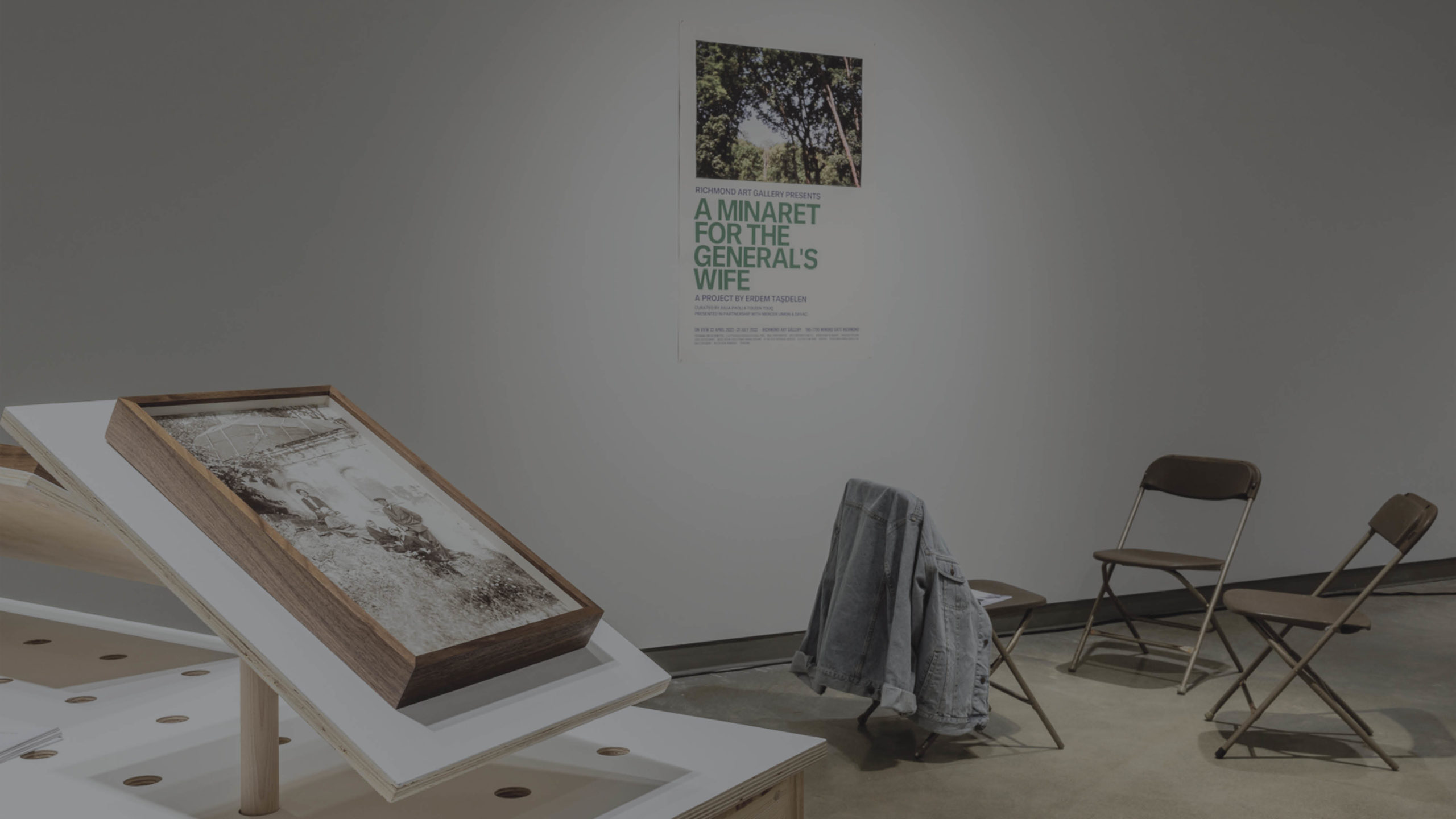
Resting in Kėdainiai Town Park, in one of the oldest cities in Lithuania, an Ottoman-style minaret stands peculiarly alone. Without a mosque attached, this minaret has been fractured from its archetypal usage, left to perform the literal definition of folly.1 Initially constructed in 1880 by Russian General Eduard Totleben, the reason for the minaret’s formation is unclear. Some say it was built as a testament to Russia’s victory in the 1877-78 Russo-Turkish War; this narrative gives explanation to the two marble plaques affixed to the minaret’s exterior — one written in Ottoman Turkish describing a palace built by Sultan Mehmed in the 15th century and the other bearing an inscription in Arabic from the Qur’an2 — which were likely taken from Turkey as loot after the war. Contrastingly, the locally-preferred narrative tells of a romance between Totleben and a mysterious Turkish wife, proposing that the minaret lingers as the limb of the mosque he built for his lover.
In A Minaret for the General’s Wife, co-curated by Julia Paoli and Toleen Touq at the Richmond Art Gallery (April 22 – July 31), Turkish-Canadian artist Erdem Taşdelen reflects this solitary minaret through multimedia installation and an accompanying booklet, utilizing rhizomatic narrative to incorporate embodied historical research. After coming across the minaret in a Turkish travel blog a few years back, Taşdelen became interested in the multiple records which surround this seemingly displaced architectural oddity. In this exhibition he uses these contradicting accounts to unsettle historical records through a melding of fact and fiction. Within his larger body of work, Taşdelen blends these two (often distinct) categories as a means of encouraging slippage between subject positions. In his investigation of a dislocated object, Taşdelen allows a multitude of subjectivities to relocate themselves through the creation of new narratives.
Across an array of archival images and research ephemera, a portrait of the minaret becomes clear. As a freestanding edifice, it rests atop a small stone structure fitted with a few sealed doors, windows, and a prominent stairway that leads nowhere — creating a feeling of suspension which permeates the exhibition space. A few empty wine bottles collected near the gallery’s entrance appear to await recycling. On the opposing wall, several stage lights lay indeterminately face-down next to a lone music stand on a highlighter yellow spotlight rug. Further in the room, a large orange ladder is propped adjacent to the exhibition didactic, and not far off, a carefully bubble-wrapped package — maybe a photograph — leans against the wall. This air of pause between a before and after feels as precarious as the four perforated wooden display tables of varying heights on wheels throughout the room. Each one holds a range of objects: archival and stock images, buttons, a thumb drive, a microfilm reel, and a well cleaned brass trumpet, among other things. Gallery visitors are provided with a complete list of objects, but this only articulates additional gaps in the research process — the provenance often clearer for the Shutterstock images than those from the Kėdainiai Regional Museum archives.
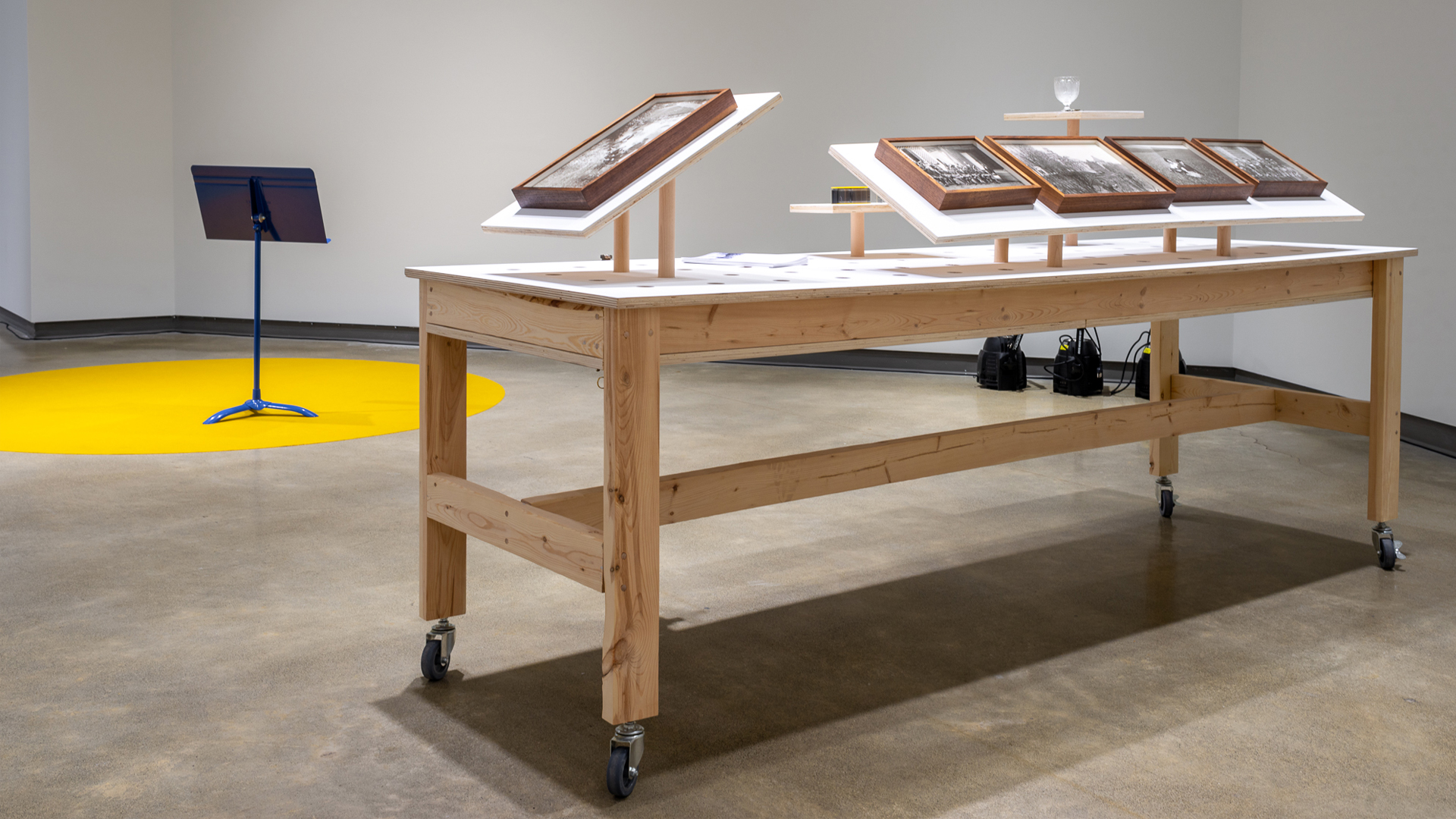
This collection of gathered and fabricated objects are residues of a body of research carried out, in part, during the artist’s 2019 residency in Vilnius, Lithuania, where he studied in the capital’s State Archives and Kėdainiai Regional Museum. There is a certain sense of resignation to many of these enigmatic objects — a computerless thumb drive withholds its contents, the microfilm sits without the technology to read it — and their tethering catalogue gives little explanation beyond face value. As Taşdelen tactically blends the fictitious with the factual in his inquiry around this architectural folly, he playfully uncovers another type of folly — that which arises out of the often Sisyphean nature of archival research. After enough time endlessly chasing files and records that have been mislabeled, forgotten, mistranslated, buried in unsearchable databases, or have simply fallen between bureaucratic cracks, a light-hearted irrationality of the research process presents itself. Archives, especially institutional ones, are often presented as full histories, without space held for their inevitable voids and biases. In face of this incompleteness, Taşdelen validates futility as a possible outcome (the evil step-twin of research no one likes to talk about), gently reminding us that historical narratives are not built on an objective truth to be simply uncovered, rather a compilation of subjective ones to be listened to.
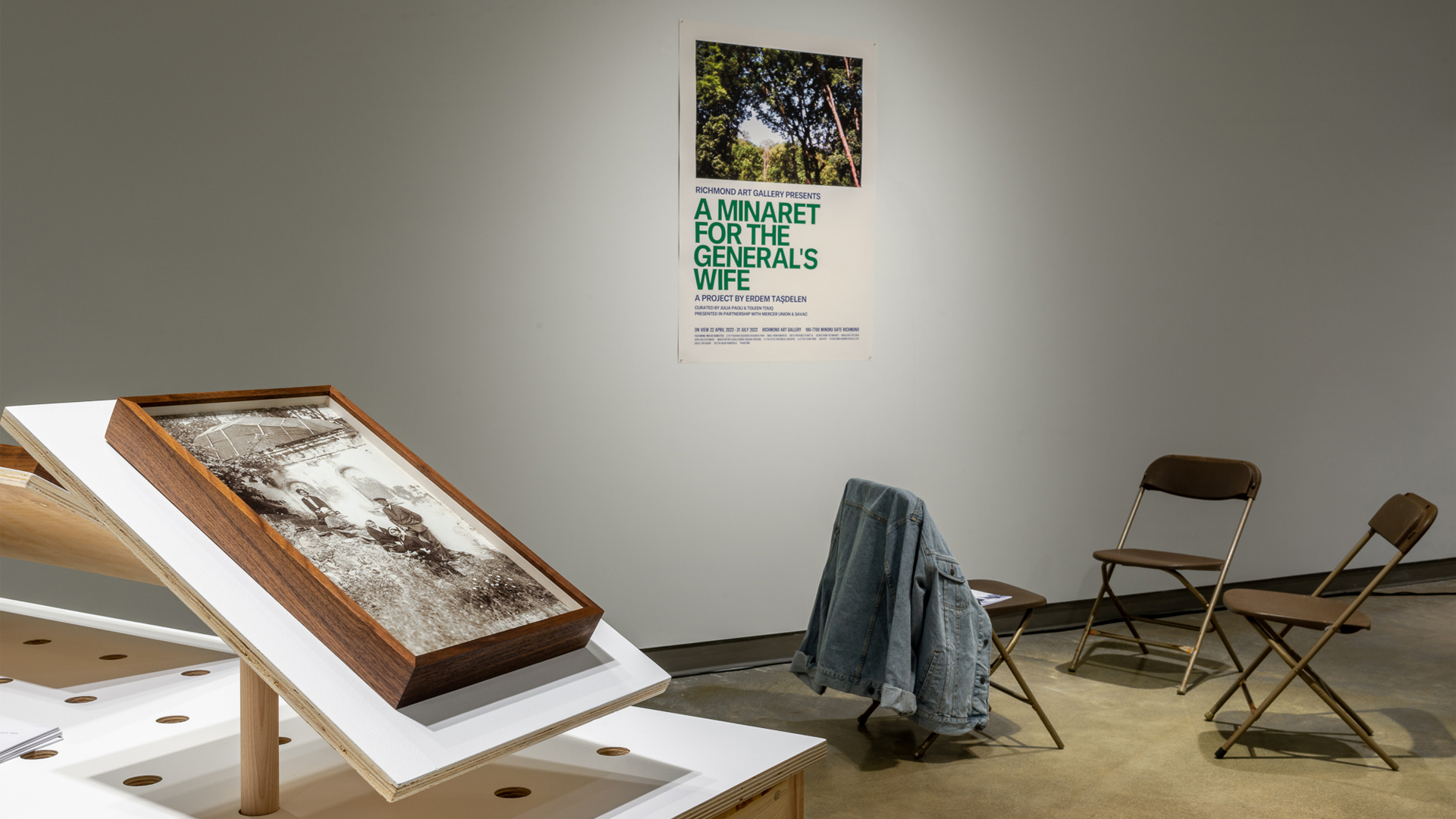
Moving through the space, I see many objects that hold a cultural resonance for me — the Vakıf Taşdelen brand water bottle, the pile of sunflower seed skins, photographs that remind me of my own bubbie’s archive of family albums. One of the black and white photographs, Two Turkish women on a field (date unknown, photographer and source unknown), makes me think of a picture of her and my grandpapa with my father and uncle as children, lounging in the grass in the Istanbul countryside.
There is an audio track playing from two large speakers bracketing the gallery space. A Lithuanian folk song, field recordings gathered around the site of the minaret, and a crackling recording of the Adhan (the Islamic call to prayer) emerge intermittently from a 45 minute loop of mostly silence. The melody of the latter took me back to being in Turkey; that side of my family is Jewish so the call’s resonance is not a religious one, rather one of comforting repetition recalling warm days and nights of travel and family visits. Initially, I was confused by my partial comprehension of the call; I’d thought I caught a word or two but dismissed my understanding as a sentimental conflation. Later, I realized I had understood it because it was a rare recording of the call being sung in Turkish.3 I’d never experienced the call in a language I could (even partially) understand, and this unfamiliar familiarity made me both curious and uncomfortable. I felt simultaneously pulled in and far away, welcomed yet uncertain if my experience and displaced nostalgic projections were obfuscating my understanding of the work. As my own memories and experiences began to take form in the exhibition it became clear that this is exactly what Taşdelen was making space for. Rather than assuming a position, Taşdelen’s research presents itself as a narrative riddled with holes as entry points. As viewers navigate a space built beyond the binary of fact and fiction — a binary which constructs so much of our understanding of what is historically legitimized — we are encouraged to activate our own subjective experiences, inferences, memories. As we take up space in the work, we become interpolated into the collectivity inherent within the creation of both history and narrative.
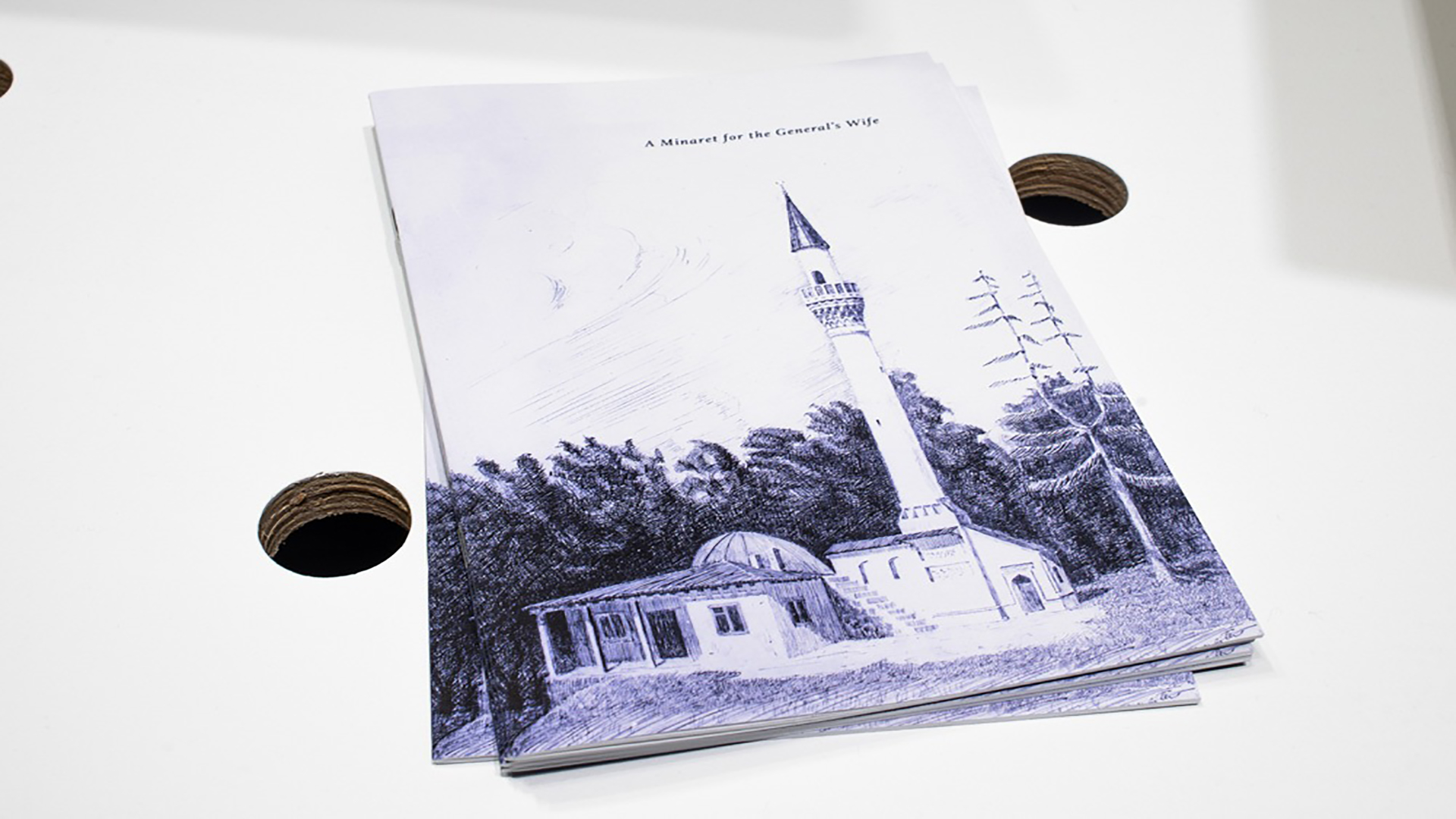
Towards the back of the room is a row of three CRT television monitors. Only the TV on the far right is on, displaying footage of Kėdainiai Town Park: grass, trees, sky, tightly cropped building features — everything but the minaret. I sit in one of the chairs in front of the monitor on the left, my reflection filling the empty screen, and read the booklet I picked up upon entering the exhibition — in it, a series of 12 vignettes, all but one written by the artist,4 each from a different character’s perspective (some fictional, others rooted in historical figures), and the majority written in the first person. Each vignette is tethered back to the physical exhibition through textual references. A few lines from the Lithuanian folk song playing in the background are translated into English in “Greta prepares to meet K,” a story about a young woman arranging to meet a lover at the minaret in secret because her family does not approve of his profession as a musician. The brass trumpet is suddenly infused with this forbidden romance and reading the haunting lyrics5 drastically shifts the energy I feel in the room. In “At the State Historical Archives,” gallery visitors’ inability to access the microfilm’s contents is mirrored in the researcher’s story of being at the archive. Through this experiential doubling the goal shifts away from discovering these hidden answers and becomes more about a sympathetic resonance between bodies. Various scenic details depicted in “Ilya Ptashkin describes Kėdainiai Park” are featured throughout the space either as photographs or tactile elements, like the cobalt blue laser-cut acrylic pond which reflects viewers’ faces as they study the form. Through these accounts, both fictitious and grounded in his own research experiences, Taşdelen elucidates an interplay between corporeal displacement (from one’s home country or family or residence) and the physical displacement of archival materials (mislabeled ephemera, inaccessible search engines, linguistic and technological barriers etc.).
Slightly off center of the exhibition space there is a circle of folding chairs in front of a cinematically designed exhibition poster. A denim jacket hangs off the back of one of the chairs and a copy of the accompanying vignettes has been left on the seat. This suspended scene evokes a collective reading, a group of people (or maybe ghosts) passing around the text, taking turns reading these narratives like scripts-in-progress, each subject conjuring another version of the story. Although each vignette is another account of a body out of place, be it a person, a document or the minaret itself, every form is permitted residence within the exhibition space. Yet the polyvocal comes with a margin for “error” and as narratives weave and overlap, contradict and complicate one another, we are reminded of the inherent instability of constructing “objective” histories.
*
A few weeks after seeing the exhibition, I talked with Erdem over Zoom. I asked him about the narrative slippage that arises in his play with fact and fiction and this additional layer of intersubjective slippage brought on by translation. He spoke about how there were times during his research that he turned to image-to-text translation algorithms as he does not speak much Lithuanian. I found comfort in this as I had been embarrassed by my usage of Google Translate’s image function to assist in reading both the Lithuanian and Turkish texts in the booklet. Taşdelen mentioned that by using automated translation programs you take on the role of surrogate translator. As your interpretations begin to more directly affect your understanding of the text, the source starts to drift farther from the original citation, slipping into that ripe liminal space between the intention of the signifier and meaning of the signified.
While working on this piece, I’ve been in Montreal having a long-needed visit with my grandparents. One afternoon I ask my bubbie if she will help me read the vignette written in Turkish, whose title loosely translates to “all the waiting was not for nothing.” Together we read the lines, some she translates word by word, other sentences she strings together. Sometimes she pauses, remarking,“This is not my Turkish, not how I would say things.” We continue through the text: the story is a first-person account of a foreigner, someone residing in a place where they don’t speak the language and is feeling out of place and lonely because of the linguistic and cultural barriers. The story describes an interaction between the speaker and a bird that leads them to wonder if the difficulty of this displacement is worth it and if, just maybe, everything is falling into place as it should. As we work together to translate the text, going from a gender neutral language to a one with a pronominal gender system, our interpretations begin to vary. I have been reading the text as a piece from Taşdelen’s point of view during his residency in Lithuania; his feelings of unfamiliarity blending with day dreams of what it might have been like for Totleben’s Turkish wife to reside there. But my grandmother gathers, through details I missed, that the narrator was likely a woman and someone who’d relocated to be with a lover.
As the two of us bend over this text, our voices mingled in the first-person narration, I am reminded of Eve Tuck and C. Ree’s Glossary of Haunting, where the authors use a composite narrator/combined “I”, tactically merging their voices to “double fold [their] wisdom and mask [their] vulnerabilities.”6 This glossary, which like the minaret is a host-less appendage, speaks to the power held within this fractal format, one that works outside colonial systems of knowledge production, that “includes the particular and the general.”7 This simultaneity is a means of counteracting colonial separation of embodied narrative onto land as well as hegemonic conflation of nationalism and place. Tuck and Ree allow their memories, histories, and personal experiences to blend and bolster one another through this combined “I”. In A Minaret for the General’s Wife, I see Taşdelen deploying a similar tactic by inviting the audience into the composite form to fill in the narrative gaps provided. By setting the stage, Taşdelen allows the collective “I” to bridge the sense of displacement that begins with the lonely minaret. With polyvocality acting as a salve, the viewer is invited to depart from the isolation of single point-perspective and move towards an alternative collective form of narrative building.
A Minaret for the General’s Wife continues at Richmond Art Gallery through July 31, 2022. Check out the exhibition hours and online materials.
Notes:
- Folly (in architecture) is an expensive ornamental building with no practical purpose, especially a tower or mock-Gothic ruin built in a large garden or park.
- Sura Al-Baqara, verse 255 āyatu-l-kursī which translates to “Who is it that can intercede with Him (God) except by His (God’s) permission?”
- The recording was taken in Turkey between 1932-1950 when a reformation law was passed requiring the Adhan be translated from Arabic to Turkish as a means of encouraging secularism in the nation.
- Vaikystė was written by Fausta Krasilnikaitė.
- “Life is hard for people of this world / squeezed from all sides by worry and troubles / from sadness heavy and hard / hard not to cry when your heart is crushed.”
- Eve Tuck and C. Ree, “Glossary of Haunting,” in Handbook of Autoethnography, ed. Tony E. Adams, Stacy Holman Jones, and Carolyn Ellis (Routledge, 2013): 643.
- Ibid, 640.