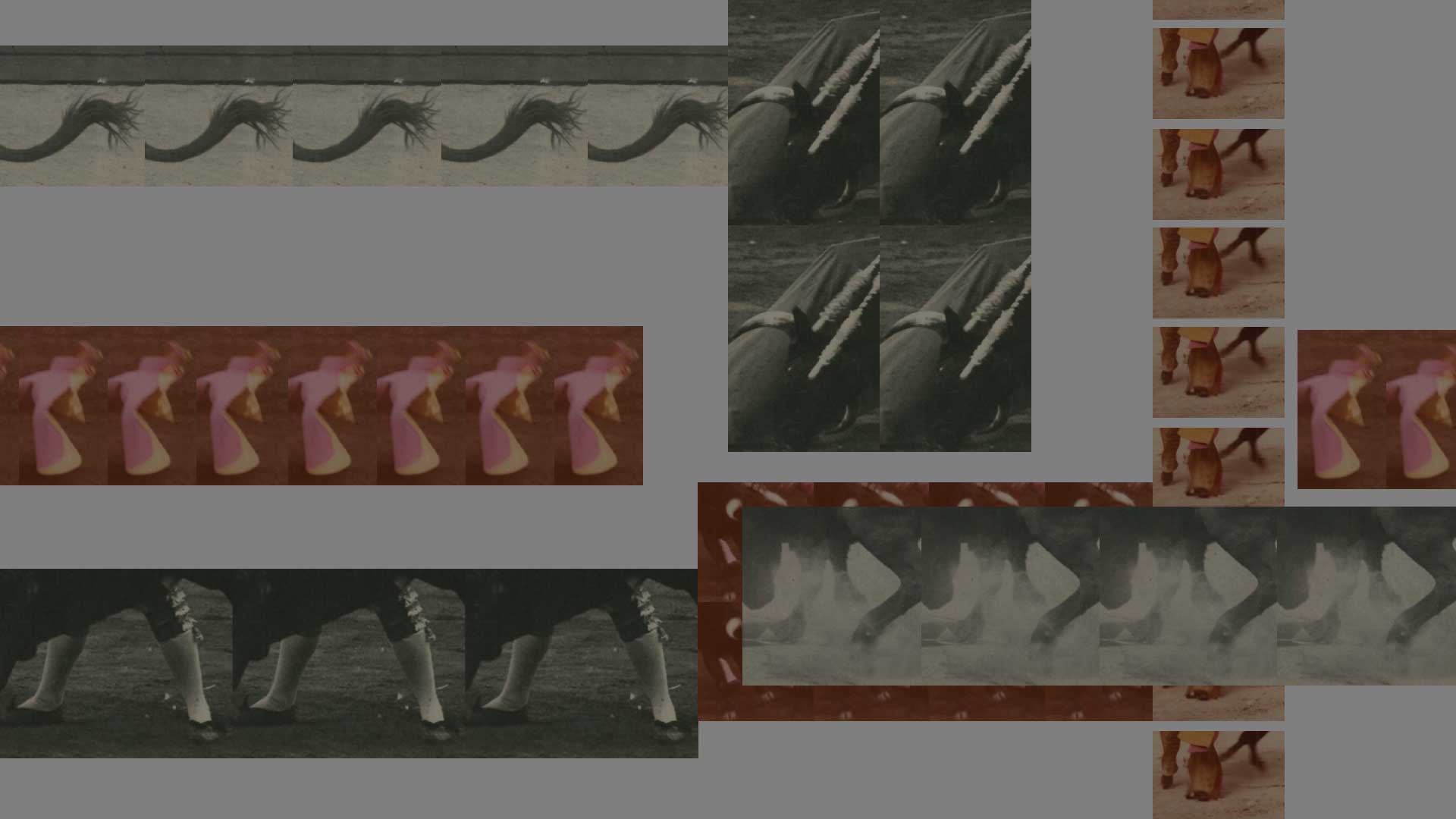
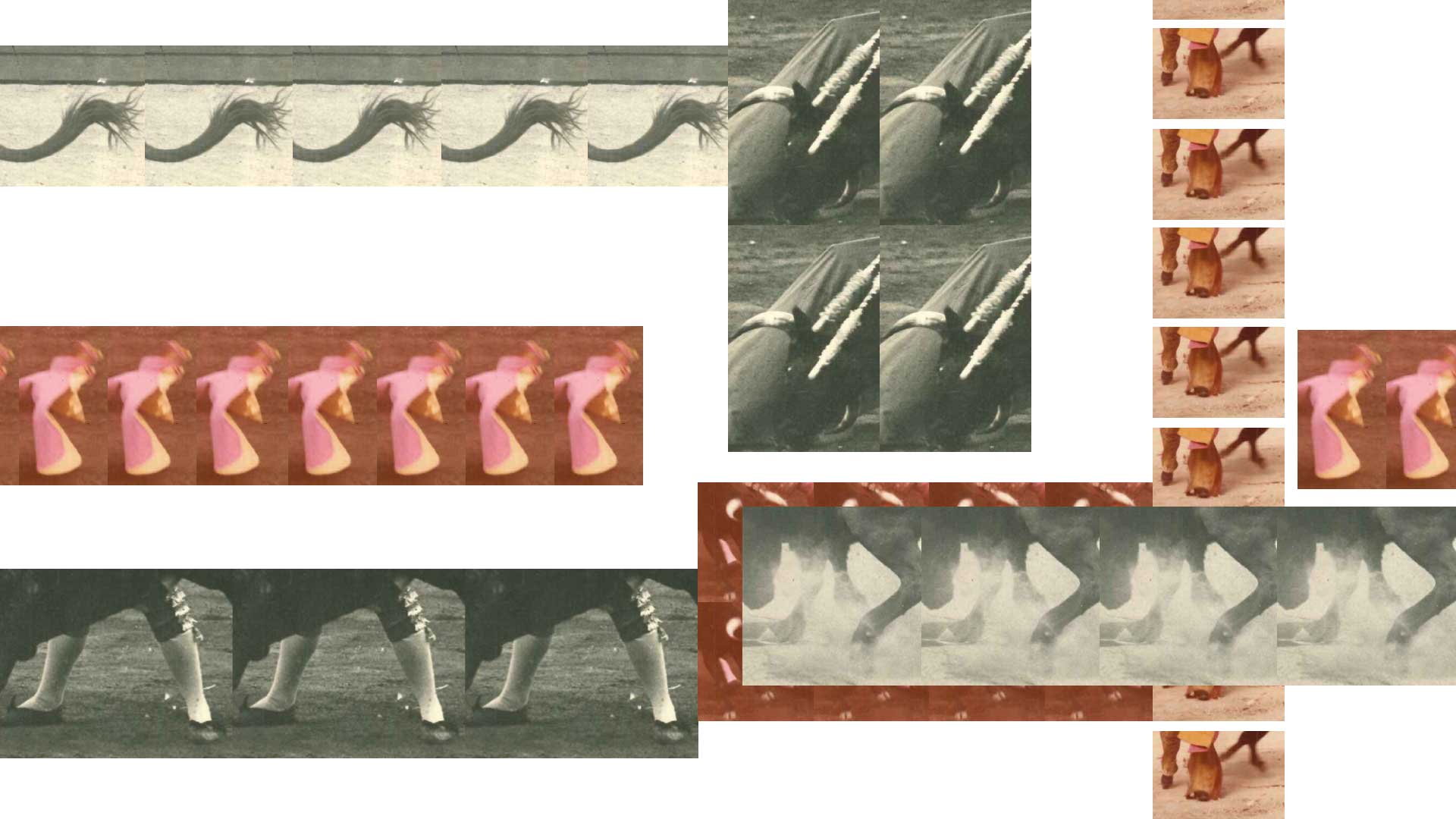
At 2018’s iteration of the Vancouver Latin American Film Festival, preceding the documentary film, Devil’s Freedom (Dir. Everardo González, 2017), I caught filmmaker Francisca Duran’s experimental short, Suit of Lights. In an impactful 18 minutes, Chilean-Canadian artist Francisca Duran crafts an expressive documentary utilizing archival footage of a Spanish bullfight which the artist buried in soil, unburied and re-assembled. Along with this abstracted imagery, Duran incorporates texts by Susan Sontag, Alice Miller, and a poem by her father Claudio Duran, textually and sonically probing at spectacularized perpetuations of cruelty. Along with Devil’s Freedom — a Mexican documentary presenting intimate testimonies of lived violence resulting from the country’s ongoing drug war – this program brought into sharp focus the haunting reverberations of sensationalized violence that are carried out through Latin America, in spite of a seemingly desensitized visual culture. Both films subvert the expression of a visual language that carelessly disseminates and reifies sadistic fantasies as an unshakable legacy of our collective imaginary.
While my memory of Devil’s Freedom has faded, the image of Duran burying and unburying strips of 16mm film still lingers, and I return to the symbolic nature of this act. Suit of Lights meditates on the ephemerality of the film strip, and in turn questions the tactics that allow cults of spectacle to retain their permanence.
Having grown up with a now fading connection to bullfighting, the tradition has been an intimate part of my family’s vocabulary and universe for generations. The techniques employed in the film helped me frame personal ghostly remembrances of the spectacle, so that I may begin to formulate the question of how we can reckon with violent echoes and invite their re-readings via strategic appropriations and activations of the past.
*
The sounds in the plaza were always the same — first the trumpets, then the 400-kilo trot, persistent insults and adulations, from time to time the song of the vendors. In this ancient corrida, the noises are muddled together in a monotonous whine, trudging along like machinery bound to an infinite loop or an old, fatigued film projector, reeling film as old as itself.
Every movement on screen is repeated.
My father would hurl ‘Olés!’ at the screen, qualifying the skill of the matador’s strikes to the bull.
For the taurine aficionados, the pases in a bullfight are hauntings, performed vocabularies for predetermined movements, shouted over and over again in order to materialize a tradition and their role within it. For every pase, spectators moralize a stabbing or tear at the flesh by calling out its specific name: an anticipatory, “Veronica!” or a dramatic, “Chicuelina!”
The breeding of bulls for their ferocity enlists the matador in a self-assigned fight between wildness and technique, only resolved in front of an audience. Ever subservient to each other, torero and crowd make their appearance on screen caught up in a ceremonious cycle, further reinforced by the film’s use of Kuleshov assembly. The faces in the plaza stand uncannily still in an eternal performance, freezing every minute detail of its past in the present. Cruelty flows perpetually through the spiral of the plaza, travelling from the seats to the center of the ring and back outwards.
The iconography of suffering has a long-standing pedigree that begins with liturgy, our interminable compulsion requiring: cleanliness, posturing, and restaging.
To arrive at ecstatic death.
The fresh whitewash traces concentric circles to delimit the insides,
the pasodoble resounds the ground it once profaned,
the crowd waves its white handkerchiefs in the air,
the juez de plaza grants glory with an ear or a tail,
the sand rakers cover up any traces of slaughter.
My grandmother would take my father to the Plaza Mexico as a baby. She would carry him in her arms in the company of cigar-smoking men and elegant ladies wearing their Sunday best, these details became ritualized in my father’s life.
*
Re-assembling in a draggy and hypnotic manner, Duran plays with continuity and abstraction, spinning the bullfight out of order, cutting it, repeating it, obscuring it. The memory of the plaza seems further away; something else reveals itself as the imagery disappears and reappears more fragmented with every pase. The footage is unheimlich, a reddish tint obfuscating the colours of capes and banderillas, pink lycra, and suits embroidered in gold. Every ostentatious object is washed over by the tinge of blood he seeks to draw out. The high contrast print of the film obscures the fabrics, furs, and dangly-adornments that would otherwise shimmer underneath the sun, brightening the sand-filled ring and the figures around it in the same glowing intensity.
Sitting there in the open glare of daylight as a young child surrounded by decorum, I recall how the barbarity of the spectacle would subtly creep up, lulled by the leisurely sleepiness of a weekend afternoon.
The layers of significant thickness begin to peel away, the recognition of oppressive symbols and rituals becomes easier once they are pulled away from their sacrosanct theatricality. Still, the genetics of titillating aesthetics is hard to transcend. Dismissing the complementary relationship between the two mementos, sometimes I would wish my father had kept one of his shiny traje de luces, instead of the terrifying severed head of an eral he killed at 17, whose vacuous glass marble gaze would meet mine every time I climbed up the staircase at my grandmother’s old house.
Unlike how my family kept the eral, Duran rejects this taxidermic impulse to immortalize. Instead, her investigation of the corrida emerges from the ground, where the artist’s rephotographing of the unburied celluloid re-animates the archive by way of forensic examination. The ritualized combat between animal species takes on a deeper level of signification: bugs versus filmstrip, film inevitably losing its omnipotent power once its materiality has been eaten away by microbes and worms.
The gusanillos feed on once proud and zealous nationalism1 contained in those film reels to leave behind scratches, silences, and empty spaces.
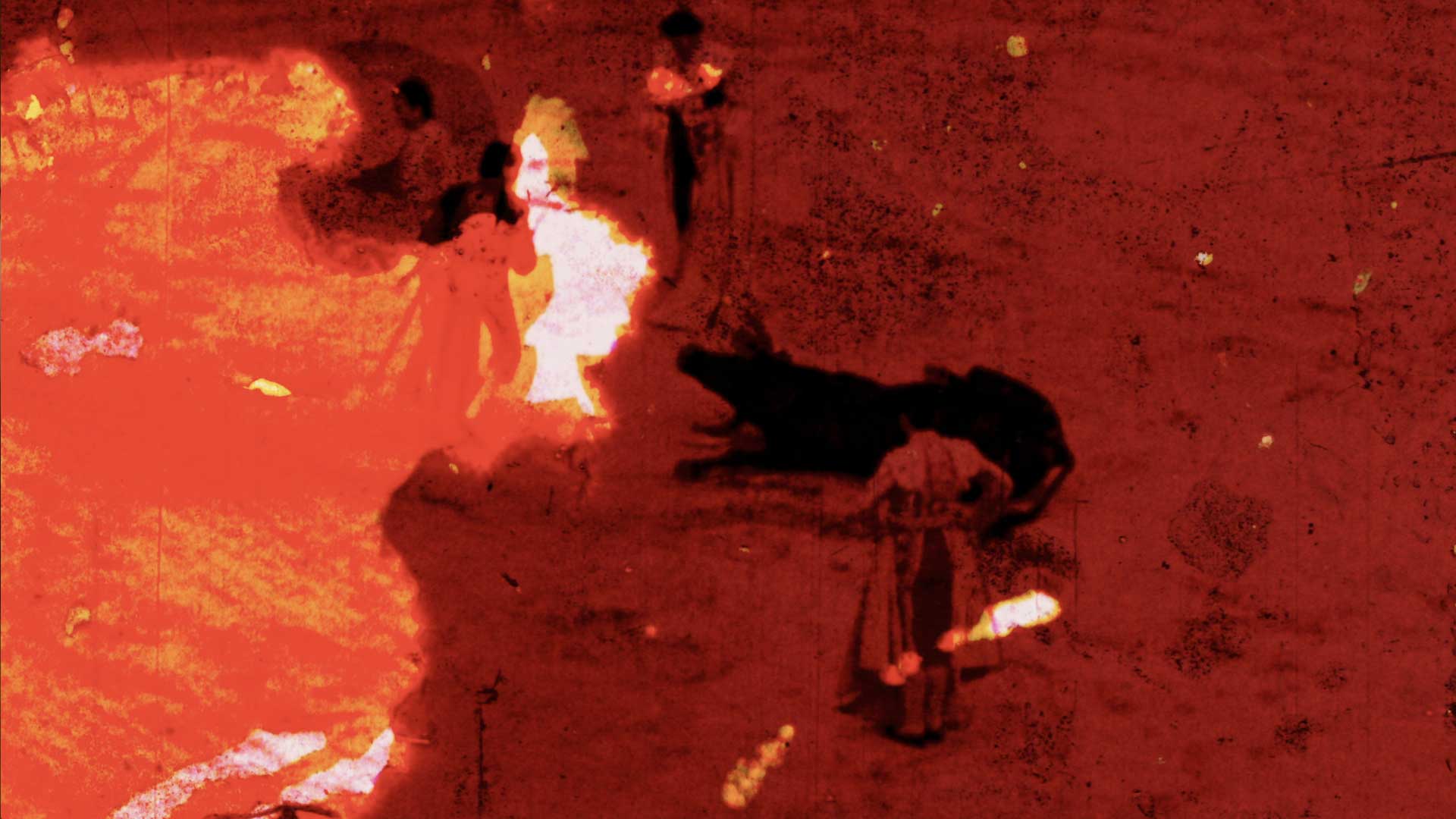
From the silence, a paternal voice recites lines by poet Claudio Duran; along with the translations on screen, a denouncement is made. The voice of the poet is worn by time, the denouncement has been resounding for decades but is still fervent in its unresolved plight. This impassioned language contrasts the fragility of what is seen, the authority of the image is challenged as lines of text enclose the struggle of the moribund bull in between. The corrida becomes a footnote to the words, fading in its bravado. Growingly fuzzy silhouettes fight against the relentlessness of each other’s lethal movements, torero and bull appear as mere specks in the void of decay.
The disembodied voice reveals the taxidermy of executed ghosts, resentful that the pinnacle of nationalism masked as art must involve the spilling of blood.
Layered scratchy scenes replay on top of themselves at disorienting speeds.
The pageantry of the corrida is intoxicated and swollen from its own excesses to uncharted depths. The assemblage conjures an exhausting discomfort.
Interrupted in its horror of disorder, the image finally gives into its fatigue, enveloping the viewer in an all-consuming emptiness. The only consistent abstraction of light in the 18-minute film appears in closing, as a stream of yellow light running horizontally across a now blank screen. Words by Alice Miller etched on the reposing footage confirm the suspicion that “the roots of violence are not unknown.”
*
Loaded with both catholic piety and an oppositional poetic grandeur, my grandmother would often exclaim, “I’d rather have a dead son than a son who would cower in the ruedo!”
The poet’s voice explains that the truth of our shared excesses is like a splinter buried in the flesh, a lodged-in yet dismissible discomfort. Aficionados often will say “[bullfighting] is a contagious profession.” It would seem that their truth is more like the gusanillo, a worm that travels alongside roots unplanted, to be transported to spread into new soil. Carrying the culpability of our bad manners, responsible for infecting the body of those it enters with heroic ideations and the dispossession of any moral or faint-hearted reservations, the gusanillo is another word from an imposed, borrowed and mutated vocabulary, edifying myth as truth. Duplicating itself and burrowing inside a new home, it is the dutiful inheritance of archaic art forms, the legacy of great grandfathers fluttering into grandsons’ susceptible ears.
I was always bound to be an out of time observer, more so late to the function rather than overstaying my welcome, as aficionados seem to be nowadays.
“Hardly anybody goes to corridas anymore”
my father lets me know, condemning the fact that the decline of the spectacle has forced him to consume it in less tantalizing ways;
“The encanto doesn’t translate over computer live streams”
he tells me.
A corporeal extension of that contained by layers of film emulsion, the torero is also ceaselessly eaten away by the gusanillo, gnawed off gaps only satiated by an enactment of violence. This continues by his own accord, long after he has renounced his traje de luces, as his containment has become compressed into glitchy pixels.
Just as in front of a frozen bull, my father’s fascination left him with one extended hand, the other behind his back, and a foot planted firmly on the ground beginning to sink in quicksand, just as the seats in the plaza began to empty. The lasting physical connections to the tradition existing beyond the realm of pure memory are worn out family photographs. Immortalized in them is a doubly naive yearning: for a future that is not to come, and a past that is no longer honored.
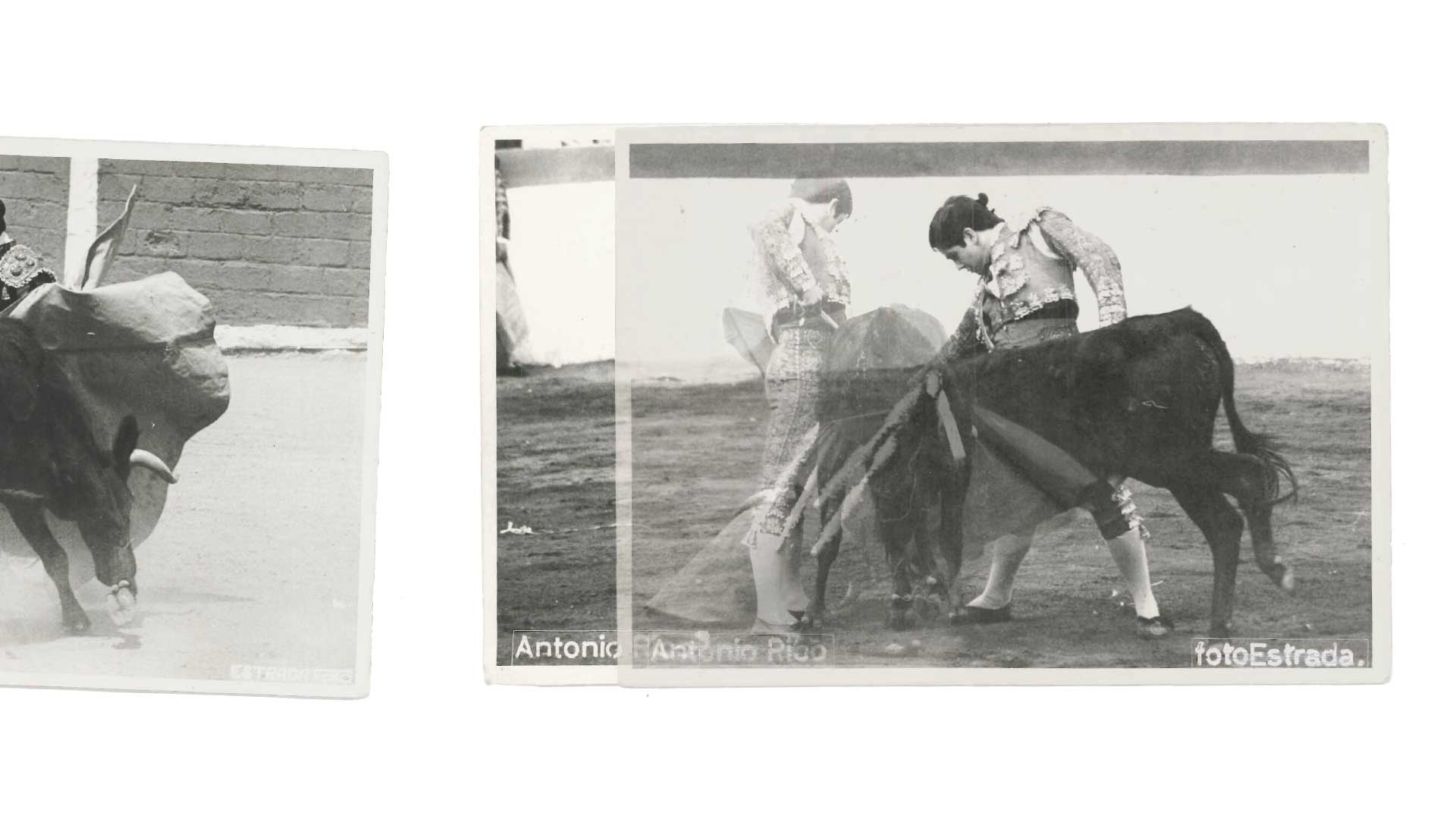
Caught in between the layers of mediation both personal and archival, wanting to throw a white sheet over my family’s heinous activities and displays of chivalry that time has now turned defunct, I dig up these memories with reluctant complicity. I pry and judge with a vision sometimes obscured by blinders, like those bound to the horses before they enter the ring, and more often like those of a child haphazardly peeking at a goring through the space between their index and middle fingers. Trudging along a path of slippery moral judgments, I dwell on the photographs’ antiquated and masochistic beauty, secretly hoping that my familial proximity will grant me access to unlock and redeem their mysticism.
Materializing that which I have only heard about, I recognize my father in a displaced majismo, caught in a cloud of dust kicked up by a bull’s hoof, in a cape’s undulation in the air, and with the rigid angling in of his sword — he is blurred into an archetype acting out a frigid and century-old expression. Everything and everyone inside the rickety provincial plazas are preserved in a similarly unreleasable tension. Inviting a self-prescribed reckoning, I air out the drawer of these hidden away photos that safekeeps a shut-in mystique. The act of unearthing images signals a type of yearning. With the soundtrack of words lifting the dust off an unburied object, it is born from an impulse not to return to but to spectrally liberate that which has been inscribed in memory.
The torero, with his own ideas about art, traces over with a pointed weapon, repeating and perpetuating those inscriptions latently embedded into the consciousness inside and outside of plazas. The poet uses words to sober the bullfighter’s dizzying showmanship, each one lances words or swords for contradictory ends, tearing away or laying bare the remains of something carcomido. Undertaking a laborious process to obscure and reimagine bullfighting, Duran refutes the corrida’s inevitable end, tragic in every one of its previous iterations, to probe and sharpen our nostalgia speckled vision. Turning the melancholy-poisoned gaze onto the document itself, the process of respinning and refracting the violence therein contained allows for a catharsis without the escapism of glory or defeat. Here, a solemn requiem becomes possible.
Notes:
- The footage used in Suit of Lights is from a bullfight in Spain during a time when the country began its difficult transition to democracy following the death of dictator Francisco Franco. The display of nationalism that Duran points to is woven into this history and also implicated with the history of colonialism and the autocratic regime of Augusto Pinochet in Chile. See: Tara Zanardi, Framing Majismo: Art and Royal Identity in Eighteenth-Century Spain. Penn State University Press, 2016, JSTOR, http://jstor.org/stable/10.5325/j.ctv14gp8ff.
In the case of Chile and Mexico, among other Latin American countries, bullfighting has a similar history where the tradition was imposed by the regimes in power and consequently taken up as a symbol of national pride.