

This piece has evolved from a performance in April 2022 with Ghazal Abdolhosseini, who wrote and was unable to perform their own speech as Vice President due to COVID19. The premise was to imagine what we would address if we were the President and Vice President of ECU.
With gratitude, I have lived most of my life on the stolen and unceded Lands and Waters of the xʷməθkʷəy̓əm (Musqueam), Sḵwx̱wú7mesh (Squamish), and səl̓ilw̓ətaʔɬ (Tsleil-Waututh) Nations. I am a child of Sarah, Rivkah, Rachel, and Leah; of what is commonly called ‘Jewish’ ancestry; and born of multiple forced diasporas, relocating as an uninvited guest on many Lands and over several generations. I am here in the legacy of my grandparents and great-grandparents’ arrival on Turtle Island fleeing genocide in the USSR, Poland, and Lithuania in WWII — I am grateful for how this Land has held us. At the same time, I feel the need to acknowledge that the Canadian and American systems through which we were welcomed here are predicated on colonialism and occupation of stolen Land. I recognize that the systems which ‘allow’ me to occupy stolen Land do not serve any of us, as capitalist-colonialism breaks apart systems integral for the sustaining and nourishment of community. Although these histories are fraught with complexity, my politics ultimately reside within the framework of LAND BACK.
In what follows, I will outline three examples of how artists have been exploited or extracted via the hegemony institutionalized by Emily Carr University of Art + Design (ECU). Crossing the boundaries of student/instructor/staff, ECU’s bureaucracy does not serve the vast majority of those who provide the often invisible labour to ensure that the school delivers on the services it promises. Students, who are not employed by ECU, as well as sessional faculty and front-line administrative staff, usually supply this labour without pay as it resides outside of their job description. This labour includes: advocating publicly and in private for the environment to be more hospitable to people who aren’t cisgender and white; meeting the demands of this advocacy through piece-meal special topics courses; providing wellness check-ins; peer representation in meetings; editing corporate-coded official statements; and giving advice to students on how to navigate politically charged situations. Beyond this labour provided freely as an exercise of one’s moral consciousness, it is exploited as an aesthetic of ‘community,’ a marketing tool, and a philanthropic cause for gentrification. While there is an often unspoken pressure to keep issues in-house at the small university, I have been jaded by the bureaucracy in place to deal with complaints and grievances. What follows are only examples of systemic challenges that are beyond the scope of individual intervention — they speak to the larger issue of corporatization of the arts and post-secondary institutions.
1. Deadnaming
The first case of labour exploitation at ECU has been a direct experience. It has been a slippery slope since my initial optimism at seeing the university’s general neutral bathrooms during my first days at ECU. Before I legally changed my name, every new set of instructors required me to send an email in advance of the start of each semester to avoid being deadnamed for roll call — but even then, professors would consistently use the wrong pronouns. Leading up to my graduation from the Bachelor of Fine Arts program in 2021, I was active in advocating for two of my trans friends who were worried about how they would be named at convocation — they had changed their preferred names years before graduation, but were still being deadnamed by the institution. After being promised by administrators that this would not occur, both friends were indeed deadnamed during their graduation ceremony.1 With acknowledgement that assessing the scope of legal versus chosen name requires research and time, in the aftermath I consulted with the administration and recommended a stopgap: for the graduation committee to solicit students’ chosen name for manual entry into online systems.
When I initially posted on Instagram the issues I was having around convocation deadnaming, there were multiple people with whom I corresponded. Over the course of a couple months, people fell away due to exhaustion and pessimism; my close friend who was deadnamed said to me that they just didn’t have the energy to fight anymore. This exhaustion plays a significant role in all our mental health, particularly for those who have already experienced oppression and are reluctant to speak up. Students, staff, and faculty who wanted to push for positive change became so overworked; the collective energy necessary for activism proved impossible to maintain in the long term.
Two and a half years later in October 2023, a wepbage called “Chosen names at ECU” was published, addressing the issues that were raised, presumably after consulting with other trans and non-binary folks. I still find myself conflicted about this win, as the corporatized language of this page does not take responsibility for the trauma inflicted upon trans students, acknowledge the labour that spurred this change, nor honour those who consulted for the process that supported the trans-informed result.
2. Inclusion on Their Terms
The second case of exploitation is in the university’s treatment of its BIPOC staff and faculty, many of whom are precariously employed under sessional contracts. ECU has proven it has much work to do in order to provide an anti-oppressive environment for BIPOC staff and faculty members, as publicly exposed in the fiasco that was the administration’s attempt at an “Indigenous cluster hire” — a quickfix strategy that numerous universities have adopted following the 2015 Truth and Reconciliation Commission of Canada’s 94 calls to action. Michelle Cyca, a staff member who left ECU, wrote an article published in Maclean’s on pretendian Gina Adams’ hiring during this trend. About the school’s culture, Cyca states:
As a staff member at Emily Carr, I believed that although I could voice my concerns in private emails and conversations, I would almost certainly lose my job if I were to join my Indigenous community in publicly calling on Adams to explain herself. Despite their promises to Indigenize, universities require their Indigenous staff and students to comply with the institutional ways of doing things. Our inclusion is always on their terms. And their reluctance to act in the face of widespread identity fraud suggests that their primary concern is always for themselves: their reputations, their rankings, their finances.2
ECU practises inclusion on their terms through their systems of identification: rank,3 race, gender. This is how diversity is tokenized and used to publicly signal that the institution has done their due diligence. For example, two Indigenous professors who spoke to Adams and “believed her to be truthful,” were “apparently enough for the administration to consider the case closed.”4 These insidious and largely invisible systems of oppression within ECU’s pristine white hallways repress the democratization of knowledge within a university that prides itself on being “a worldwide centre of excellence in art, design and media education and research.”5 Cyca eloquently highlights the colonial strategies used by the institution designed to break up intersectional coalitions for fear of political and career consequences. For those of us who continue to fight for inclusion on our terms — that is, an inclusion not structured by the reputations, rankings, or finances of those in power — Cyca’s article gives mainstream, journalistic evidence of systemic challenges faced by those providing invisible labour within the system.6
3. Artwashing
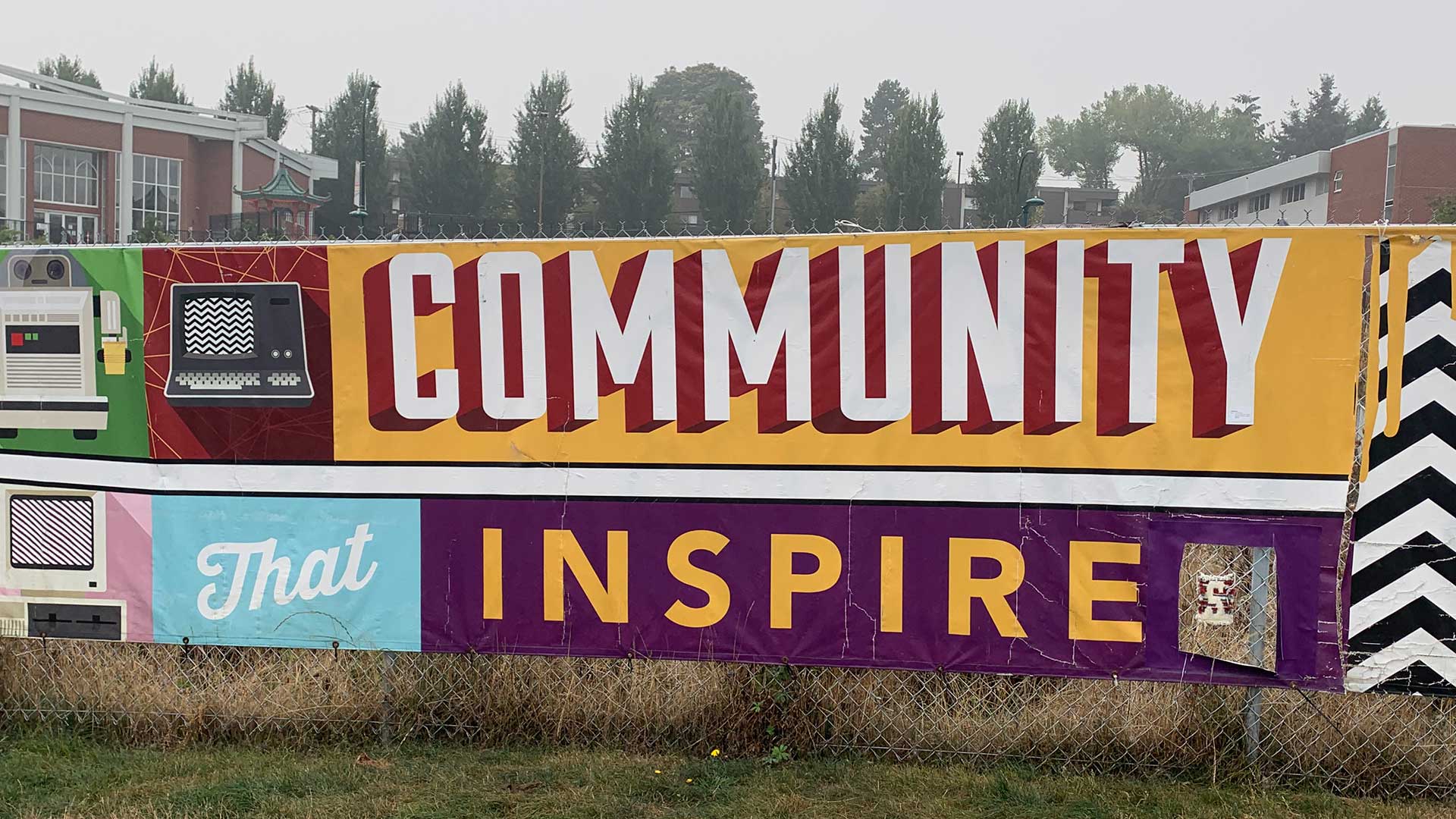
This leads me to my final point, that the goals of ECU’s leadership are clearly in conflict with the goals of the institution’s community made up of students, staff, and faculty. Turning focus onto the ECU campus itself, the school serves as a successful implementation of the City of Vancouver’s False Creek Flats Plan. In typical colonial fashion, the donors who have largely financed the city’s gentrification plans for the neighbourhood have been honoured by having campus spaces and amenities bearing their names. Reliance Properties donated $7 million for the capital campaign to build the Great Northern Way campus and is the namesake for the Reliance Theatre. Chip Wilson, of the Chip Wilson Plaza outside on the first floor, is co-founder and CEO of Lowtide Properties which is the development firm responsible for South Flatz — the office buildings and current construction site just east of ECU. Several faculty and staff I talked to privately indicated that former ECU Presdient Ron Burnett was responsible for shifting the university to its current business-focused model of schooling; his name is on the Library + Learning Commons.
These investments matter because investors have realized that our schooling is in their best financial interest; their names throughout the campus is indicative of the priorities for those with decision-making power. Students and alumni — ‘emerging artists’ — are indoctrinated to paint pretty pictures on buildings7 as a part of the process to increase market value in a twisted logic whereby artists and art workers beautify spaces they can no longer afford to inhabit, let alone pay off student debt. Most arts workers I know cannot afford to live in the city and don’t make ends meet on artswork alone; precarious gig-work is a normalized part of the industry. According to livingcost.org index for Vancouver renters, the monthly cost of living is $3358 for 2023, while a 35-hour week at minimum wage amounts to just $2,345 monthly. The same source touts Vancouver as one of the most livable cities in the world, and those who work in arts and cultural sectors are part of what makes it so.
*
Going on three years since my graduation, I still find myself invested in the ECU community. The strong feelings I hold about how students, staff, and faculty are treated are rooted in a care for the people here, and the parts of the ecosystem that have reciprocated this care. This speech recounts some of the experiences I have had first-hand, and quietly witnessed, during my time as a student and immediately after graduation. I believe that better things can be achieved, but from experience, the official channels have proven inadequate to realizing the inclusion and equity its community wants and deserves. We, who have been exploited by institutional hegemony, are still doing the invisible labour so we can survive such an environment. We do this work without credit, and as an alumnus, I am in the position of being now outside the institution so that I may offer this critique publicly. The ‘Indigenous cluster hire’ and related departure of multiple BIPOC staff and faculty members over the last three years show how oppressive the working conditions are at ECU, and is intersectional to the oppression experienced by myself and my trans colleagues, including students. The use of the students, staff, and faculty — the ‘human resources’ — to artwash the investments of ECU stakeholders must be continually brought forth to the public. Those of us who have spent years of our lives dedicated to the belief that art should be for everyone as a means to engage critically with the world — to even make the world better — are left to continue this survival work until the operations of this economy changes from our actions. We deserve better.
Notes:
- As someone who has changed their name, I was able to avoid this situation only because I legally changed my name months before graduation. This is a privilege I had that is not accessible to all trans people.
- Michelle Cyca, “The Curious Case of Gina Adams: A ‘Pretendian’ investigation,” MacLean’s, September 6, 2022, https://macleans.ca/longforms/the-curious-case-of-gina-adams-a-pretendian-investigation/.
- Undergraduate, Graduate; Teaching Assistant, Sessional Instructor, Lecturer, Associate Professor, Professor; Temporary Contracted Staff, Contract Staff, Regular Staff.
- Michelle Cyca, “The Curious Case of Gina Adams.”
- Emily Carr University of Art + Design Institutional Accountability Plan + Report 2021/2022 (Vancouver: ECU, 2022).
- For example, “Raymond Boisjoly, a Haida artist and former assistant professor at Emily Carr who participated in the cluster hiring process….emailed Adams, suggesting that he connect her with an Indigenous colleague skilled at genealogy.” See: Cyca, “The Curious Case of Gina Adams.”
- Art and design students are frequently involved in urban-development based arts opportunities, the Vancouver Mural Fest being a prime example.