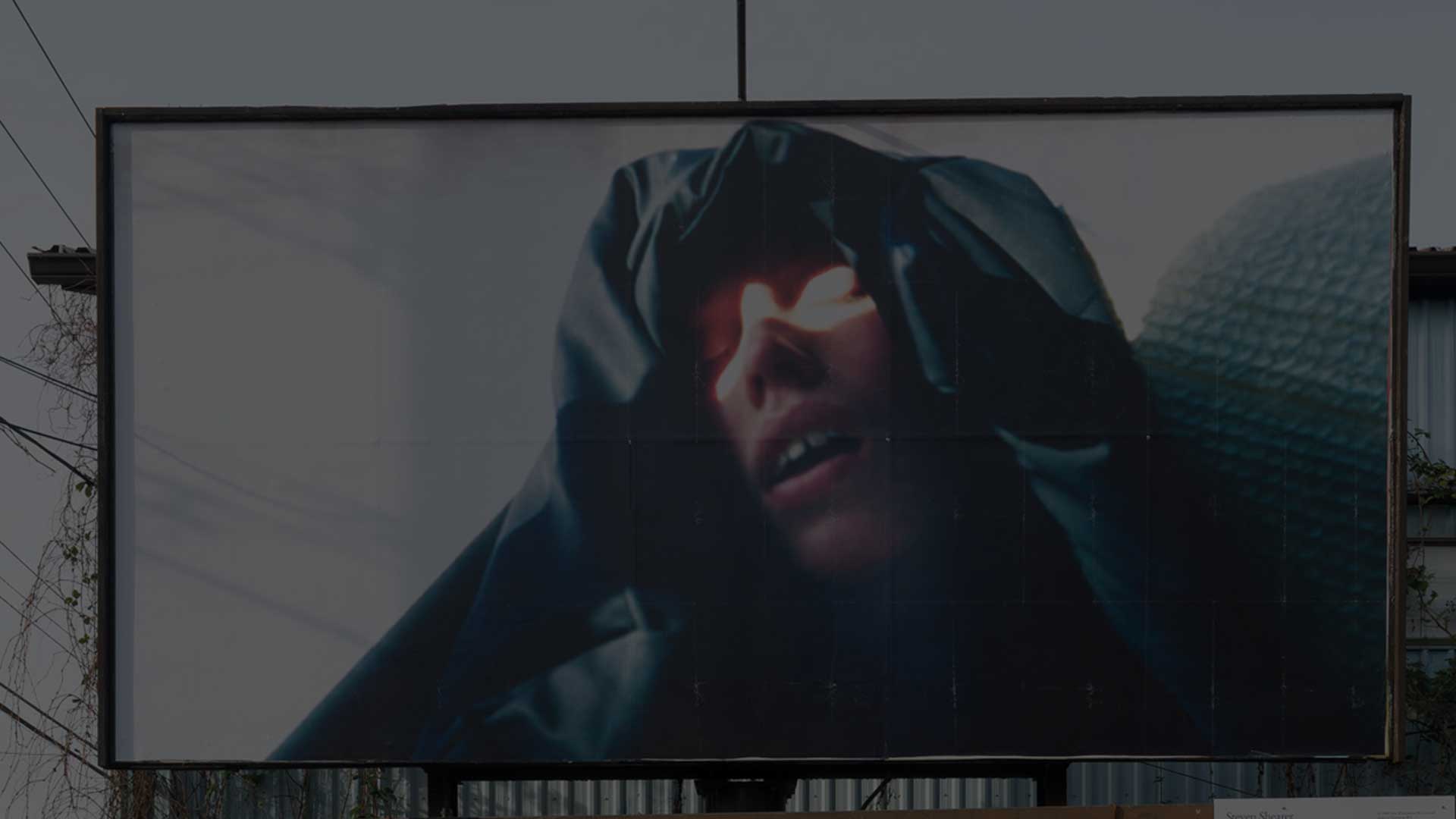
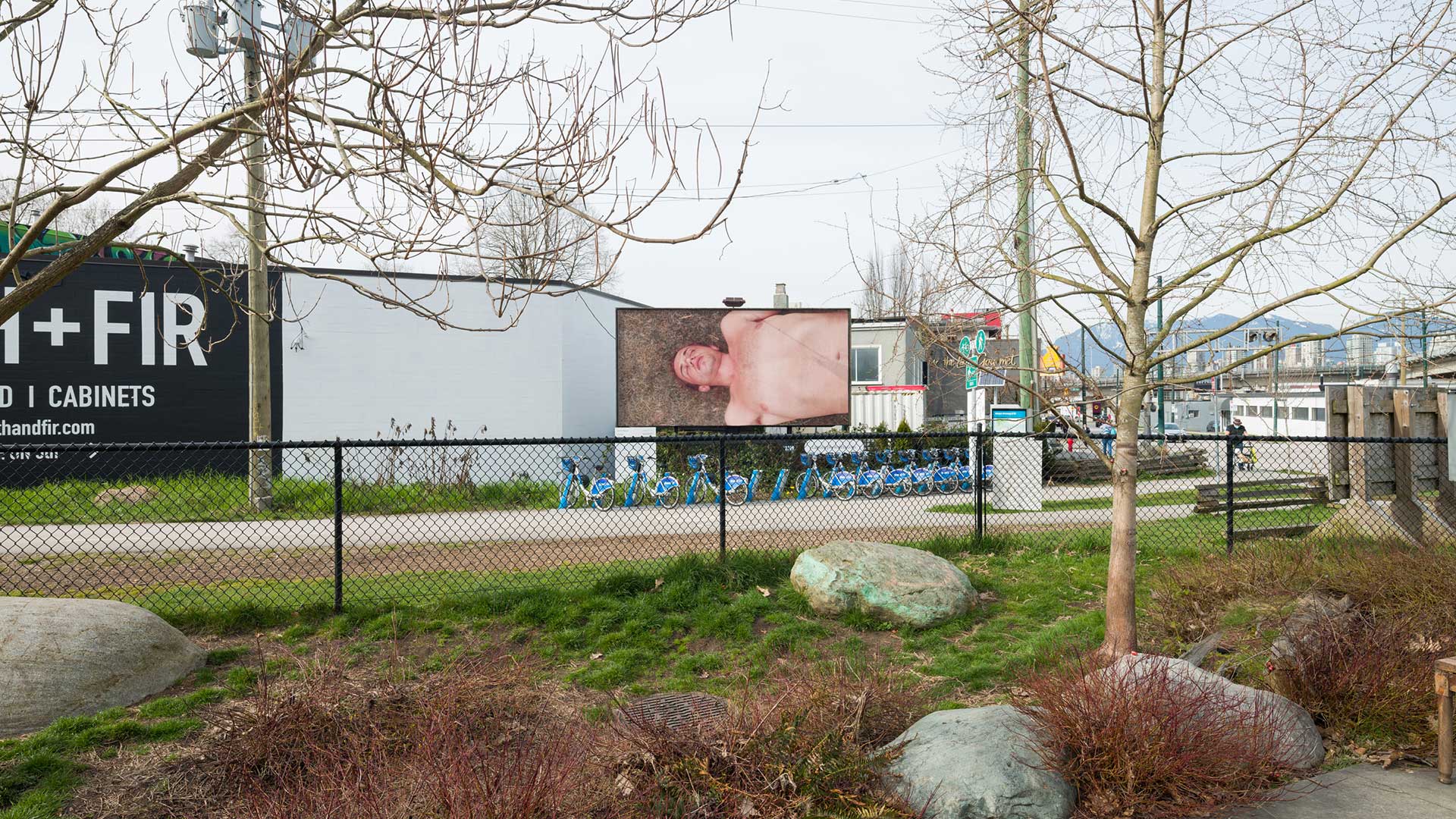
The subjects of Steven Shearer’s Untitled (2020) have soft, supple skin that convey a sort of anti-gravity. Their bodies are eerie in their perfect stillness: eyes closed and mouths agape — at all hours — semi-exposed in their (most often) mobile surroundings. These people are dreaming. I can feel their REM eyes fluttering in place: in cars, busses, trains or wherever — even the dirt. Cat naps, sun strokes, or travel fatigue? Regardless of cause, the effect certainly fulfills the curatorial statement’s promise: each subject appears to have been “released of their earthly bonds.”1 Originally installed on a series of commercial billboards along the Arbutus Greenway, Shearer’s found images are so terribly beautiful that I can’t imagine seeing them at such an enormous scale.
I write ‘I can’t imagine’ because they were removed by the time I walked past. All I could do was marvel at the size of the billboards as I considered the images’ absence.2 It feels a shame that Untitled was taken down only 48 hours after its Capture Photography Festival debut, but it makes sense that the public/private context of the global pandemic, amplifying city-wide tensions of a severe housing crisis, was bound to complicate the series’ meaning — or at the very least, the way the ‘uninitiated’ might encounter them in the open.
To say that Shearer’s billboards were poorly received is an understatement. Both festival founder Kim Spencer-Nairn and festival curator Emmy Lee Wall have been quoted calling the complaints “vitriolic.”3 The images allegedly stirred reactionary responses in their unsuspecting viewers, ranging from feelings of queasiness to the macabre. Reading Wall’s statement — which was attached to a handful of the billboards — might have abated a few concerns, but this may not have been easy to do for someone swiftly cycling past.
It’s a strange enough time to be in public, never mind confronting monumental images of unconscious bodies. As I walked toward the now Shearer-less billboards, I had to give a wide berth to a handful of other people. We all wore face-masks and shuffled from side to side so as to avoid each other. The now-normalized etiquette of ‘6-feet apart’ hasn’t in a long time reminded me of the analogous measurement ‘6-feet under,’ but Shearer’s removal somehow made this plain.
Could part of the reason the public responded so aversely to the images have to do with the figures’ gaping maws? Their unmasked mouths, breathing softly (or potentially not),4 posing a threat we’ve by now been conditioned to fear above little else. Capture’s statement suggests that the images invited members of the public to notice the subjects “heightened level of vulnerability,” but this may be experienced tenfold by the average viewer, after being continually petitioned for over a year now by government health officials to mask up and conceal their moistened danger.5 The exhibition’s timing could not have been more delicate, as the third wave’s numbers rise.
Contemporary art ought to push boundaries, but when that boundary is death during a global pandemic, pushing may be interpreted as crass. After all, for the culturally ‘initiated,’ Shearer’s images are simply more accessible. Art communities may be more prepared to relish in the figures’ ethereal beauty, to decode the artist’s subtle nods to religious iconography, and to bring a willingness to understand Untitled, especially when approaching them through the framework of Capture as a reputable festival. Can the same enthusiasm be expected from folks just walking by, who (whether they are contemporary art enthusiasts or not) are more than likely trying to forget their currently-heightened risk of falling deathly-ill?
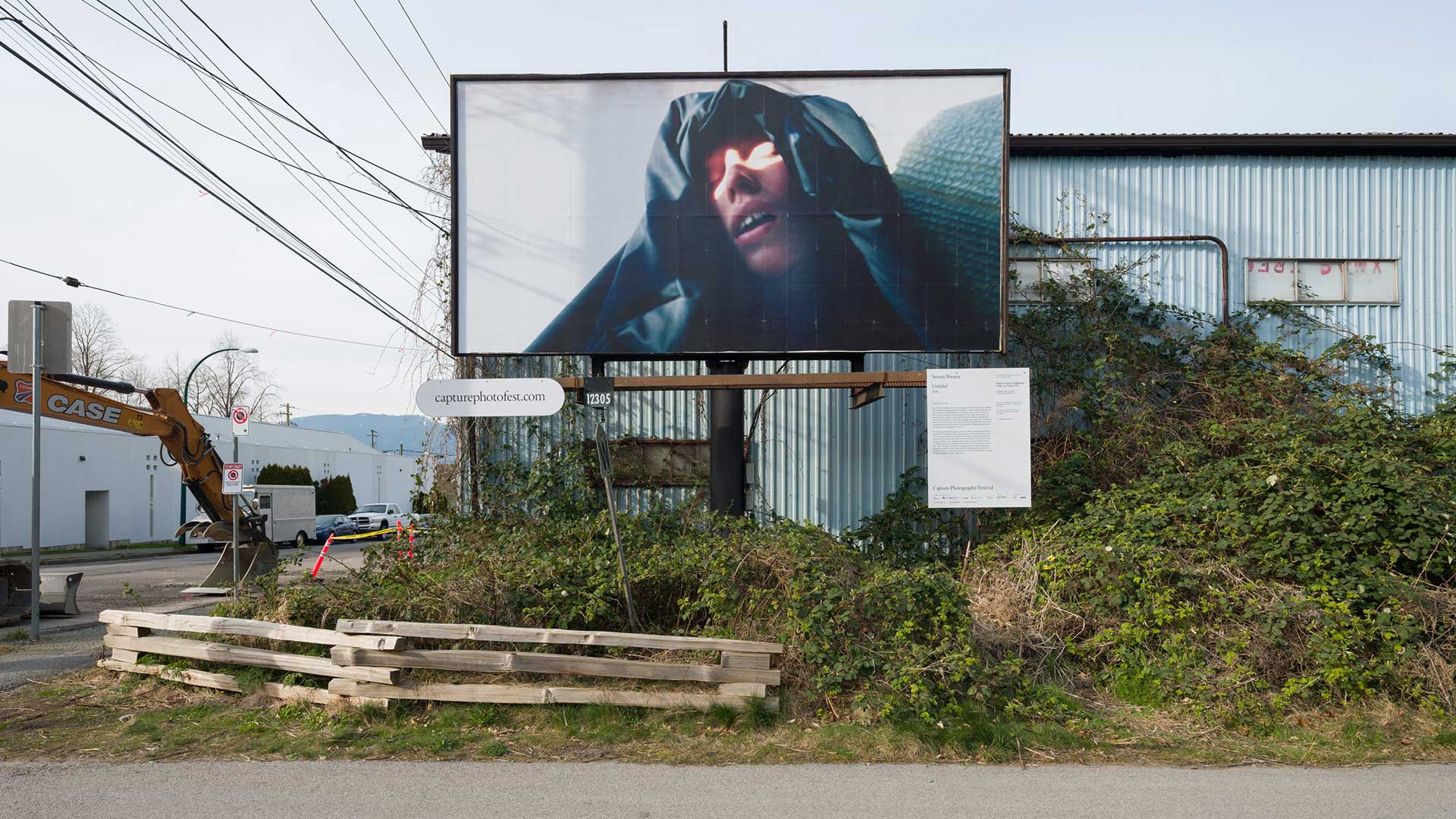
While I understand the art world’s protective reaction to their being taken down,6 the general public’s sensitivity to these pictures — presented at a colossal scale, at this moment in our collective lives — is not entirely unfounded. Despite the artistic community’s outcry at its removal and the Capture team’s previous hint that it might reappear,7 Wall has confirmed that there are currently no plans to restore the Untitled series.8 For now, the only way to view Shearer’s work is through online documentation. As these images gain infamy on various news and social media platforms, public installation photos of the series have developed a performance-like quality, heightened by the occasional face-masked figure in their periphery.
Given the nature of Shearer’s massive archive of photographs, maybe the Untitled images are fated to return in some alternate form, or else to become the subject of much agitated conversation and, over time, to be historicized as Vancouver art-lore. But if nothing else, the photo-documentation of the Untitled series’ brief days in situ offer a spectral glimpse of Shearer’s intendedly innocuous sleepers, which will surely haunt conversations regarding the role of public art in this city for years to come.
Notes:
- Emmy Lee Wall, “‘Untitled’ by Steven Shearer,” Capture Photography Festival, April 1, 2021, https://capturephotofest.com/public-installations/untitled
- Curator Emmy Lee Wall states that taking “the billboards down was ultimately the decision of Pattison Outdoor Advertising.” Frankly, the images’ inevitable removal should not come as a surprise; a commercial industry, even if it supports the arts, does not have a firm stake in protecting contemporary art if that art is bad for business.
Maryse Zeidler, “Photography Festival Billboards Taken down after Complaints about ‘Horrible’ Pictures,” CBC News (CBC/Radio Canada, April 3, 2021), https://www.cbc.ca/news/canada/british-columbia/vancouver-capture-photography-festival-billboards-steven-shearer-1.5974583.
Hadani Ditmars, “They See ‘Dead People’: Billboard Works Removed from Vancouver Photography Festival after Locals Complain,” The Art Newspaper (The Art Newspaper, April 2, 2021), https://www.theartnewspaper.com/news/they-see-dead-people-billboard-works-removed-from-vancouver-photography-festival-after-locals-complain. - Marsha Lederman, “Vancouver Billboards with Images by Renowned Artist Covered up after Complaints,” The Globe and Mail, April 2, 2021, https://www.theglobeandmail.com/canada/british-columbia/article-vancouver-billboards-with-images-by-renowned-artist-covered-up-after/
Emmy Lee Wall, “‘Untitled’ by Steven Shearer.” - Their breath is not guaranteed; due to the static nature of the medium, it is impossible to empirically prove life over death (or death over life) in Shearer’s images.
- Emmy Lee Wall, “‘Untitled’ by Steven Shearer.”
- Let’s be honest, public art has long been a tender and polarizing subject for Vancouverites.
- Hadani Ditmars, “They See ‘Dead People’: Billboard Works Removed from Vancouver Photography Festival after Locals Complain.”
- Alexandra Bischoff, email to Emmy Lee Wall, April 5, 2021.