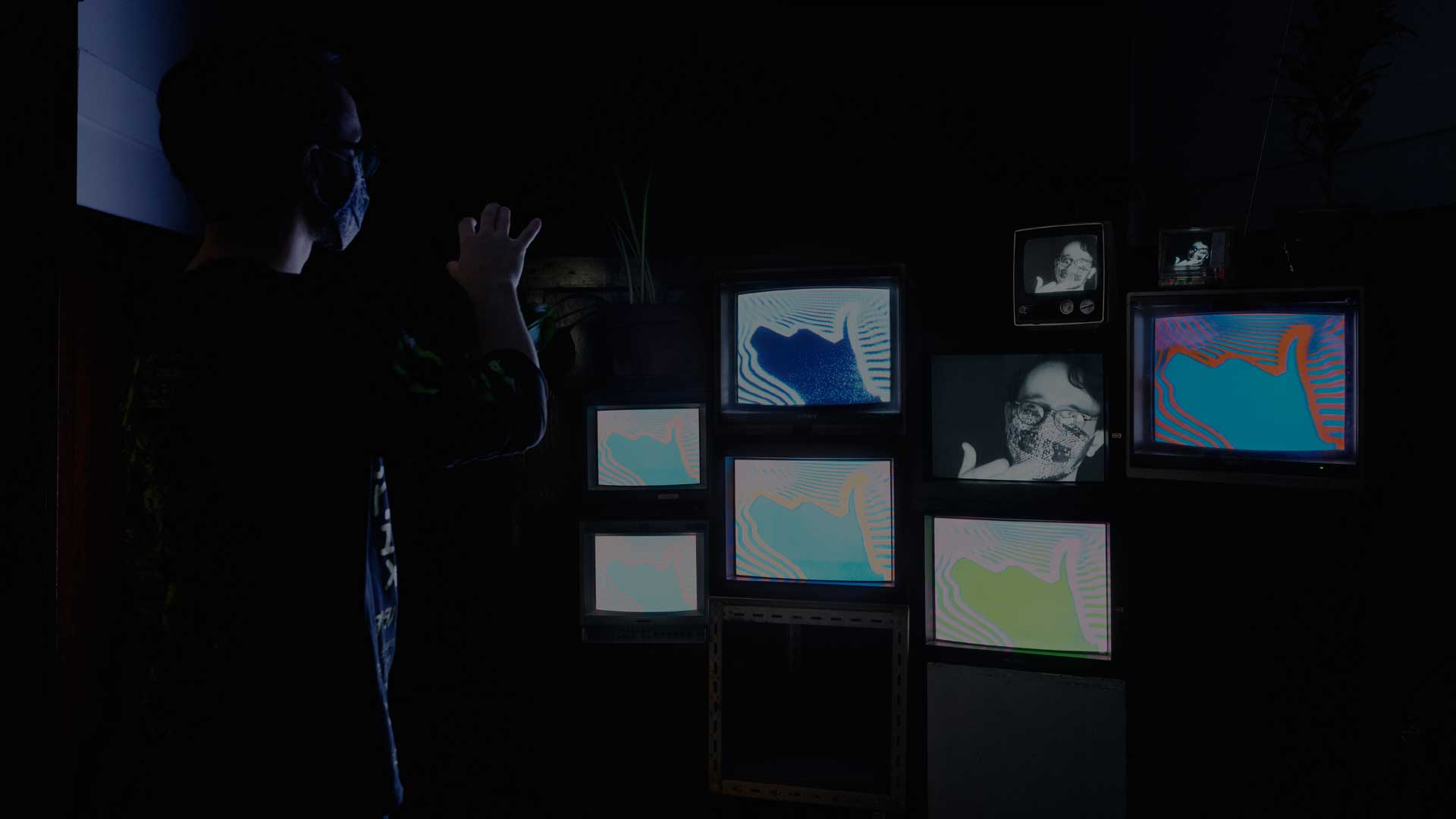
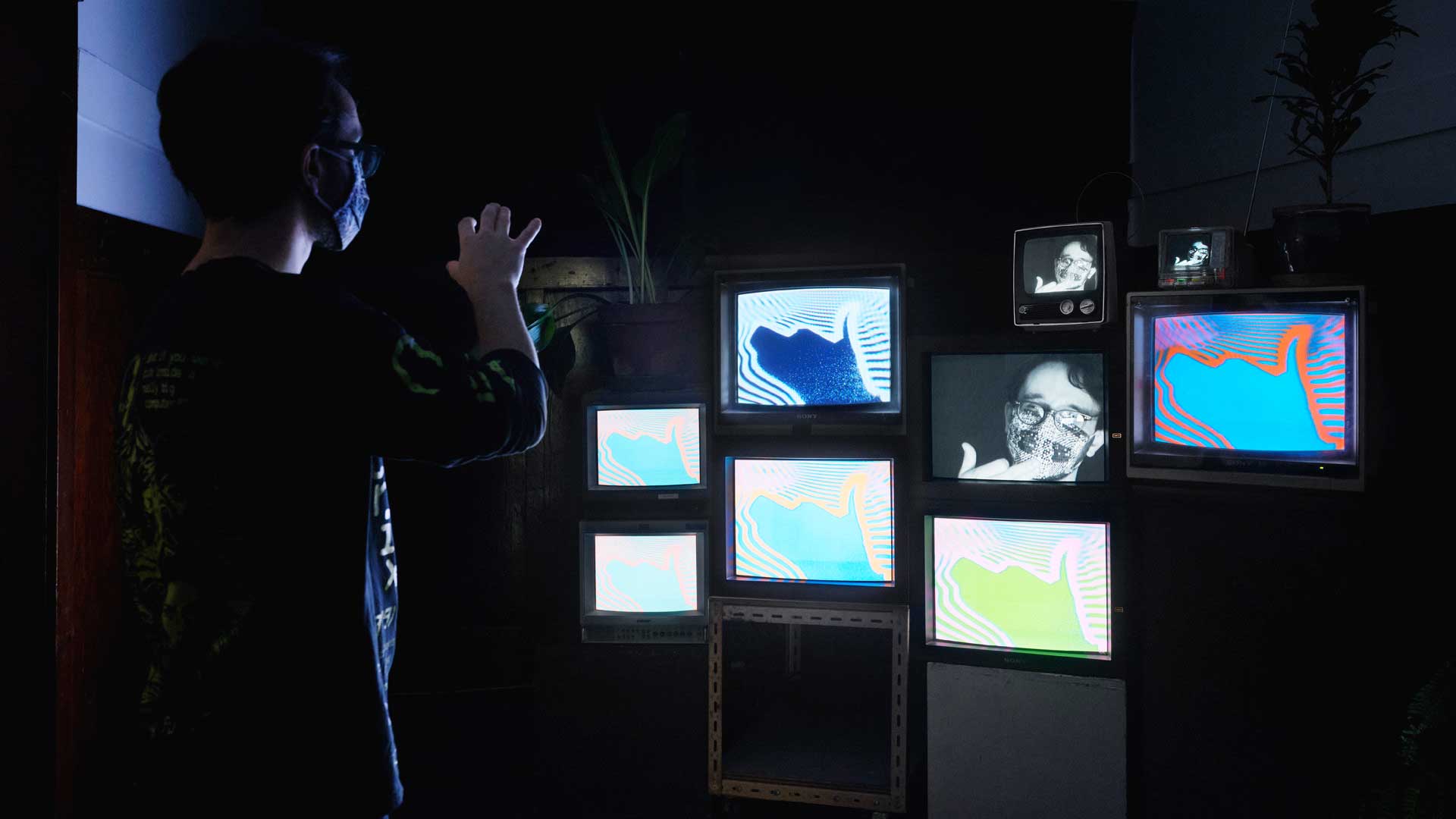
Flavourcel Animation Collective (FAC) is a group of ten artists currently in residence at Western Front until the end of 2021. Current members are Alia Hijaab, Chhaya Naran, Chris Strickler, Gil Goletski, Harlo Martens, Josh Neu, Julia Song, Kat G Morris, Lana Connors, and Laurel Pucker. The collective, formed in 2018, is horizontally structured to collaboratively bring each member’s work to life by sharing resources and mutual support. Their work varies from hand-drawn to digital 3D animation, stop-motion to analogue film and video, music and live performance to looping GIFS, and a plethora of print materials such as zines, stickers, posters, and patches.
On October 31st and November 1st FAC presented a two-day installation at Western Front, titled Into the Belly of the Beast, featuring a live performance, animation loops, and print materials created during their residency. Following this event, the collective sat down in the creaky kitchen of Western Front with a table full of halloween candy and tortilla chips to speak with Alysha Seriani (AS), a media and social practice artist who collects zines and sometimes makes stop-motion movies with children.
Alysha Seriana (AS): What has your time at Western Front looked like so far? How have you used the stuff and the space inside this building?
Flavourcel Animation Collective (FAC): In 2019 one of us was working here, through the Early Career Development grant, seeing the ins and outs of how an artist-run-centre like Western Front operates. From the get go, they expressed interest in Flavourcel, and said they would really like to do something with us down the road. So that turned into what’s happening today.
FAC: Yeah, that’s how Western Front got to know Flavourcel, through that development grant, it got our feet in the door.
—All our feet simultaneously into the door.
—Three Stooges but there’s like, 10 feet.
—There’d be 20 feet.
—No, one foot each! If you have both your feet in the door, then you don’t have ‘a foot in the door.’
—I just want to see all of our feet piled up on top of each other.
—So that’s how we’re utilizing the space. We’re all just laying on top of each other plank-style. Feet on feet.
They offered us a residency of five months where we could use the Luxe Hall as a studio space. It’s the first time we’ve been able to work in the same space all together. Before, we were meeting up once every two weeks in a living room or over Zoom.
A big factor of this collective is that most of us have other jobs, and so we have tried to find ways to make animation on a low budget: low time and energy budget. With not a lot of resources and not a lot of time, but still keeping the fun and keeping the joy in whatever ways we’re able.
The 24-hour access to the space is really huge. It’s good to leave my house to work. It’s really helpful. I work crazy hours but it’s nice to be able to come here and work more crazy hours.
—But not in your bedroom!
—Whenever I walk in here, I can see who’s done something new in their little alcove. It’s good to witness, it shows that things are happening all the time.
We have this nice big communal space and so I built a cave behind a curtain. It’s not perfect, but it’s way better than my apartment. Where and when in life do you have a huge curtain that can surround you on all sides?
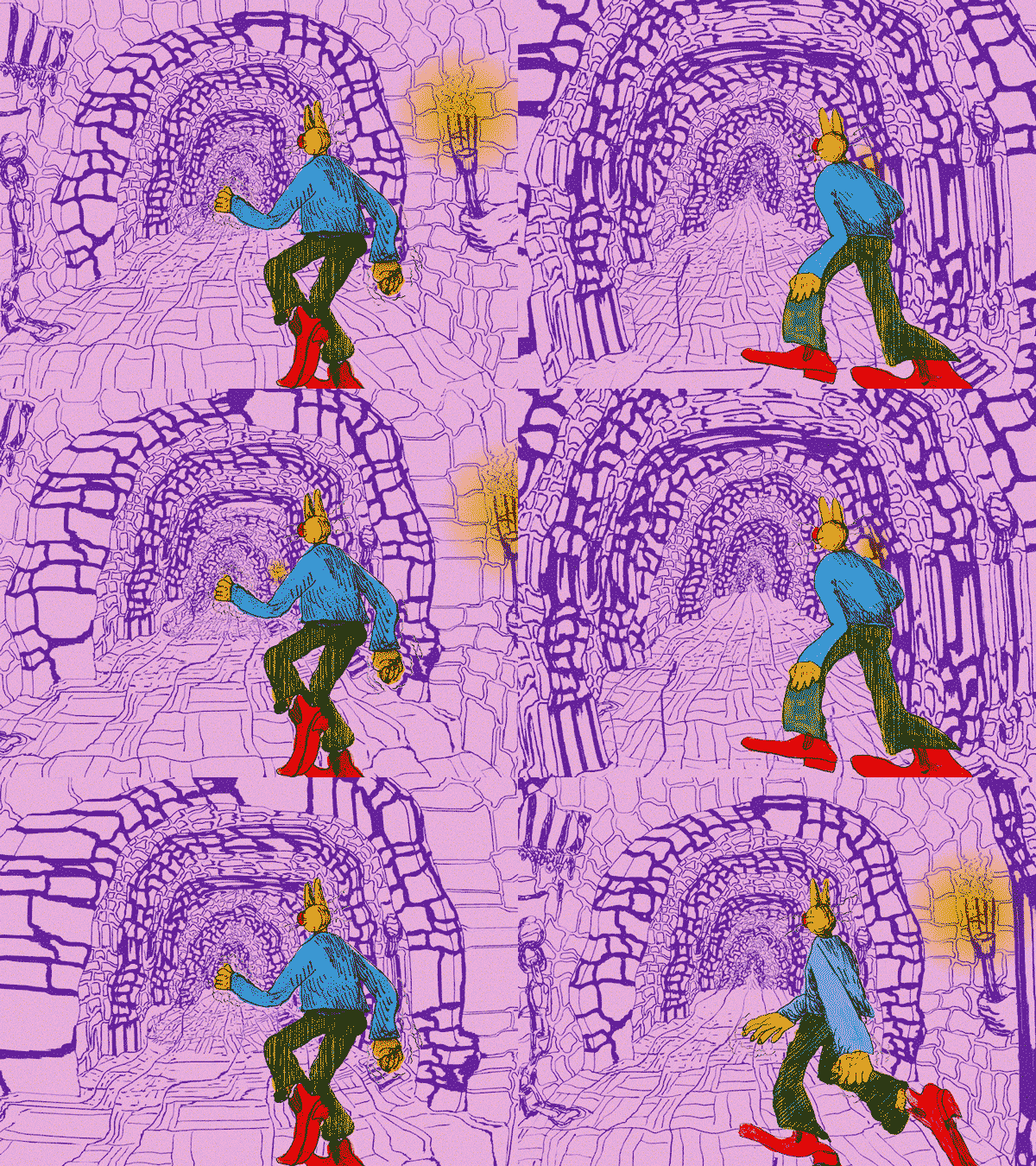
AS: I’m interested in that because I think artist-run centres were, in theory, founded on the desire for collective access — for artists to be able to actually make use of shared resources. So I think the fact that you’re literally taking old film and video equipment down from the shelves and pulling these curtains out, is like, really animating the space. I promise that is the last animation pun.
FAC: Literally dusting off old stuff and using things that have not been used in probably a decade or more.
This is such a gorgeous historical building, with a lot of character, which you often don’t really feel in spaces in Vancouver at all. So it’s a pleasure to not only be connected to these resources, but also to participate in a big part of this artist history in a crucial moment where the world is changing very quickly.
Something that makes Western Front different from a lot of other artist-run spaces is they actually own the building. And they bought it in like the ‘70s, which is the only time you probably would have been able to purchase a building like this as a group of artists. I feel so grateful that we’ve been allowed to use this building.
AS: Have you encountered any ghosts in the space, any presences, any energies?
FAC: Sometimes I hear piano playing upstairs.
—I see what you’re getting at, but there’s no malevolence.
—I feel like there’s some leftover Masonic spirits — just a very humble little Masonic goat.
—When this was a Freemasons Fraternity.1
—I just assume by default that any kind of fraternal society was probably bad. But I don’t know, maybe they were benign?
—I’m sorry I haven’t seen a ghost.
—The scariest is when you’re using the bathroom upstairs and you stand up, and then you’re worried that somebody on the street can see you.
—That’s my favourite part of Western Front.
AS: I wanted to ask you about mutual aid and collective care within your group and how you support each other with labour, act as collaborators, show up in each other’s work, and share resources that allow you all to be able to live and work as artists in this community.
The starving artist trope is bad and I don’t like it. Feed yourself. The snacking artist is a thriving artist. — FAC
FAC: I think the first thing we always try to do is share gigs. If somebody else needs money more than me, they should take this gig, that kind of thing.
Flavourcel as a collective gets a lot of work requests that we can’t always take. There’s been more than a few times where a project has come our way that we either feel we’re not right for or don’t have the time for but know someone who’d be perfect for it. The beauty of being 10 people is having a big community. That is a function of this collective, to benefit other artists as well.
I feel like we really trust each other — we work collectively, but it’s not usually more than one person working on a given project. Like, if it’s a looping GIF, usually, it’s one person in charge of every single aspect of that GIF. By maintaining our own visions individually, I think we create a communal space of collaboration. It gives everybody the ability to really do what they want. Because all of us are really neurotic in that way. [Laughs.]
The collaborative part is when we bring everything that we make, collectively together.
We really make a lot of space for people to show up in the capacities that they can. Every project that we do agree to do, it’s never mandatory for all of us to do it. Most of the time, not all of us opt in. Having as many members as we do means that if you don’t like one aspect of something and don’t want to take part in it, it’s probably okay because someone else will pick it up.
—Also, I want to point out: the food is a really big part.
AS: Yeah! There’s always food served at all of your events: breaking bread together seems like a big part of being together.
FAC: It’s important to all of us. Wherever we can, make sure that we just spend artist budgets on food as much as possible.
AS: We all still need food to live, apparently.
FAC: The starving artist trope is bad and I don’t like it. Feed yourself. The snacking artist is a thriving artist.
I also like having a set group of people that you can always turn to to show your work.
I think we’ve also been fair in the division of labour on specific projects. We’ve been strategizing on how to make things, dividing up the labor so that it’s equal pay. Like chef’s theory.2
AS: This was actually another one of my questions around conflict within co-creation. I recognize your work as intentionally rooted in queer and anti-colonial communities and see you all as very organized: you have an aim, you have this space, you have this time together. I want to know how you relate to each other to create this sense of easeful connection, where everyone’s work is different but complementary. It seems like everyone here is pretty clear about where they’re coming from, and also where their art is coming from.
FAC: We have had conflicts in the past, and I feel like those conflicts were harder to deal with when we were in the beginning stages of the collective.
A big part of it is maintaining a regular schedule — we consistently meet every two weeks. Even if there’s a conflict, no one’s ever been like, “I’m not coming next week, I can’t talk to you.” We always try our best to keep continuing the conversation even if it’s tough.
I also think acknowledging time is a big thing. In capitalist colonial systems, it’s all about quickness and the efficiency of the product, right? Whereas there have been decisions that have taken us so long — literally months — because we wanted to do it right! We need to be okay with the fact that everything will take longer because, yeah, there’s 10 of us and there are a lot of opinions.
Like, literally, what’s the rush? There is no rush. We go at the speed that we can.
I’ve definitely caught myself a couple times getting annoyed at how long something is getting dragged out. But at the end of the day, whenever we have a disagreement on something, and it lasts longer than one meeting, it shows that we are not all the same person, and it’s a conversation that needs to occur as a learning process.
—And through our disagreements, the length of time it takes to resolve them has gotten shorter because we’ve gotten better at it.
AS: Okay, I’m going to out myself as a Jack Halberstam3 fan girl right now.
FAC: We stan.
AS: I really wanted to ask you about the methods of animation serving a potentially radical agenda. In Halberstam’s The Queer Art Of Failure (Duke University Press, 2011), he writes about the Pixar movie A Bug’s Life: how some of the technologies of digital animation were created so the ant colony was treated as a whole entity as opposed to a lot of duplicated individuals. That’s a really specific example, but I wanted to ask, within each of your practices, where do you find the form or method or technique that you’re using to serve your greater values?
FAC: Animation, for me, has been a lot about the construction of memory. Every time I look at an animation that I made in the past, it has brought me back to that place and what I was thinking, what I was working through. I think that’s really important, to record those moments in a way that’s not in words.
AS: I haven’t thought about that before, how by default, moving image making now is so immediate, and that we’re not actually dealing with repetition or needing to memorize repeated gestures the same way. So, animation is a way of slowing that down — frame by frame — and creating an embodied memory.
FAC: Also, it’s rare to see your labour reflected back at you in a way that actually feels like you own it.
—Yeah. It’s like the runner’s high of art.
—I feel that way whenever I do 2D animation, but whenever I do 3D, I don’t have that feeling at all. It feels like a fun little puzzle that I solved, and then it’s done and I never think about it again.
—Yeah, I mean, potentially, that’s why I don’t fuck with 3D animation, you have to really like puzzles.
—With 2D, I ask myself, do I want to be emotional about this? It’s gonna be hand-drawn.
—I’ve never thought of animation as particularly radical. I don’t know if I could claim that of my work.
If we’re building on “the personal is political” then I think we reflect that really well, because we are all individuals with different styles and we’re able to uplift each other. So I think that the work does reflect our lifestyle, what we like, in the content — oh shit, I said the c-word.
—I don’t think we ever hold each other back, and I feel like that is political, ultimately.
I think that versatility really lends itself to animation because animation is like everything all at once. At its best, it incorporates everything. Animation is really the medium where you can bring anything to the table and make it move. — FAC
AS: I noticed that you’re also putting out zines, prints, and objects alongside the moving image work. How are these practices connected for you? I always leave Flavourcel events with these treasured objects to add to my ever-growing archive of zines and ephemera. The physical objects feel like gifts and are very precious to me.
FAC: Whether it be with writing or sound or music or illustration or comics, we all dabble in at least a few mediums. I think that versatility really lends itself to animation because animation is like everything all at once. At its best, it incorporates everything.
Animation is really the medium where you can bring anything to the table and make it move. Whether you’re a painter or a sculptor — really, any kind of medium can be animated. It’s really cool.
—But also, it’s really hard.
—It takes a long time.
—Yeah, and a lot of us don’t stretch and we get these back issues.
—Yeah my back is a horror show.
AS: I see a lot of haunted figures across everyone’s work: sexy monsters, uncanny hands, aura color fields, and depictions of chronic illness. What draws you to the monstrous?
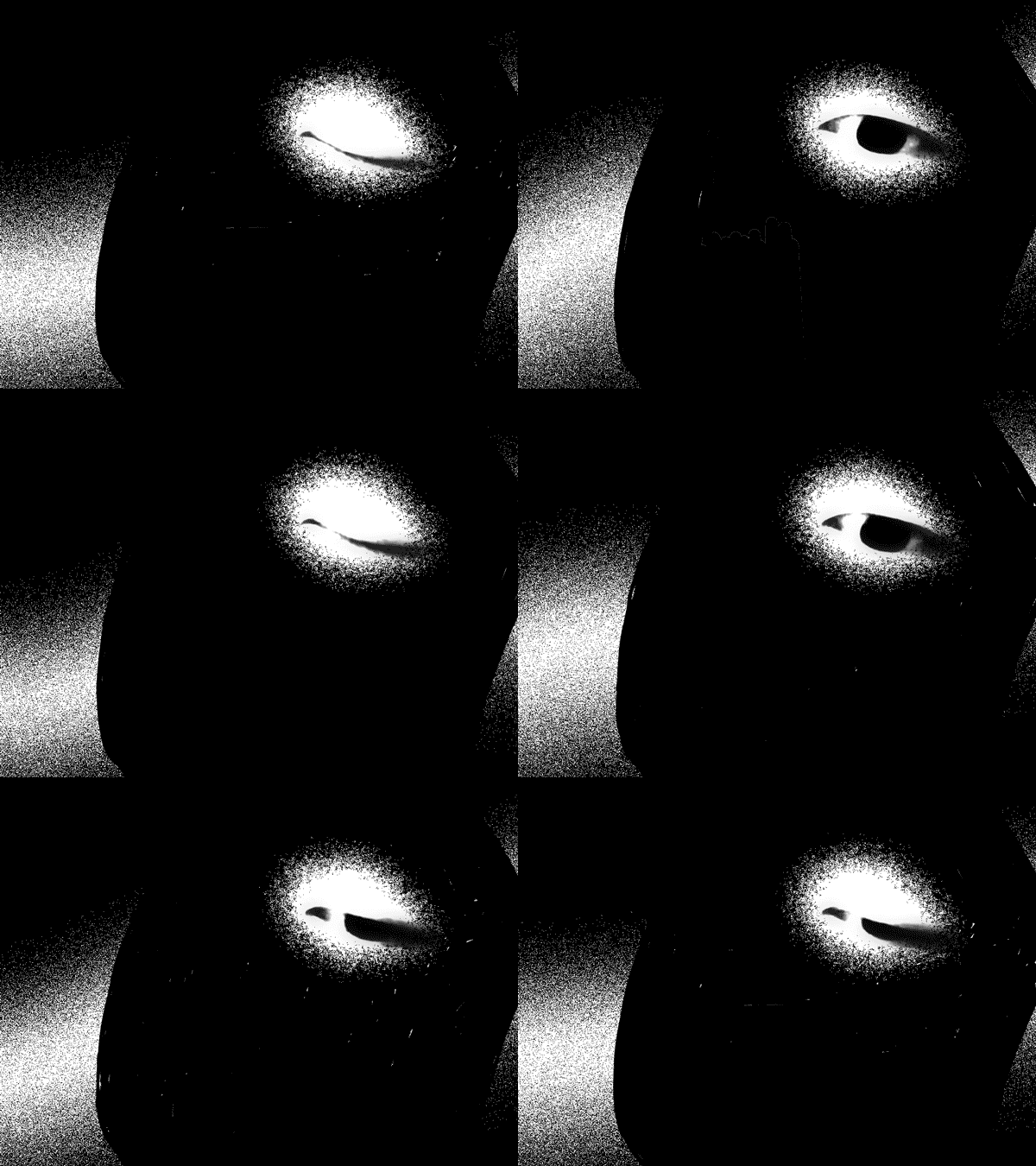
FAC: I have been trying to figure out why I was drawn to that type of imagery. I think it comes from a fascination with the boundaries that bodies encounter. Having a body is a very weird and strange thing.
—I feel like a lot of us in the collective can relate to the horror of having a body.
—And having to animate it!
—Yeah. Every day.
—This is why I don’t animate bodies. Too scary.
There’s something very bodily horrific — or horrifically bodily — about animating. You’re actually putting your physical form through some terrible things sometimes to animate.
I didn’t go to school for animation. The collective here is the most animators I’ve ever known. I find independent animators always have a really interesting perspective through the characters that they bring to their work based on people that they know.
Character animation has been very industrialized and has a lot of standardized rules and practices. I like to try to break out of those and do something new. It is really hard sometimes but even if you partially succeed at doing something new I think it’s worth it every time.
—How many frames did your cat guy’s walk cycle have?
—That’s a three frame walk cycle, my friend.
—Mr. Disney himself would fucking weep.
—I hate walk cycles.
AS: Okay, a walk cycle is the perfect segue: I’ve been off social media for the last year, and one of the few things I miss about Instagram is the account @24memespersecond. What you think are the greatest gags about experimental or non-commercial animation as a lifestyle choice. Any funny stories?
FAC: It is funny how popular that account has gotten. They’ve fostered their own internal memes about sand animation. Or Asparagus.
—I think the stereotype of experimental animators has been this hermit or priest of a long dead religion. It’s a joke, but basically…
One of the things you learn in animation school is how to create silhouettes of characters. I feel like every animator right now is such a real-life cartoon character in their own way. If each of us did a silhouette, we’d be able to know who’s who.
When I work at Emily Carr [University] and I see students, I can tell if they’re an animator. And if not an animator, then they’re an illustrator and they have animator friends.
I think the 24memespersecond account is funny because they’re animators that actually animate full-time and some of the memes are about being really overworked. And I’m just like wow, can’t relate because I’m in a collective where everyone values everyone else’s time and I just animate on the weekends and I still get to make really great stuff.
Notes:
- According to Western Front’s Community History plaque, the building “was originally a Knights of Pythias Hall.” “The Western Front,” Places That Matter, accessed Nov 14, 2021. See Keith Wallace ed., Whispered Art History: Twenty Years at the Western Front (Arsenal Pulp Press), 1993.
- FAC: A handful of us came up with our version of ‘chef’s theory’ in 2019. At the time, we had to devise an organizing method that would function for 11 animators working (simultaneously, and in our own homes) on a single project — in our case, a music video.
Chef’s theory has been used in non-profit and co-op organizing, which is where a couple of us had first encountered the term. It usually entails that there are one or two main chefs directing the flow of the kitchen/project (simply in terms of communication and mediation of ideas). A few other animators will designate themselves (or be loosely elected) as sous-chefs who will lead a smaller group of two or three animators. The point is to spread out our workload as much as possible while allowing collaboration to happen more easily between fewer people. This has been really helpful at managing communication and workflow due to the idiosyncratic and varied way we all work, but it isn’t always a perfect system. It works best when there is a consensus on who is willing to commit a bit more time into spurring dialogue, doing admin and following up with other members before deadlines.
- Jack Halberstam is a theorist and author who writes about animation and filmmaking, queer lives, gender, feminism, anarchy, failure, children, and bewilderment.