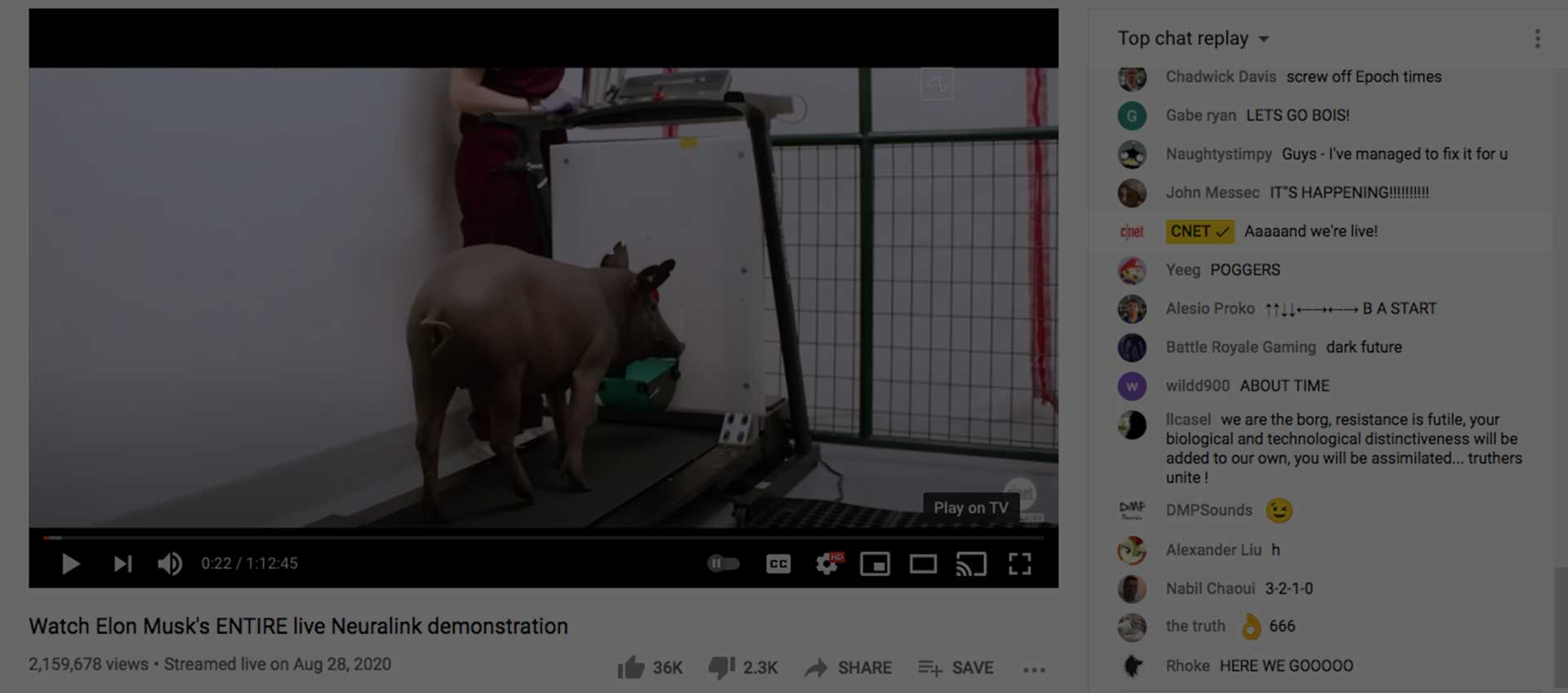
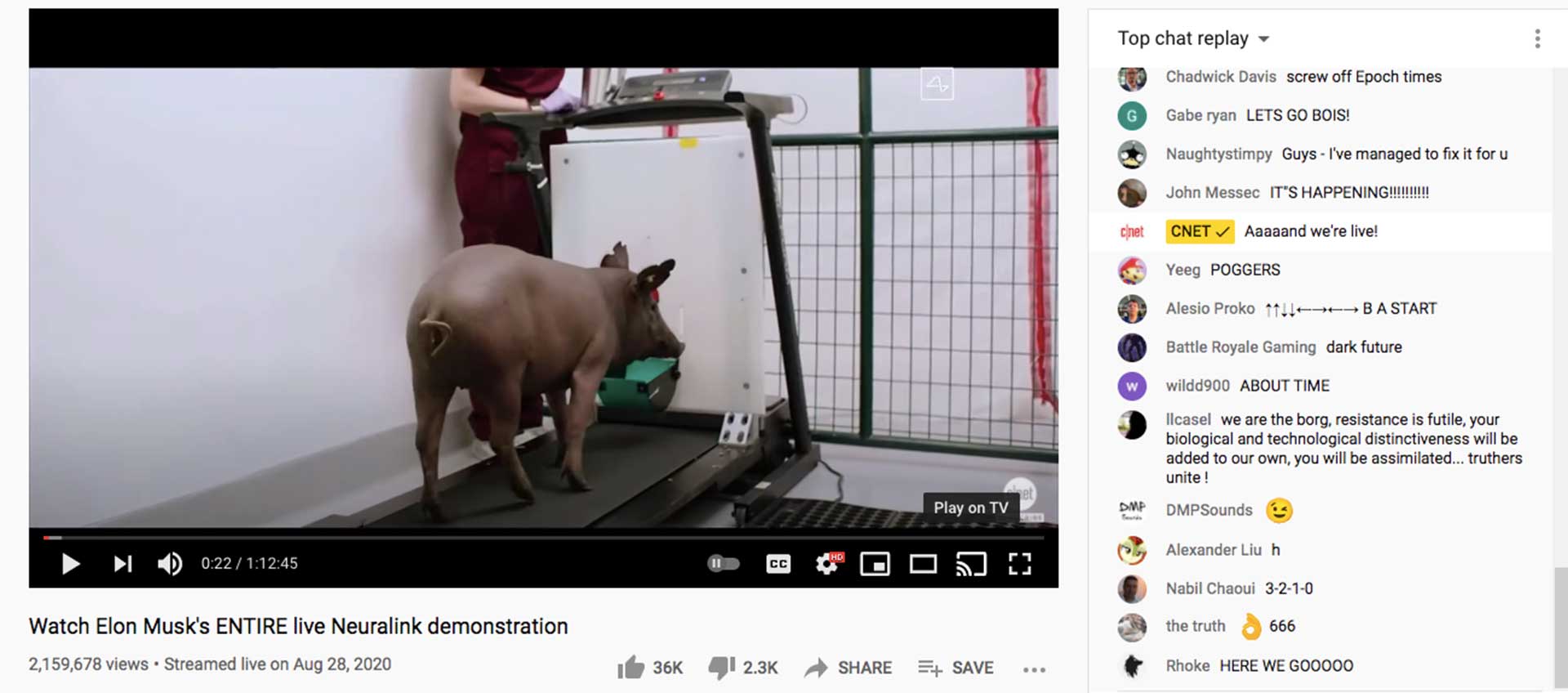
In 2016, back when he only had 14-billion dollars to his name, Elon Musk founded a company called Neuralink: one of many new companies racing to develop a Brain-Computer Interface, or BCI.1 In theory, a BCI is a device capable of linking human brains directly to various digital technologies including Artificial Intelligence (AI) and the internet, bypassing the messy interpretive processes and motor functions of the human body.
Neuralink expects its BCI will be able to send information directly into users’ brains as digital code corresponding to neuronal patterns, and will similarly be able to receive neuronal patterns from users’ brains as input.2 Such a technology could eliminate swiping and typing altogether.
In August of 2020, a “Live Neuralink Demonstration” was streamed on YouTube which has now garnered well over two million views. Among other things, the video reveals how Neuralink’s conception of cognition is deeply related to simulation theory and other Gnostic reboots of the digital age, and demonstrates the menacing efficiency of Elon Musk’s theatrics and mythmaking in a world where public spectacle generates capital. Since the technology is still almost entirely theoretical, I’m writing about Neuralink to raise some philosophical questions; namely, what assumptions about information, representation, and cognition underlie Neuralink’s goal of turning personal thoughts into commercial products?
Information in a Tube: The Computational Model vs. The Autopoietic Model
Before examining the particular cognitive model that undergirds Neuralink’s research and development, I’ll first briefly outline an opposing cognitive model as a backdrop.
The Autopoietic Theory of Mind proposes that cognition occurs in the relations between the brain, body, and environment of living systems — or rather, that the brain, body, and environment are composed of separate but entangled systems whose mutually dependent activities might appear to an observer as cognition.3 This theory relies on the concept of “Structural Coupling” to describe a phenomenon when multiple systems evolve together to become co-dependent while remaining operationally closed to one another.4Structurally Coupled systems stimulate each other in ways that they come to rely on over time, e.g., the relationship between pollinating bees and the flowers that they interact with. Structurally Coupled systems function as parts of one another’s environment, and, as such, elicit responses that are often specifically conditioned and thus appear as cognitive responses. As Riccardo Mortorrana puts it, cognition occurs “every time we observe an organism and we consider its behaviour adequate to the current circumstances, attributing to the entity the capacity of sensing and knowing the environment.”5
In contrast, the Computational Theory of Mind is based on the idea that cognitive systems are computational and thus work the same way as Turing Machines.6 This model, also known as “Functionalism,”7 proposes that mental states associated with cognition exist exclusively as “physical-chemical states” in the brain.8 The Computational Theory, then, is precisely what is needed to begin thinking of mental states as commodities. It frames experiences, memories, and any other cognitive activity as something that is reducible to a neuronal pattern, which, by using a BCI, can be extracted, stored, and shared directly with other brain-having entities (BHEs).
A general distinction can be made between the ideas Neuralink presents that are already well established in the field of neuroscience and the more speculative content of the presentation, which appears mostly in the Q&A portion of the video. This gap between the established and the speculative is one reason the MIT Technology Review characterized the presentation as “neuroscience theatre.”9
We Can Experience it for you Wholesale
46:12 When asked, “Will you be able to save and replay memories in the future?” Musk answers confidently in the affirmative, adding that “this is obviously sounding increasingly like a Black Mirror episode, but, well, I guess they’re pretty good at predicting… but yeah, essentially if you have a whole brain interface, everything that’s encoded in memory you could upload. You could basically store your memories as a backup… and restore the memories. And ultimately you could potentially download them into a new body or a robot body… the future’s gonna be weird.”
Here we catch a hint of how Musk’s understanding of the world is unknowingly influenced by science fiction, as he proposes that Black Mirror is “good at predicting” rather than recognizing how the show conceives of the world through the same lineage of ideas that inspired Neuralink itself. Not only that, we also see a clear application of the Computational Model as a means of identifying the ultimate cognitive commodity. This idea has distant roots in science fiction, a formative articulation found in William Gibson’s Johnny Mnemonic (1981) among other sci-fi extrapolations of the brain-as-computer.
The Autopoietic Theory of Mind conceives of information in a way that is fundamentally incompatible with the billionaire’s predictions about thought-capture and memory storage. Two early developers of the Autopoietic Model, Chilean biologists and philosophers Francisco Varela and Humberto Maturana, explicitly criticized “The Metaphor of the Tube for Communication,” claiming that cognitive information does not originate in one place, travel through a tube or conduit of some kind, and then arrive intact somewhere else to be taken in by a receiver.10 Instead, communicative processes in biological systems are characterized not by what is communicated but by what effects emerge between the systems in communication. The concept of Structural Coupling frames information as the measurability of a system’s relation to its environment and other systems, a dynamic that is constantly being renegotiated as a field of difference. The Structural Coupling of two or more systems does not mean that they transmit information between one another. Instead, information is the measure of any internal changes of state that are “triggered” between coupled systems; a phenomenon that Maturana and Varela call “perturbation.”11
How to Become a Genius Without Honing a Craft
1:04:20 Later in the Q&A, Musk frames one of the potential benefits of Neuralink in a way that clearly illustrates an adherence to the computational model of cognition: “A lot of our thought capacity,” he declares, “goes into compressing our thoughts into words… and words are very low data rate, and we’re putting a tremendous amount of mental energy into compressing the concepts and thoughts in our head into words, and then slowly talking — speech is very slow. (With Neuralink) we could actually send true thoughts, we could have far better communication because we could convey the actual concepts, the actual thoughts uncompressed to somebody else.”
This assumption that there are “actual thoughts” in our heads, and that they can be identified as the true reality of what humans seek to convey through linguistic communication, divests the neuronal activity in cognition from the rest of the cognitive network. According to Maturana and Varela, “language is an essential condition for the experience of what we call mind.”12 As such the embodied reality of cognitive networks include such things as the materiality of the speaker’s lungs, the vibrations of the molecules in the air that form sound waves, and the ontogeny of the listener who interprets the spoken message. The cognitive network, then, “is also composed of embodied responses shaped by specific social conditioning; cultural and structural information that is not easily coded.”13
1:05:37 Shortly after Musk’s declarations about sending “true thoughts,” one of his employees builds on this idea by discussing the future of art: “there’s a lot of trapped creativity in your mind. For example, you could close your eyes and conjure up an incredible Daliesque scene, but ya know, if I wanted to actually show someone that, it would take years of honing a craft to be able to paint that. And so eventually with enough electrodes in the right places, you could begin to tap into those raw concepts or thought vectors…”
Once again, we see how mental representations are primary in the computational worldview that underpins Neuralink, and that other aspects of the cognitive network are seen not only as less important, but degrade the quality of cognitive exchanges. “Central to this argument,” writes N. Katherine Hayles in How We Became Posthuman, “is a conceptualization that sees information and materiality as distinct entities. This separation allows the construction of a hierarchy in which information is given the dominant position and materiality runs a distant second. Embodiment continues to be […] an accident of evolution we are now in a position to correct.”14 According to the Neuralink employee, Dali’s paint was nothing more than a neutral medium (a sort of “tube”) with which he extracted pre-existing images from inside his head. The Autopoietic Model, however, would suggest that the paint that moves around the canvas to create images and patterns is a crucial part of the artist’s cognitive network: the information corresponding to the image is neither on the canvas nor in the artist’s head; it is the margin between the world that precedes the painting and the world that includes the painting.
World on a Wire
Computationalism, characterized by the notion that information is in fact a thing that travels through a tube between communicators, was first put forward by Warren McCulloch and Walter Pitts in 1943, who claimed that “neural activity is computational.”15 The basic premise for this model of cognition fit well with the Cartesian dualism and political individualism of the post WWII Capitalist West, and it has since stimulated some amazing technological advancements. The notion that all cognitive behaviour emerges through a series of internal (subjective) mental representations that are fundamentally separate from the rest of the world, but which correspond somehow to physical (objective) states in the brain, became the prevailing theory in Neuroscience. It also revitalized an ancient form of paranoia.
Gnosticism, a nebulous set of religious beliefs that originated in the first century AD, is characterized by the idea that the material world is a false world.16 To break free from the illusion of physical reality and return to the realm of True Spiritual Reality one must achieve direct knowledge of the Divine, an experience called “Gnosis.” In mid-twentieth century America, a few science fiction writers planted seeds of cultural paranoia by reimagining the Gnostic worldview through the conceptual framework of Computationalism. Frederik Pohl’s The Tunnel Under the World (1955), Phillip K Dick’s Time Out of Joint (1959) and The Electric Ant (1969), and Daniel F. Galouye’s Simulacron-3 (1964) all laid the foundation for fears that the world had become a computer simulation, and that people had become trapped inside this false reality without knowing that it was a prison at all.
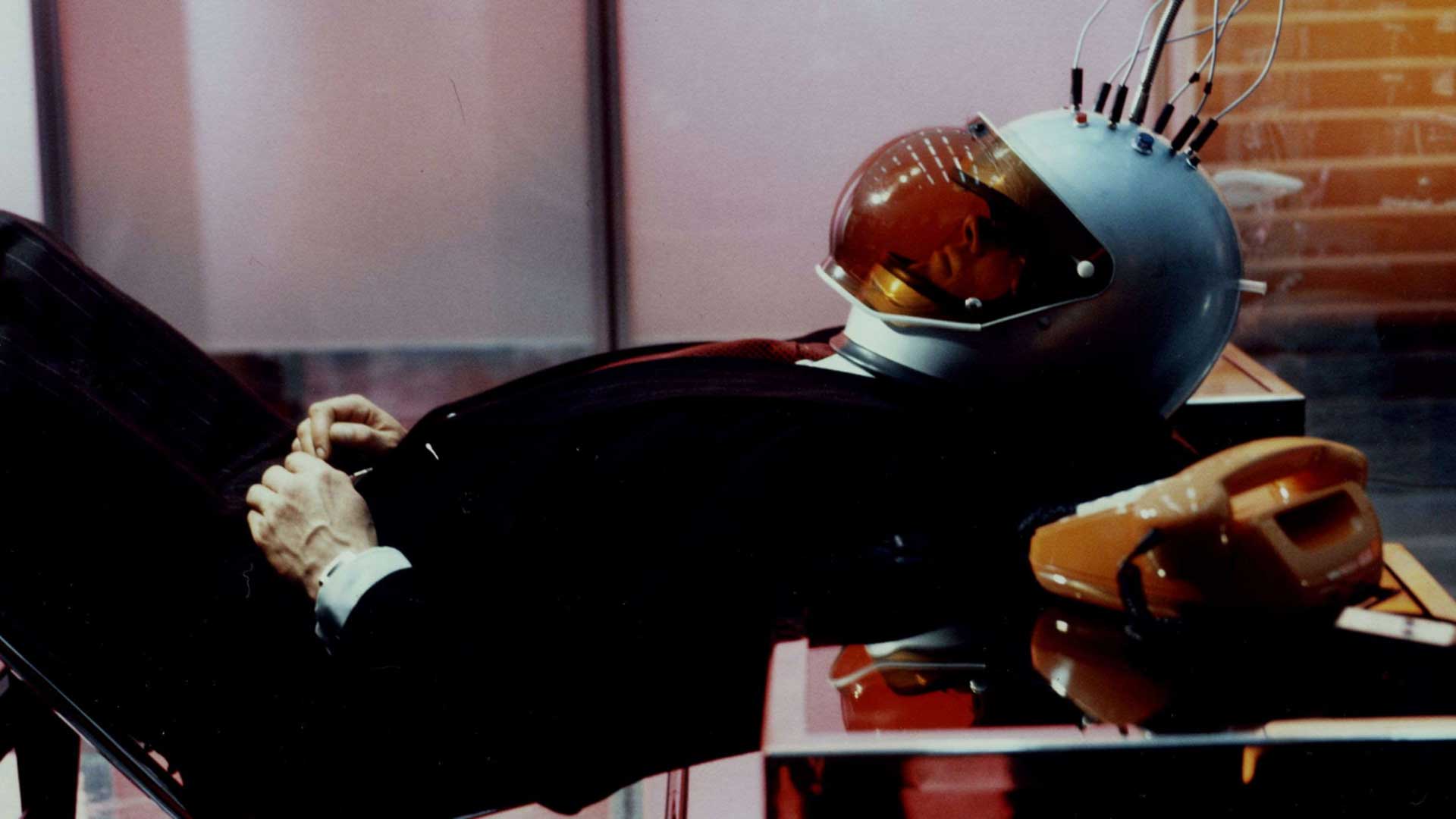
Around the same time, philosopher Hillary Putnam put forward the Brain in a Vat (BIV) thought experiment which reinvented the premise of René Descartes’ Evil Demon using modern technology and a computational model of mind.17 And finally, at the edge of the new millennium, all these cultural currents coalesced into a film called The Matrix (1999), written and directed by Lana and Lilly Wachowski. Themes from all the above-mentioned media and many others form the basis for a Neo-Gnostic mythology that is increasingly adhered to. Elon Musk himself has made the claim that we are currently living in a simulated reality.18
The Computational Theory of Mind is the cognitive model that enables Gnosticism for the digital age, because such a story is only possible if experiences can be fed directly into the brain as digital code and interpreted as “real” experiences. According to Hayles, throughout his writing about technologically simulated realities and mechanical humans, Philip K Dick “leaps over the importance of embodiment. Descriptions of bodies rarely appear in Dick’s fiction. The emphasis falls almost entirely on perception and thinking.”19 So, with Philip K Dick inspired media so commonplace in pop culture,20 Musk, whose credibility as a future-shaper is bolstered by his aerospace manufacturing company SpaceX, is able to make an easy public spectacle out of his new project. The strangest part about the Neuralink story, however, is this: Musk, drawing generally on the sci-fi mythology outlined above, claims that we need BCI technology as a way to avoid being taken over by malevolent AI.21
1:08:20 Musk responds to a question about the end-goal of Neuralink: “On a species level,” Musk begins, “I think it’s going to be important for us to figure out how we co-exist with Advanced Artificial Intelligence… I think it’s going to be important from an existential threat standpoint to achieve an AI symbiosis. That might be the most important thing that a device like this achieves.”
Musk reiterates what he has said many times before when talking about Neuralink: that we must “merge” with advanced AI so as not to be left behind. If we “develop a symbiosis with AI then we can actually go along for the ride,” he says. It’s an interesting logic and it reminds me a bit of the scene in The Matrix where Neo goes to see the Oracle.
After a long buildup Neo finally gets face to face with the infamous Oracle. The meeting takes place in her kitchen while she’s finishing up with a batch of cookies (this is perhaps the only scene taking place within the simulated world that has a heightened sensuous quality: a warm kitchen filled with the aroma of baked goods). After issuing the kind of sweet and humble greeting that we’d all hope to get from the mythical figure of Pure Wisdom, one of the first things she says to Neo is, “don’t worry about the vase.” Neo responds, “What vase?” while spinning around slightly to see what she’s talking about. He then accidentally bumps a table and knocks over a vase, and it shatters. Neo stands there stunned. The Oracle adds: “What’s really gonna bake your noodle later on is: would you still have broken it if I hadn’t said anything?”
In the case of Neuralink, Musk is our Neo, and a collection of sci-fi stories that stand in for the Oracle seem to have said to him: “Don’t worry about helping AI take over the human race.” Musk asks, “What AI?” while spinning around slightly to survey the room for evil robots. He then accidentally bumps a table and invents a Brain-Computer Interface. Musk stands there stunned. “What’s really gonna bake your noodle later on is: how’d you get so rich while being so clumsy?”
Elon Sells Hope
0:00:45 Forty-five seconds into the Neuralink presentation Elon Musk makes something very clear to the audience: “The primary purpose of this video is recruiting…”
But it’s more than just an attempt to gain the interest of potential employees, it’s part of a larger process of myth-making that Elon Musk is strangely masterful at. As the owner of many futuristic tech businesses including Tesla and SpaceX, and spinner of many wild techno-fantasies including the Hyperloop and PayPal, Musk is constantly forging his own mythology.22 He made his fortune in Silicon Valley, so he knows the value of the “fake it till you make it” approach. There are many other companies working on developing BCI technology, but none that would get over two-million views if they live streamed their progress to date. That may be because Neuralink’s competitors don’t think to situate their products within a mythological framework that evokes humanity’s existential struggle against evil machines. They also don’t get to stir up the YouTube masses by smoking weed on The Joe Rogan Experience while waxing prophetic about space colonization. Musk didn’t even need to inhale for it to shake up the stock market.23
Musk’s approach to the Brain-Computer Interface business seems to uniquely combine the grand theatrics of Silicon Valley hype tactics with the paranoid speculations of American Neo-Gnostic Sci-Fi media.24 The cognitive ontologies that Neuralink has woven into its research and development are stretched to their limits in an attempt to establish a new frontier for resource extraction: the Human Mind. In the arena of speculative advertising and YouTube view counts, determining whether a technology is desirable may be less important than whether it can create a future that looks like the movies. So, perhaps Musk’s sensational speculations seem appealing simply because they give a population of YouTubers “a future to look forward to.”

Notes:
- Some of these other companies include: https://www.neurable.com, https://www.emotiv.com, https://www.kernel.co, https://www.next-mind.com, https://www.meltin.jp/en, https://www.bitbrain.com.
- “Understanding The Brain,” 2021, https://neuralink.com/science.
- Humberto R. Maturana, Francisco J. Varela, and Stafford Beer, Autopoiesis and Cognition the Realization of the Living (Dordrecht: D. Reidel Pub. Co., 1980), 9.
- Humberto R. Maturana, Francisco J. Varela, The Tree of Knowledge: The Biological Roots of Human Understanding (Boston: Shambala, 1992), 75.
- Ricardo Martorana, “The first two E’s,” May 2020, https://medium.com/c-oo-gnition/the-first-two-es-ab67a935ab0b.
- Hilary Putnam, Representation and Reality (Cambridge: MIT Press, 1991), 73.
- Ibid., xi.
- Ibid., xii.
- Antonio Regalado, “Elon Musk’s Neuralink is neuroscience theatre,” MIT Technology Review, August 30, 2020, https://www.technologyreview.com/2020/08/30/1007786/elon-musks-neuralink-demo-update-neuroscience-theater.
- Humberto R. Maturana, Francisco J. Varela, The Tree of Knowledge: The Biological Roots of Human Understanding, 196.
- Ibid., 98.
- Ibid., 231.
- Katayoon Yousefbigloo, unpublished, 2021.
- Katherine N. Hayles, How We Became Posthuman, (Chicago: University of Chicago Press, 1999), 12.
- “Computational Theory of Mind,” Wikipedia, last modified February 10 2021, https://en.wikipedia.org/wiki/Computational_theory_of_mind.
- Andrew Phillip Smith, The Secret History of the Gnostics: Their Scriptures, Beliefs and Traditions (London: Watkins, 2008), 2.
- Putnam later became avidly opposed to the computational model of mind which he had helped popularize.
- Mike Wall, “We’re Probably Living in a Simulation, Elon Musk Says,” Space, September 7, 2018, https://www.space.com/41749-elon-musk-living-in-simulation-rogan-podcast.html.
- Katherine N. Halyes, How We Became Posthuman, 163.
- Mark Fisher, The Weird and the Eerie (London: Repeater Books, 2016), 47.
- Maureen Dowd, “Elon Musk’s Billion Dollar Crusade to Stop the AI Apocalypse,” Vanity Fair, April 2017, https://www.vanityfair.com/news/2017/03/elon-musk-billion-dollar-crusade-to-stop-ai-space-x.
- Tech Insider, “The Elon Musk Fiction: How Myths Paralyze Progress,” Medium, September 4,2018, https://medium.com/s/story/the-elon-musk-fiction-how-myths-paralyze-progress-1c3256d12f1d.
- Hamza Shaban, “Tesla’s shares drop after execs resign, video of Musk smoking marijuana circulates,” The Washington Post, September 7, 2018, https://www.washingtonpost.com/technology/2018/09/07/elon-musk-smokes-weed-joe-rogan-podcast/.
- Ashlee Vance, “The man who’s transforming cars, energy and space travel – all at the same time,” Scroll.in, June 29, 2015, https://scroll.in/article/737421/the-man-whos-transforming-cars-energy-and-space-travel-all-at-the-same-time.