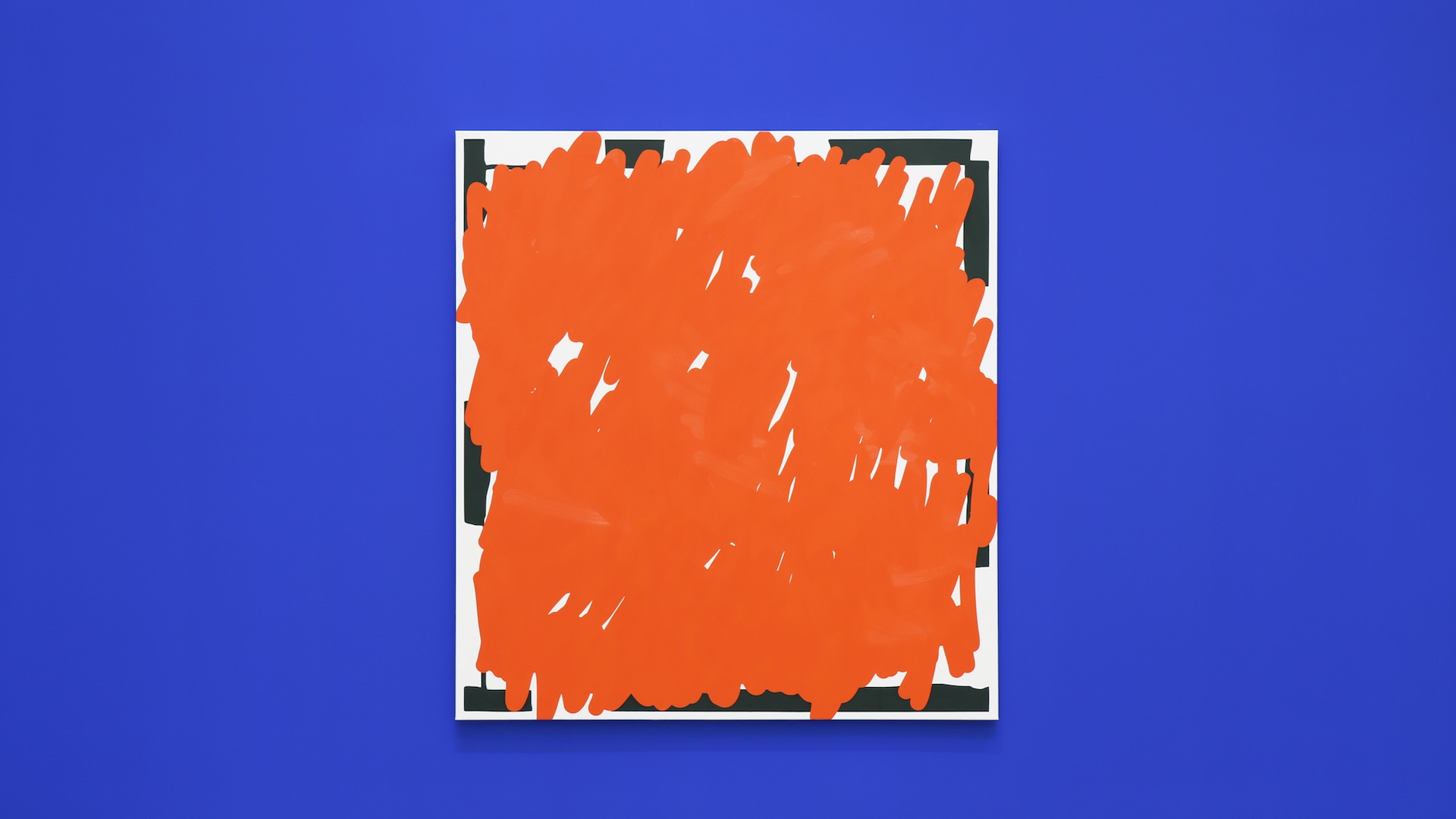
A few weeks ago, two friends and I visited Elizabeth McIntosh’s exhibition, Real Relationships, at Catriona Jeffries Gallery. Days before, I had checked out the gallery and found the work difficult. The paintings depicted knotted forms of elusive energy illuminated against a radiant ground of blue, black, white, pink, and red. McIntosh’s marks were like doodles scribbled on an iPad, but doodles that assumed a monumental form and scale. From a distance, the marks appeared spontaneous, yet upon closer inspection, it became clear each mark was mapped through a stencil, realized through subtle and short brushstrokes which occasionally ran against the grain of the line. The work was reticent and intractable, as though it were internally driven by the logic of a redaction or erasure. What the paintings demanded was a second viewing.
As we walked around the gallery for the second time, one of my friends posed the question: “What do these paintings want?” From the way he asked the question, it seemed rhetorical. This friend was once a painter. He went to school for painting, studied its debates, and worked through its contradictions. Although he no longer worked in the medium, he still possessed the knowledge and means to answer the question. When he broached the subject, it was articulated with attention to the collective feeling of pleasure and strangeness all three of us were experiencing at that moment, standing in front of the work yet not knowing what to say, suspended in a productive state of not-knowing.
A month before we met, my other friend had expressed a desire just to stare at paintings and only paintings. He was frustrated with what was on offer in the city. He would visit a show, drawn to what was circulating online, but expressed his dismay in coming in contact with the work in person. The paintings failed to deliver in real life. His response to our friend’s question — “What do these paintings want?” — was direct and was delivered without hesitation: “These paintings want nothing — they serve no purpose.” Following his lead, I added that their purpose was founded on a unique desire: “To make things which we do not know what they are.”
When viewing McIntosh’s paintings, the word that came to my mind was ‘obstinate.’ This word felt like a close approximation to the experience of viewing since it alluded to a type of work that was impossible to control, difficult to puzzle, manage, or solve. In our own time, the obstinate has many synonyms: the unmanageable, the uncontrollable, the ungovernable, the untameable, the out of hand, the stubborn, the fractious, the indomitable, the intractable, the recalcitrant, the unruly, the unyielding, the wayward, the wild, and the willful. Obstinacy suggests how the reading of a painting offers its own resistance — this is its power.
I noted to my friends that this inclination toward obstinacy, to an unruly form, the attraction to conditions of uncertainty and not-knowing, differs from how paintings are often discussed in the contemporary moment. Everywhere I turn, emphasis often lies on the certainty of a pronouncement, statement, or criticism. When talking about painting, we act as though we always know what we are talking about.
Over the past decade, abstraction has been viewed as a bad object. The mode has been dismissed as empty and vacuous, no longer serving as an index of our time, vacated of any utopian or social potential, denigrated for operating as a pure commodity. In 2014, a term started to circulate on the internet that addressed this state of affairs. Critics labelled this new type of work as zombie formalism, a new mode of abstraction made to spread on Instagram and serve as easy currency for the contemporary market, easily bought, sold, traded, and flipped with a click of a button. It was a zombie form since it appeared everywhere as if aimlessly wandering around the screens of our phones, undead, devoid of any life, reviving the corpse of Clement Greenberg only to untether his formalism from an aesthetic idea or project. A natural reaction slowly developed within this culture of empty gesture and form. Painters and galleries started to champion figuration as an antidote. Over the past decade, different iterations assumed dominance. Some leaned toward a type of pseudo-surrealism, while others emphasized identity and identitarian modes of thought and painting. In short order, both modes were also questioned, subsequently condemned as empty and vacuous — some even went so far as to call this recent raft of works, zombie figuration.
In a recent article for Artnet News, Kate Brown coined a new form of figuration as hypersentimentalism, where artists paint their community and scene. According to Brown, there is a distinct logic to this approach — painters paint their friends and their scene and their friends and their scenes are seen as cool, and this coolness is viewed as a constitutive quality of good art. Brown recognizes how this shift in representation, particularly the representation of a micro-community and a select social circle, represents a distinct “vibe shift” in contemporary art. This shift signals a movement away from the hyper-politics of the past decade towards an emphasis on the social life of a community or scene.
For Brown to speak of “vibes,” one might also note a hollowing out of aesthetic and political discourse, away from terms such as criticality or theory, or other words which might ground the conversation in a discourse of debate and contestation. Brown refrains from overt criticism, hesitating to pass judgement. However, the way she presents the trend certainly invites skepticism. She suggests that this mode might only be an expression of a passing style for a select few, made for a select few. In the pages of Art Monthly, the art historian Larne Abse Gogarty takes her criticism one step further, interpreting this figurative style as reductively oriented toward “propertied forms of self-possession.” To cite Abse Gogarty on this trend:
Identity is situated as a special form of property, painted into the canvas in ways that seek to appeal to fellow proprietors, and, if that isn’t available, the work can always be purchased, displayed and circulated in ways that provide buyers, viewers and institutions with a piece of that property, enabling an expansion of the forms of ownership previously in their command.1
Brown notes, however, that there is an added wrinkle of interpretation to this figurative mode: artists who paint their friends paint their friends so that each member of their scene is recognized amongst their scene. Interpretation follows the logic of the acronym, IYKYK, ‘If You Know, You Know.’ To make sense of the work, each painting holds what can be conventionally understood as a bundle of Easter eggs nestled in the work — social referents, icons or other formal qualities that serve as an interpretative key for those who are in the know.
I bring up this topic because McIntosh’s paintings do not adhere to this logic. The paintings are not of a scene. They do not depict a social circle. They do not rely on a secret key for their interpretation. Moreover, they are not made purely to circulate online. One of the tendencies of zombie formalism is that a non-representational work might look visually compelling on Instagram but entirely unimpressive in person. This effect was clearest in my friend’s dismay with what was on offer in the galleries of Vancouver. In contrast, McIntosh’s paintings offer more to look at in person than online. What she offers is not a boutique mode of experience that can be turned on or off.
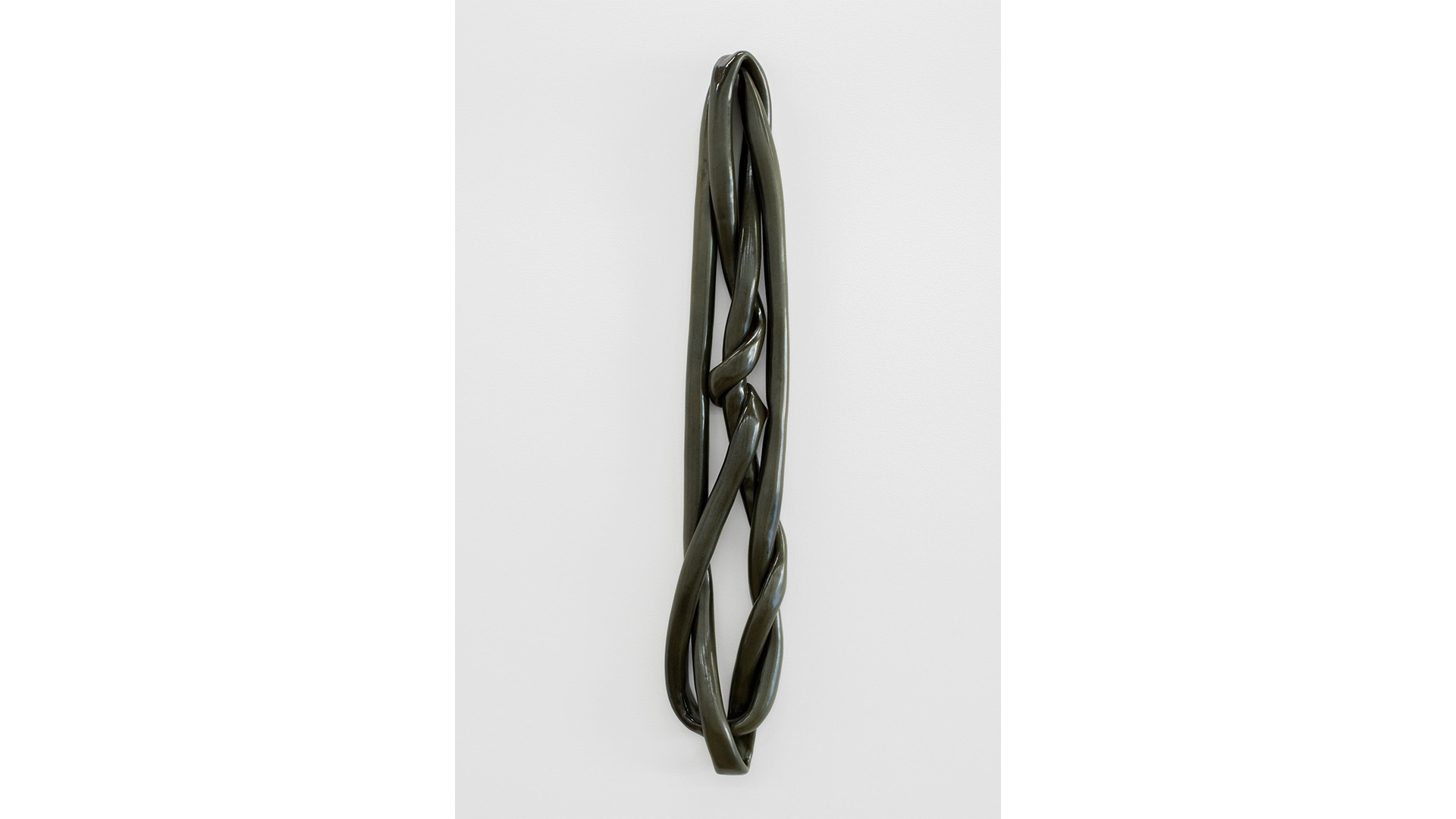
In McIntosh’s knotted forms, I am reminded of the artist’s friend and colleague, Nicole Ondre, particularly Ondre’s knotted sculptures. The starting point for Ondre’s work is knot theory, a mathematical subfield of topology. Her position, however, is not confined to her source material. When sculptured in clay, Ondre’s knots contain a malleable sculptural possibility, expanding the vocabulary of abstraction. To consider a knot is to grasp how forms become entangled, stuck or looped back on themselves. In Ondre’s hands, the knot takes on an obstinate form that proves impossible to untangle.
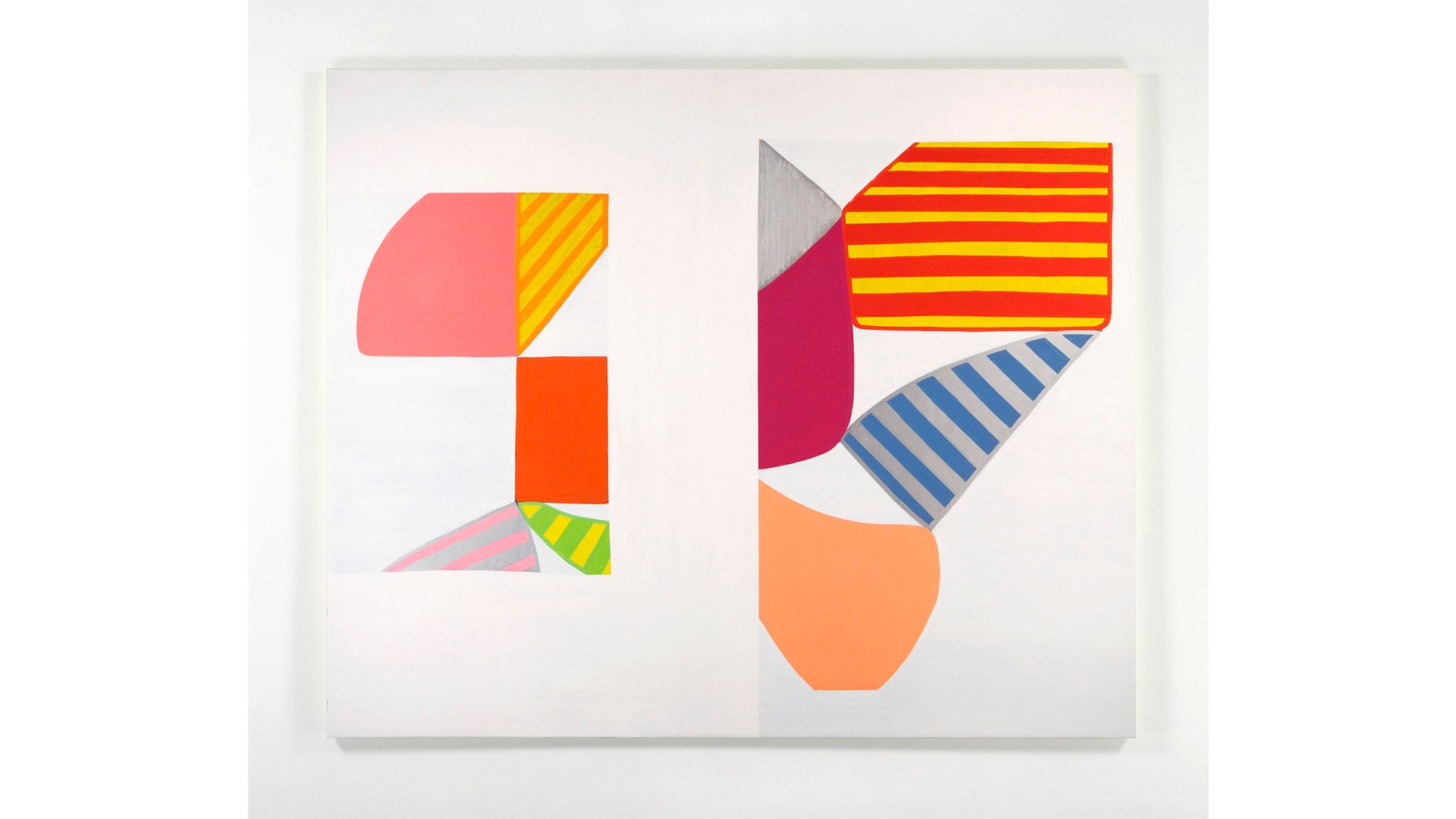
I first encountered McIntosh’s work over a decade ago for her 2010 exhibition, Violet’s Hair, at the Contemporary Art Gallery (November 19, 2010–January 9, 2011). I found McIntosh’s paintings for that show to be irreverent. They lacked a signature style or coherent program. They spoke an abstract language but through what can only be described as discordant colour combinations and awkward compositions that could feel unsettling. At the time, she described her method as a means to expose a question rather than answer it: “To make moves when you don’t actually know the outcome of the choices you’re making.” This expression is similar to what I uttered before her exhibition in 2023: “To make things which we do not know what they are.” When I saw her work in 2010, similar to my more recent encounter in 2023, I didn’t yet possess the vocabulary to talk about them.
In an essay on McIntosh’s work for the catalogue Elizabeth McIntosh: a good play (2010), curator Monika Szewczyk expressed her frustration in visiting the painter’s studio and looking forward to seeing a painting she had seen a week before, then realizing in her dismay that the work had been painted over, and was in the process of being painted over again. There was a provisionality to the work that frustrated Szewczyk. It seemed as though McIntosh’s work was caught in an endless loop of decomposition and recomposition. Perhaps this condition of reworking is one of the reasons why McIntosh’s work has often been discussed as conveying a mode of thinking. In some ways, however, I feel like this claim misses the mark. Rather, the work channels the non-cognitive side of consciousness. The side which drifts off, wanders off the garden path, gets lost while whistling in the dark, unaware of where it is going.
When I visited McIntosh’s studio this past winter, I asked her if her use of a stencil was a way to embrace a non-compositional form, wondering if it signalled a move away from subjectivity — a deliberate break from the anxiety of making a composition which forced a decision of when a painting was finished or not. McIntosh clarified that her use of a stencil was not intended to jettison subjectivity altogether. Instead, the thick application of paint, filtered through an external matrix, served to vex the viewer’s understanding of where the gesture was located and coming from. She sees herself as part of a tradition of contemporary female painters in the mould of Amy Sillman, Laura Owens, Jacqueline Humphries, and Charline Von Heyl, who troubled the paradigms of painterly gesture from the previous century, that either tied gesture to an authentic mark (Abstract Expressionism) or voided it in parody (Pop Art). Drawing from curator Mark Godfrey’s influential 2014 essay, “Statements of Intent,” on Sillman, Owens, Humphries, and Von Heyl, it becomes clear that McIntosh, too, seeks to make marks that are hard to place, indeterminate and elusive.
McIntosh’s condition of not-knowing is not synonymous with the ineffable or the inexpressible or some other state that defies understanding or verbal explanation. To speak of painting does not always imply that your hands are, in Philip Guston’s words, “stuck in a mattress.” To advance a position of not-knowing is not to argue for doubt for doubt’s sake, or to assume a position of non-belief, or to commit to a position of complete obfuscation of thought and deed. When confronting the harsh realities of experience, doubt and incomprehension only go so far.
However, understanding abstraction through its provisional and elusive forms carries broader social implications for collective experience and individual perception. In his 2013 article, “Empathy and Abstraction (Excerpts),” the artist Doug Ashford conveys the idea that engagement with abstraction leads those receptive to its various modes into a harmonizing experience with “the instability of the world.” This encounter is inherently unstable and experimental. Ashford, who first gained prominence for his work in the artist collective Group Material in the 1980s, describes how he took up painting later in his life because he simply liked how the paintings looked. “They looked like the failures of my life,” Ashford writes, “lit up by possibility.”
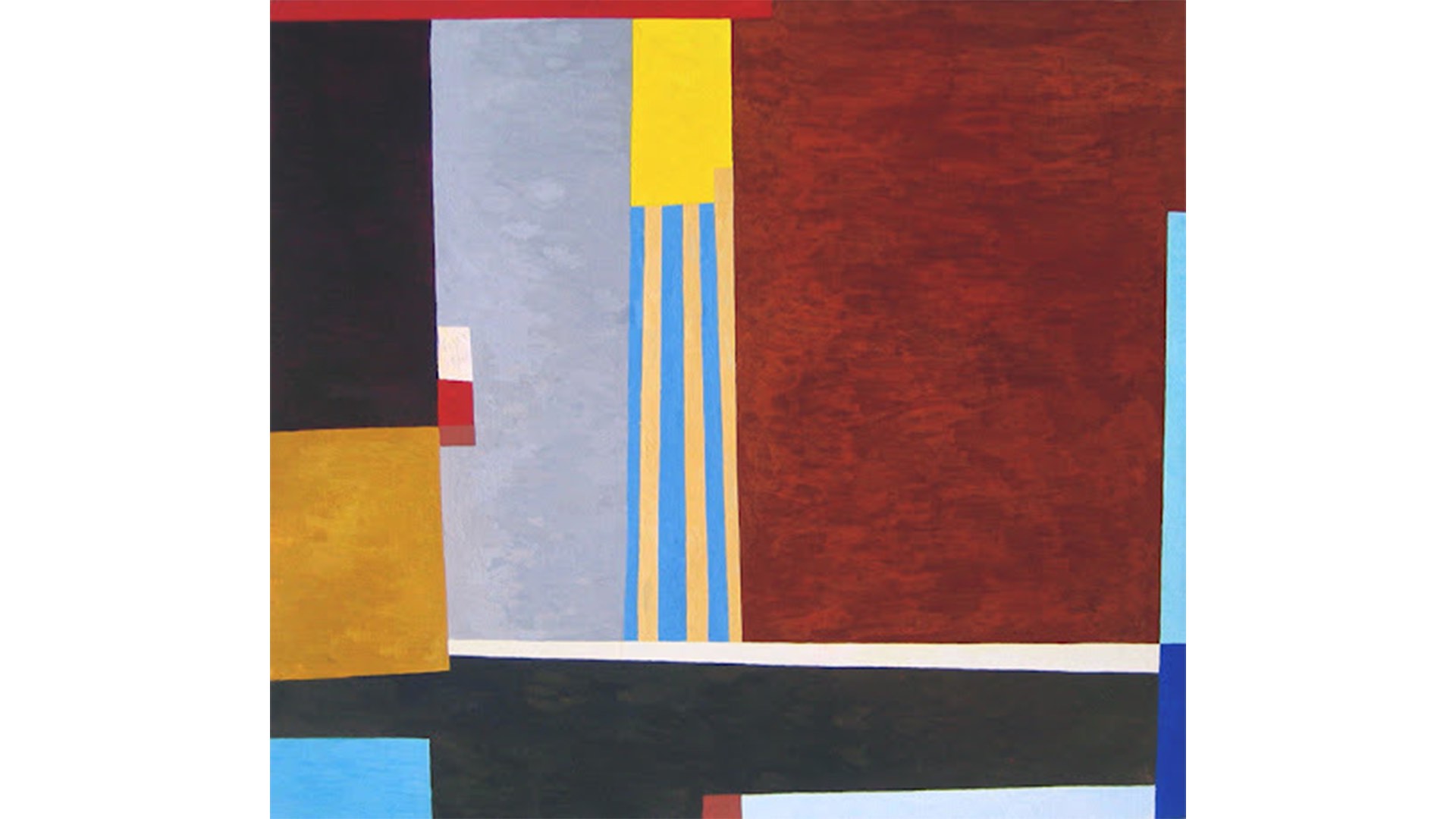
In Ashford’s framing, to grasp abstraction in this provisional state requires careful consideration of how art “demands the disordering of the world’s restrictions,” which he articulates as a position of reversal or sudden turning around, “away from the rationalization of everyday life; away from desire’s contemporary expression in commodity and violence.” Although the comprehension of abstraction might seem “off-center,” this wayward and errant experience enables more room to manoeuvre for a collective subject.
What Ashford is describing is a pleasure derived from the distortions of human experience. This pleasure lies in the realm of not-knowing and is not immediately constrained by reason, instrumental thinking, or the exclusive domain of an individual perceiving subject. A pleasure grounded, for instance, in the strangeness three friends experienced when viewing McIntosh’s paintings together for the first time and not-knowing what to make of them. This type of encounter is only grasped in the strangeness of the moment, an experience not outsourced to an app, an algorithm, or a streaming service. McIntosh’s work confronts us with the seriousness of pleasure.
When I stated the line to my friends, “to make things which we do not know what they are,” it was an attempt to describe the act of looking as a type of search — a search for a new mode of sensory experience, lit up by possibility, built from the discarded remains of experience. This search attempts to reimagine the material inheritance of the world, prying it open rather than foreclosing its potential.
Notes: