Recounting her trip to Kyiv in 1968, Vancouver-based writer Helen Potrebenko describes a city submerged by Soviet imperialism. “While I could understand some Russian, I spoke only Ukrainian,” Potrebenko explains, “I never heard anyone in Kiev speak Ukrainian. The language of this historic city, the capital of the Ukraine, is Russian.”1 Potrebenko’s parents immigrated to Canada during the interwar period as part of a larger transfer of labour from Eastern Europe to North America throughout the late 19th and early 20th centuries. Coaxed by the promise of property ownership yet conscripted into Canada’s agricultural and industrial workforce, Eastern European refugees faced exploitation in “factories, paper mills, chemical plants, construction sites, mines and the railway,” as political theorist Tyler Shipley explains.2 Despite being born and raised in Alberta’s Peace River Country, Potrebenko’s Ukrainian background remains a mark of otherness: “Ukrainians had by then been in Canada for three generations or more, but we were still regarded as foreign although we had just been accepted as ‘white’.”3 Like other migrants fleeing hardship in early 20th century Europe, Ukrainians arriving in Canada often served as “the foot soldiers of settler capitalism, battling with Indigenous people over land they believed they deserved.”4 But the history of labour immigration into Canada typically understates the ways in which Canadian capital also sought to expand outward across the globe. Canada poured huge amounts of money into the former Soviet Bloc and Ukraine in particular throughout the 1990s, offering “massive ‘assistance programs’ to the countries of Eastern Europe in order to establish the architecture necessary to facilitate an investment boom,” as Shipley observes.5 Construed thus, the Ukrainian-Canadian diasporic experience is powerfully shaped by labour exploitation, notions of racial superiority imposed on Ukrainains by the Anglo-Canadian ruling class, and the movement of global capital, all of which have served as key mechanisms within the colonial project of Canada.
Labour and Memory, an exhibition of three Ukrainian-Canadian artists at Maple Ridge’s The ACT Gallery, supplies a description and critique of that project. To wit: this group show sees geopolitical conflict in Eastern Europe take imaginative and material hold within the Canadian suburbs. While doubtless responding to the latest round of the Russo-Ukrainian War and the concomitant clamour for recognition and allyship between Ukraine and Canada, the exhibition poses complex questions about how a global crisis is registered, mediated, and negotiated at the level of social reproduction, as its title suggests. Sonya Iwasiuk, Darlene Kalynka and Ayla Dmyterko’s focus on labour, that is to say, interprets the ways in which vast historical determination is rendered tangible. Situated within Canada, however, this exhibition’s attention to working life must also be analyzed in relation to the globalisation of agricultural labour as well as ongoing forms of colonial occupation. How might we read this exhibition against the recognition/allyship grain? How, we should ask, does Labour and Memory conjunct with class and colonial history?
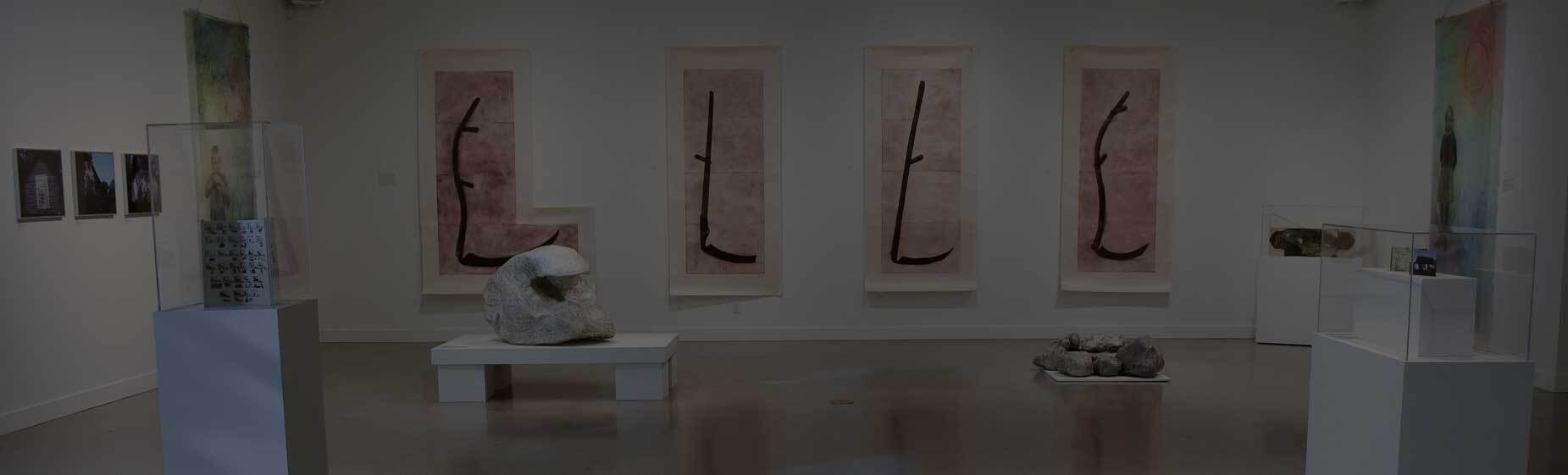
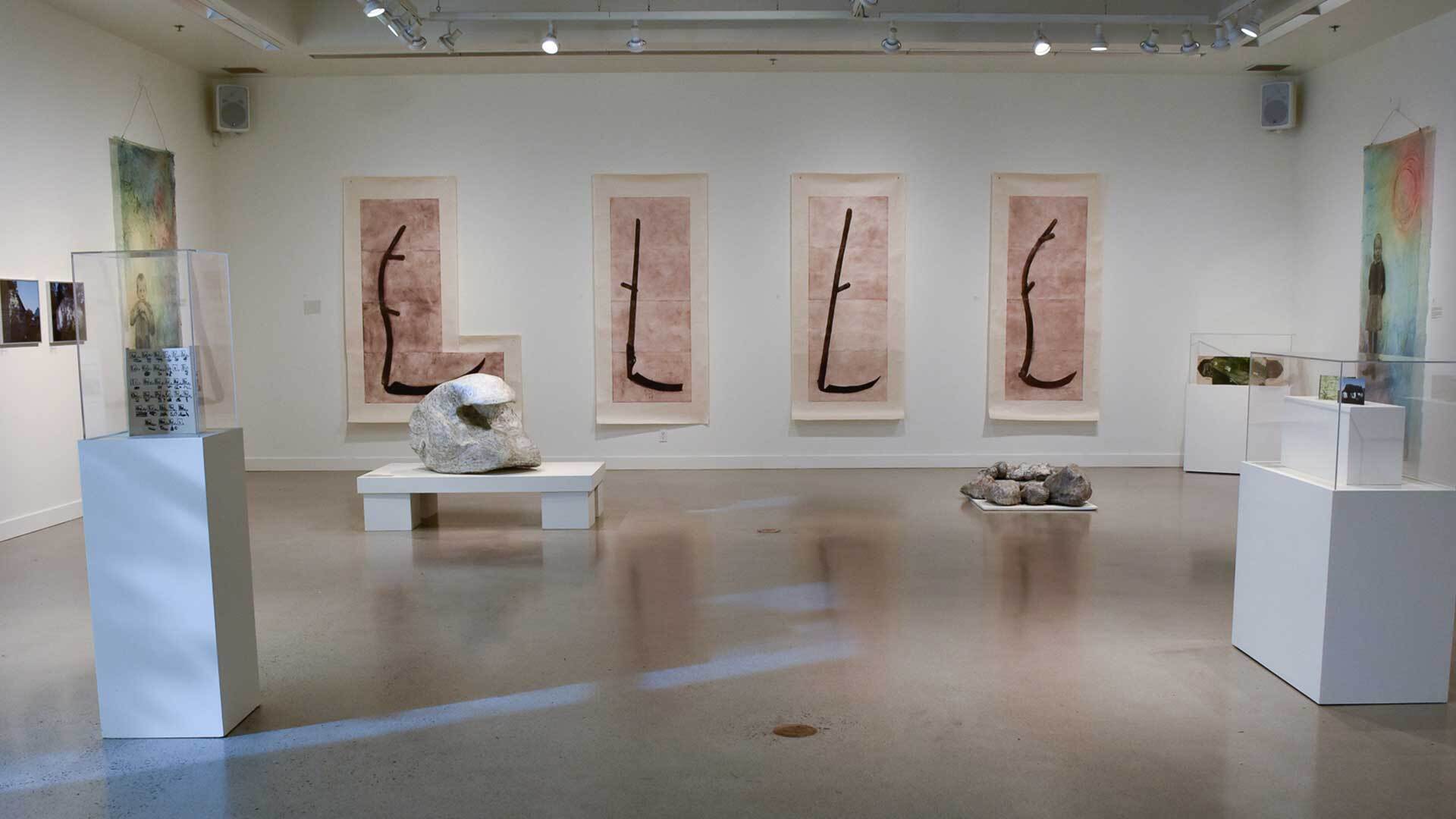
The exhibition takes a multimedia approach to tackle these multidimensional questions, ranging from sculpture and photography to book-objects and moving images. Iwasiuk’s principal contribution is a series of mixed media works — she uses acrylic, cheesecloth, wire, rusted steel — produced between 2017 and 2018 that retool archival images of Ukrainians arriving in Eastern Canada via Halifax’s Port 21. In Strong and Free? (2017), a young girl gazes at the viewer, hands held behind her back in the pose of an inspector. At her feet and atop her head are violet and blue scribbles bleeding into the gauze; I like to think that I can spot the words “territory” and “city” and “own” emerging from Iwasiuk’s spidery hand. The top right corner features a hastily drawn circle, a motif Iwasiuk repeats throughout her work: in Resilience and the Moon (2018), the circle becomes a huge plate of glue; in Yellow House (2018), it’s a sun burning off murky clouds. The physicality of the cheesecloth is especially palpable in this latter image: the canvas is a curtain of jelly that appears not so much painted on as soaked through. Here, the cheesecloth’s use in cooking comes into focus — to separate whey from the curd — in turn evoking the work of agriculture so central to Ukrainian migration into Canada’s prairies. Iwasiuk meshes domestic food production with transnational migration, her use of mixed media serving as a kind of objective correlative for the experience of transfer and displacement across the historical geographies of Ukrainian-Canadian labour.
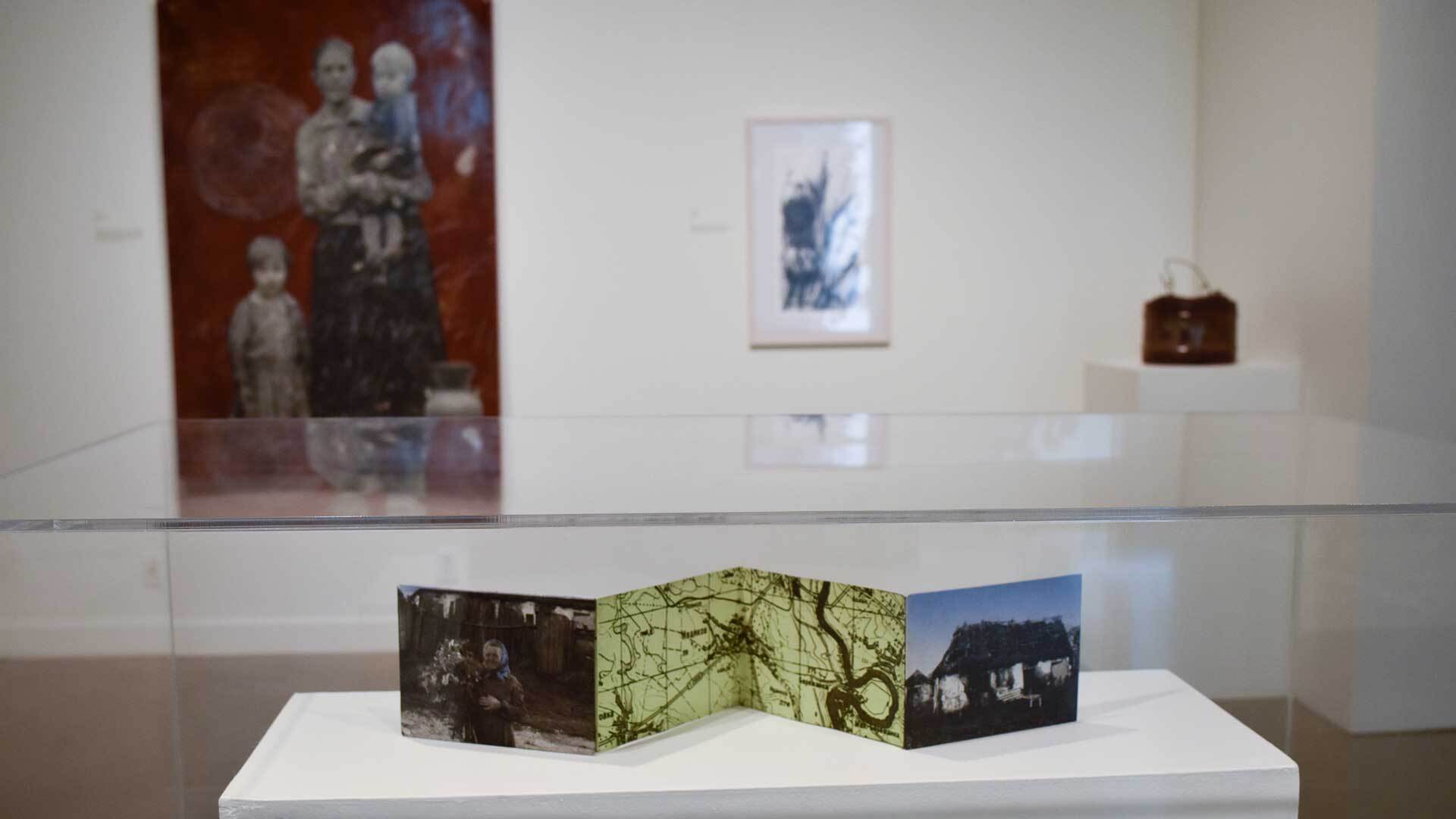
In contrast to the ambient landscapes that underlie Iwasiuk’s art, Kalynka’s bookworks are more emphatically spatial. My Ukrainian Reader (2005), a primer for the Ukrainian alphabet, pairs letters and scripts with visual cues: a for автомобіль or automobile, л for літак or airplane, followed by a cavalcade of monkeys, wolves, telephones, eyes, boots and staircases. The childlike surrealism of these associations further complicated by Reading the Homestead (2003), an accordion art book, which displays a panoramic photograph of a farm sandwiched between wedding portraits of Kalynka’s баба and Дідо, her grandmother and grandfather. Scattered across the central image are labels in English and Ukrainian: “House” or “xata,” “farm” or “Фapma.” Rural space here is not an idealised but practical landscape, composed of familial links and working lives. So too is the farm a settlement in the colonial sense, its establishment inextricably tied to the coercive and violent expansions that subsumed Indigenous land into settler property. Consequently, the English and Ukrainian text of Reading the Homestead integrates living memory with colonial history. Kalynka’s representation of the family homestead is in fact permeated by the ways of seeing typically associated with surveillance: wedding portraits become headshots while the panorama imitates security footage, as though sourced from a government file rather than the family scrapbook. Travelling in Ukraine (2014) extends these connotations to their logical conclusion, with the bellows of the accordion depicting an actual map of Ukraine — itself an unstable site within the ebb and flow of European empire — while the reverse side of the fold out page displays a tableau of cabbages whose leaf veins visually rhyme with the map’s contour lines. Taking place on stolen Indigenous land, Kalynka’s reconstruction of archival and family documents cannot not be read as criminal evidence; her art books meditate on precisely this slippage between reconstructing a lost home and bearing witness to settler colonial violence.
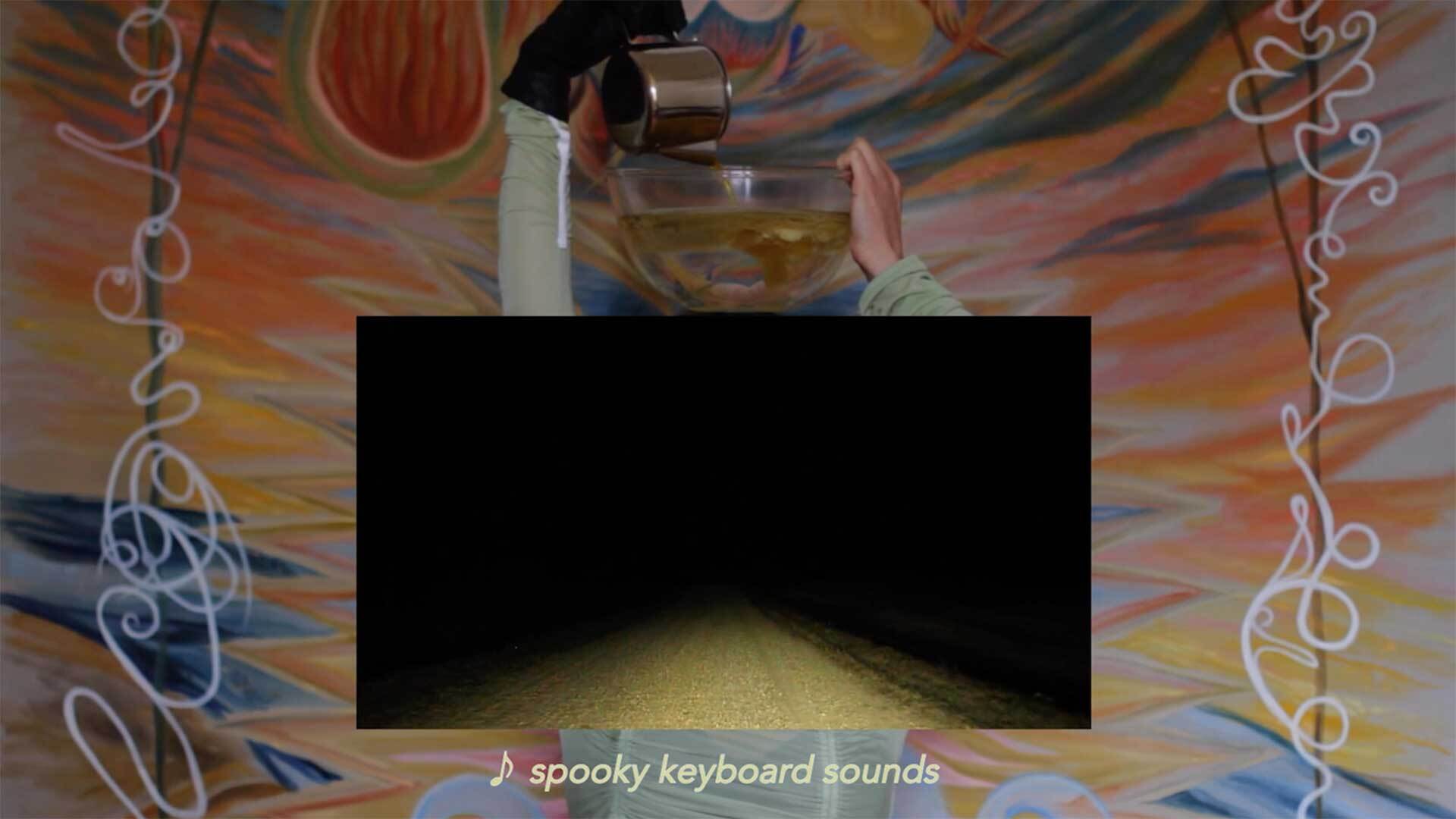
Compared to the archival strategies and sepia tones that suffuse most of Iwasiuk and Kalynka’s pieces, Dmyterko’s moving images resemble horror films. One sequence from Rite of Return (2021, 11:52) is shot from a vehicle mounted camera, whose headlights peer into the void of an empty dirt road. This smaller clip is overlaid atop a larger frame that features Dmyterko balancing a glass bowl of water on her head, which serves as a receptacle for hot wax poured from a kettle. The result is a sci-fi mutant, as the rapidly cooling wax solidifies into a shaggy intestine. Later, Dmyterko films spume twitching on the beach, a distant cousin of her wax creations. Rite of Return embeds Dmyterko’s quasi-laboratory work within a wider environmental ensemble: coastlines switch to wheatfields, urban canals to cloud banks. In one shot, hail flicks a hyacinth, the ice like pellets shed by Styrofoam. Further in, Dmyterko includes home videos that depict herself as a child in traditional Ukrainian dress, chaotically dancing in the family living room. To this effect, Rite of Return’s end credits bring into definition the mosaic of households, resource hinterlands and infrastructures that shape the world-economy: Treaty Four lands overlap with primal forests in Poland, the Port of Ness in Scotland reverberates across Dmyterko’s childhood home in Regina, Saskatchewan. While the rural is a key workspace, frontier of accumulation, and mythical landscape for both settler colonial political economy and Ukrainian refugees in Canada, and is certainly a fixture throughout Labour and Memory, Dmyterko here insists on its position within amphibious networks of production and trade. In doing so, Dmyterko recasts the narrative of Ukrainian immigration to Canada not in terms of a one-stop voyage but as something more like an oscillation between specific nodes. Taking the prairie homestead as a perspective from which to link these disparate spaces, Rite of Return represents circulation as both social fact and ecological relation while highlighting its encounter with Indigenous land.
That we ourselves view Dmyterko’s planetary map from the vantage point of Maple Ridge brings us back to the suburbs and its peculiar registration of the conflicts in Eastern Europe and the actions of Canadian colonialism. I say peculiar because the conventional image of the suburbs — a mandelbrot of cul-de-sacs, each one a facsimile of the other yet withdrawn from collectivity in the practical sense — would have us believe that some of the spaces most deeply linked to settler capitalism are also those flung furthest from its orbit. Labour and Memory disputes this fantasy in ways that feel both alert and indirect. By locating migratory labour within the transistor zones of production and circulation, Iwasiuk, Kalynka, and Dmyterko render visible the ways in which Ukrainian-Canadian relations are mediated geographically and historically. However, the exhibition’s implicit response to the Russo-Ukrainian War poses tricky questions about precisely how those same relations are reproduced in the present. Labour and Memory never addresses that crisis explicitly, though its choice of subject-matter is consonant with the litany of art institutions in Canada seeking to offer Ukraine and Ukrainian-Canadians cultural forms of solidarity. The gauntlet that Labour and Memory would then seem to throw down is that, for Ukraine and Canada, colonialism names a common, albeit differently rendered, situation: Russia’s attempts at territorial conquest can be read in dialogue with Canada’s comparatively more subtle imperial aspirations; that one deploys tanks while the other stages public apologies simply captures discrete moments within the cycles of neoliberal empire. But if the Russo-Ukrainian War is an absent cause in Labour and Memory, so too is Indigenous history; the exhibition provides scant evidence regarding its occupation of the ancestral territories of the Katzie and Kwantlen First Nations. This is the double angle that viewing these artworks and their relation to allyship calls for; we must examine the ways in which these artists toggle between settler labour and spatial dispossession as historical and ongoing structures of colonised existence. It’s an angle that asserted itself when I visited the exhibition with my mom. On the lawn in Maple Ridge’s Memorial Peace Park just outside The ACT, a stage had been set for a music festival; Michael Kelly Gabriel’s (Kwantlen First Nation) drum performance gradually began to pulse inside the gallery, producing an improvised soundscape for Labour and Memory, whose visions of working landscapes and stolen land became momentarily, yet viscerally, entangled with Indigenous cultural life.
Labour and Memory — Ukrainian-Canadian Contexts continues at The ACT Art Gallery in Maple Ridge through October 29, 2022. Learn more about the exhibition here.
Notes: