With the influx of arts spaces reactivating and reimagining their roles in the still-nebulous mire of pandemic time, mobile art spaces are on the rise. In the fall of 2022, I spoke with two Victoria-based curator/programmers, Dani Neira and Alexis Hogan, who each coordinate a mobile art space in the region — Crummy Gallery and lichen, respectively. Settled on the ground under the canopy of trees in Fernwood’s Springridge Commons, we met to talk about the flexibility DIY arts spaces offer, the unique gifts of collaborative working practices, and the ever-potent desire for true gathering spaces.
Kara Stanton (KS): Can you describe the gallery spaces you manage, and the curatorial projects connected to them?
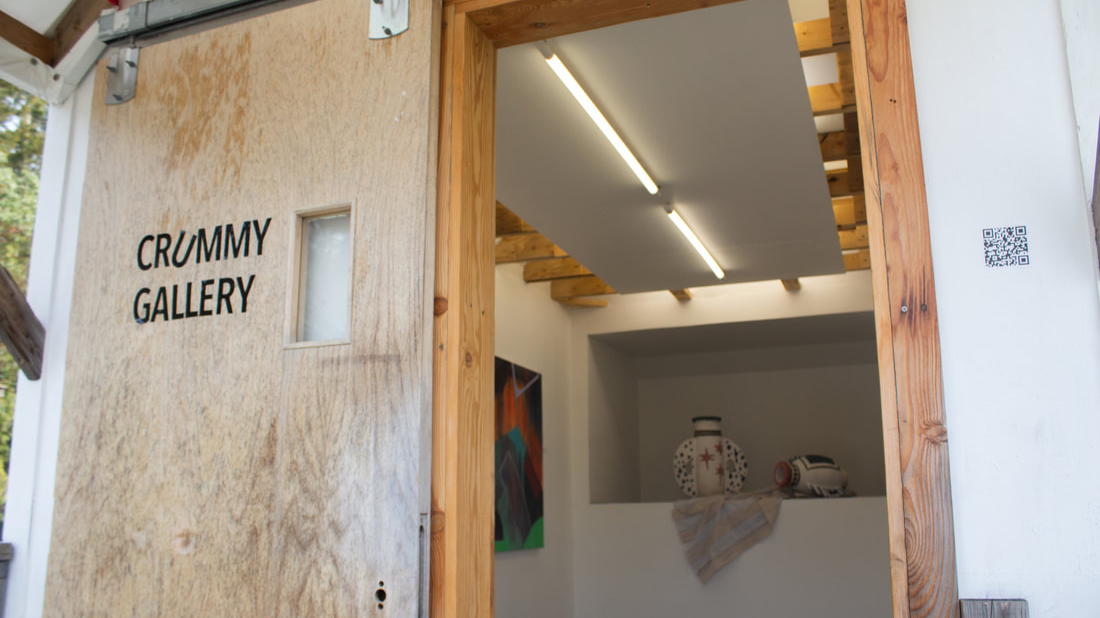
Dani Neira (DN): Crummy Gallery is a mobile art space originally constructed by Cedric Bomford, who’s currently the visual arts chair at UVic. From what I understand, a “crummy” is the name of a really small vehicle that was used to transport resource workers to and from the worksite. Cedric’s practice often takes the form of these really large-scale, interactive architectural installations, and he looks at a lot of things to do with constructed space, so he built this gallery as a part of one of his projects. He was thinking a lot about contested spaces, and his own settler history, a history of extractivism, and how art spaces and art galleries play into that, in being on the land.
Cedric built it to fit on the back of his truck, so it generally lives on the back of a truck, and then it has this little nook in the back that you can sleep in, if you were traveling with it. It’s 11’ x 7’, so it’s a pretty tiny little space — but it feels really intimate.
It was sitting empty for two or three years through the pandemic, and then I got put into contact with him. We talked about the need for alternative art spaces, and he said “go for it—you can use it.” Then through lots of conversations me and my very good friend Cassia formed a curatorial collective, Dirty Dishes, and we did some partnership programming at Crummy. We also partner with UVic sometimes for Crummy programming, but it’s its own little mobile art space — it doesn’t really have any funding.
Alexis Hogan (AH): Before I went to art school back in, like 2010, I was involved with folks in Victoria doing underground art shows — having bands play under the Bay Street Bridge at midnight kind of thing. And that really inspired me to go to art school, learn some more things and bring that back to my community. My collaborator at the time, Andy Anderson, (who runs Cavity Curiosity) and I were dreaming of what it would be like to take the show on the road and have something in a mobile space. And that’s where that seed was planted.
I’ve worked with the fifty fifty arts collective, Open Space and other art collectives in Vancouver, but I started to feel really constrained by gallery projects. The idea of being able to do stuff respectfully and with relationships that are more land-based or site-specific is something that really appealed to me, for the chance to activate different spaces or bring art to other communities.
In 2020 I had the opportunity through Michelle Jaques and Nicole Stanbridge at the Art Gallery of Greater Victoria (AGGV) to bring this project, lichen, to life. And I was able to form a team with carpenters/artists Craig Turney and Josh Ngenda and Jesse Campbell to build this mobile gallery space.
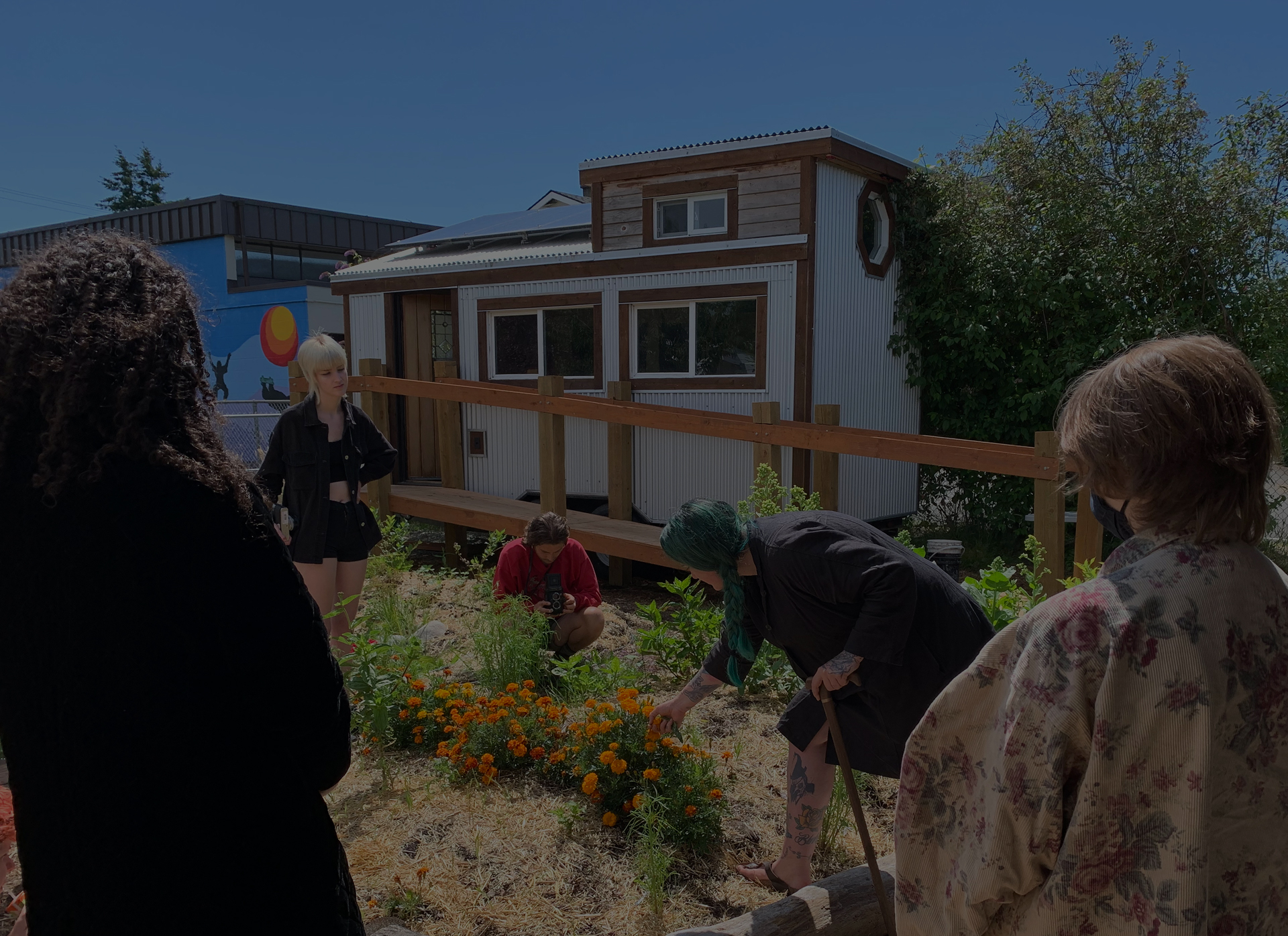
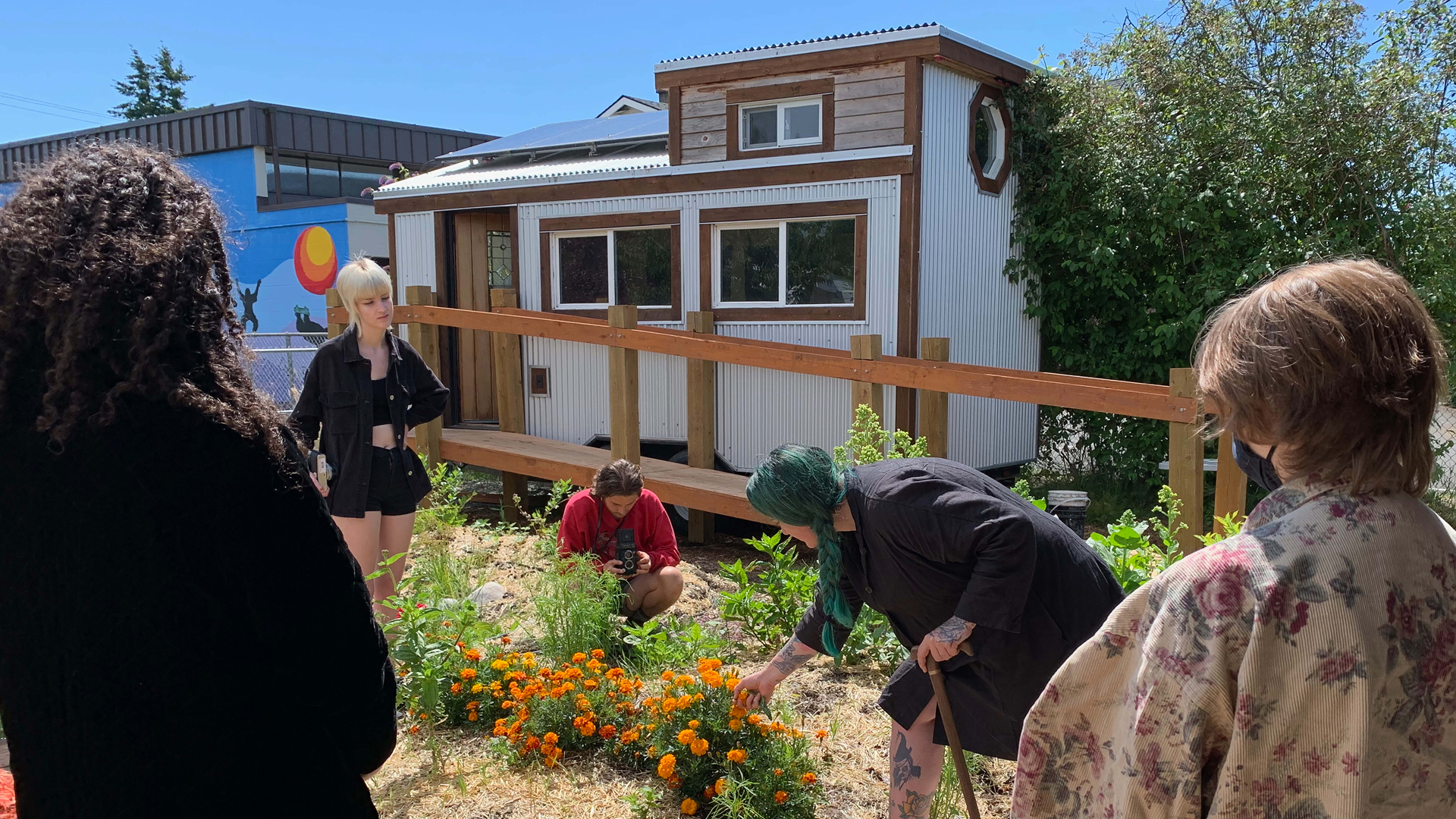
I really wanted it to be able to flex — to be really simply designed so that it could be used for a multiplicity of different things. So it looks like a tiny house… It’s 18’ long, 20’ with the tongue, and about 8.5’ wide and about 13’ tall. There are solar panels so there can be electricity off-site, a battery bank, and track lighting inside and a sort of salon-style wall. And then there’s a loft so people can stay in it.1
We started to build it at the beginning of the pandemic. It’s been slow going in terms of collaborating with people to make projects happen, but my hope for the space is to be able to have the capacity to start to collaborate with a programming collective.
KS: I’m really interested in both the similarities and differences between your two spaces. Like Dani, you’ve inherited access to this structure, and now you’re like, what can I do with it?
For you, Alexis, in the planning that went into forming the physical space, you talked about having an advisory committee to conceptualize the project: how did the design of the space come together?
AH: I had a wish list, and I took that wish list to Craig, who’s the lead carpenter, and Craig and I sat down and started to work through the designs, which we then took to the committee, and then the committee asked questions about the designs. For instance, we have a ramp to the space built to be able to handle the grade necessary for a wheelchair. It’s not 100% perfect — we’ve had to do some post modifications because of rain, and things like that. The loft is also not accessible; one of the advisory committee asked if we could lower the loft hydraulically. And it was like, Yes, in theory, but …we just don’t have the budget for that.
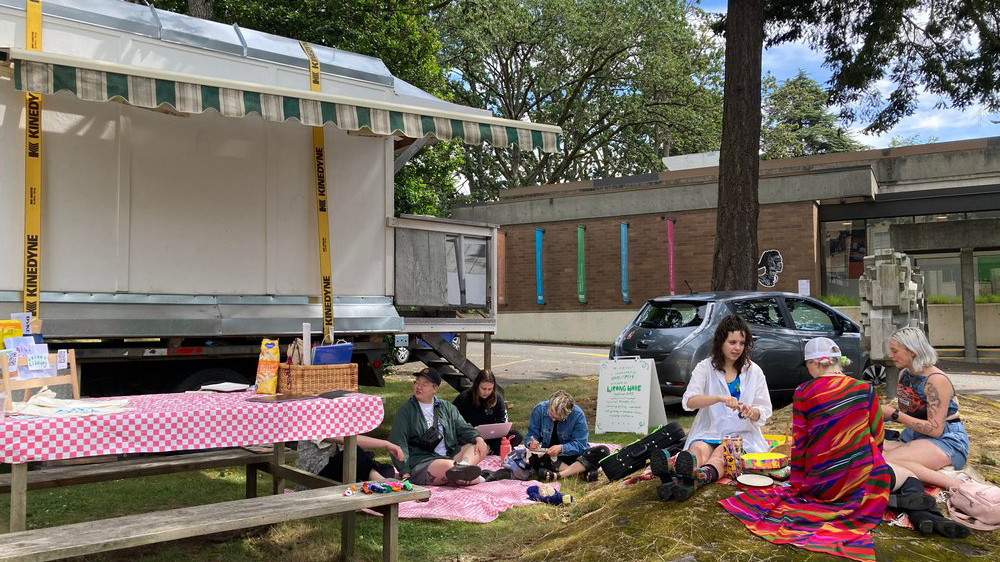
DN: The Crummy is not wheelchair accessible; it’s accessible through a flight of like three or four stairs. So in the summertime, when we did a collaborative residency outside of the Art Gallery of Greater Victoria (AGGV), we were like, Okay, how can we activate the space outside of Crummy? And we hooked up this old-school Italian awning to one side of it and set up a craft station and a zine library outside — and then we used the inside space of the gallery as a workshop space with the artist.
We’re very interested, with Dirty Dishes Collective, in food and comfort and all these different gathering spaces — and so we were bringing in carpets and lighting, like we’re gonna make it so cozy in here. It was funny to see people who were visiting the AGGV stumble upon Crummy and they’d be like Crummy Gallery! Why is it so crummy? And they would go up the stairs or look in and they’d be so confused — like, are you living in here? What are you doing? Where’s the art?
KS: Can you talk about the programming you each carried out this summer?
DN: The main project that we did through Dirty Dishes Collective and the Crummy was a collaborative research residency with the artist Kitt Peacock. We were both thinking a lot about shape-shifting geographies and the sea’s edge, and so we decided to create this collaborative residency around it, where we would gather and work together and talk and host workshops.
Kitt took a ferry over and we parked outside of the AGGV for the week — me, Cass, and Kitt. We had put out a call for submissions for a zine library that aligned with the themes of the residency, and we set up a community workshop zone right outside of the Crummy to use the outdoor space. It was just so nice. There were so many people who would just show up and everyone was sitting in the sun and people would bring their own crafts or just sit and read zines. It was a gathering space. We also took a beach field trip where Kitt took recordings of us talking and skipping rocks, and throughout the residency, they recorded stories from trans and gender non-conforming participants. From all of that, they created this online radio station, where stories play according to the tide, so it changes — whether the tide’s in or out.
KS: Alexis, do you want to speak to the project that you and your artist-collaborator, Chris Dufour, were working on?
AH: So Chris is, you know, one of my besties. We met working at the Compost Education Centre and became friends working next to each other, talking about art and the climate crisis, and like, being fucking gay, as well.
(all laugh)
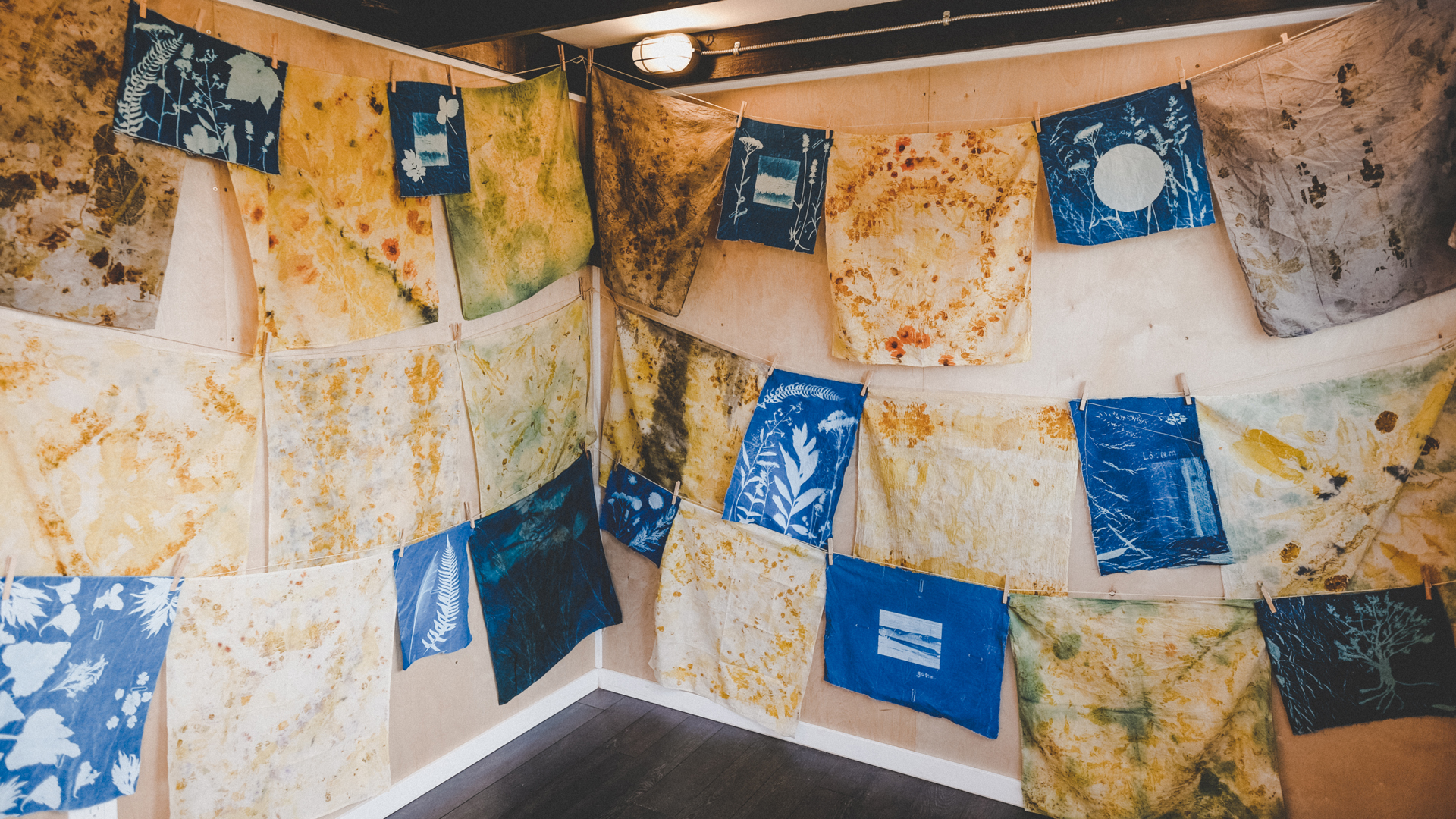
AH: They had also been working with Artemis Place Secondary, which is a school that serves trans and non-binary youth and young parents and other teens for whom traditional school systems don’t serve. Through some funding that we got at the Compost Ed Centre, they started to build a garden with a group of students there. The idea organically came about how we could bring lichen — this arts organism named for the collaboration of fungi, cyanobacteria, and algae — to the school. They built this 6000 square foot permaculture garden, which activated science from a multiplicity of different entry points, and also became a therapeutic space.
Chris has a background in photography and sculpture and fibre arts and my material practice is in the realm of installation, sculpture, print media, and social practice. Both Chris and myself had this feeling of the alienation of the climate crisis feels a lot like the alienation of queerness. And I don’t know that either of us have any answers about it, but we felt we could definitely make some art with some people about that. So we dreamed up this project centered around intergenerational relationships, skill-building, and skill-sharing with the students.
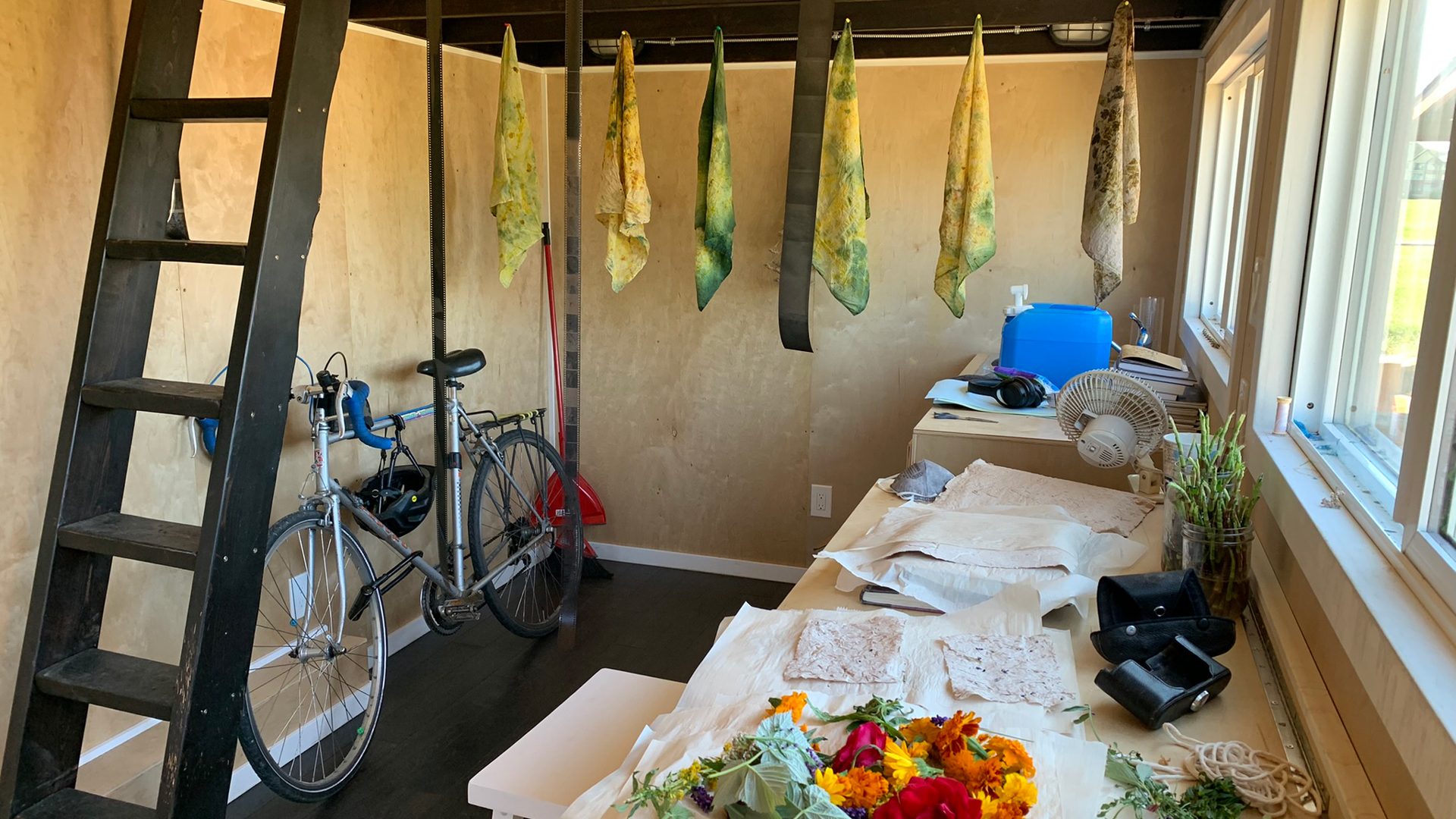
The project became a month-long intensive of workshops. We started with ecological restoration, making paper out of scotch broom and working with guest artists Sarah Jim and Caitlin French. The students learned how to shoot film, how to process their own negatives; we planted the dye garden, and they learned how to do natural dyeing. We treated the scotch broom paper with cyanotype and made prints off of that. The result of working together for a month and a half was “with busy hands,” this tremendous exhibition of shared work. For me, it was like casting back and forth, into the past and into the future. There was an aspect working with the younger version of myself — and the potential of these young, brilliant people. It was really beautiful and healing, and also sad, because it ended and they were like, I really wish that there were more opportunities like this.
KS: Wow. It’s so sweet you got to do all that with such a good friend.
AH: You know, somebody said that this project wouldn’t have happened if Chris and I didn’t have the relationships that we came to the table with.
DN: Cassia and I — that’s the other half of Dirty Dishes — have that same basis of intimacy and friendship that shapes how we work. And it’s such a different way of working. It’s very much based on needs; our deadlines change all the time, because we have to push them and that’s fine.
Doing a project like this wouldn’t be possible if we weren’t besties, because we’re both so busy. It becomes difficult to make time in my life to see friends, but me and Cass will be like, Okay, we’re gonna meet up at 9pm at a bar, but we’re gonna bring our notebooks and it’s gonna be a work date. It’s this blurring of play and work and friendship, and, you know, dirty dishes. Yeah, that makes it possible.
KS: Can you talk about in what ways you’re tied to your institutional relationships?
AH: With lichen, it’s not. I’m definitely happy to continue to collaborate with institutions, with the AGGV and with the team that I work with there on projects, but I don’t feel constrained by having to, you know. I feel that there’s a pretty open-ended, do whatever you want kind of thing.
KS: That’s awesome. Was that something that was clear from the beginning, when Michelle and Nicole came to you — that this is your project for you to figure out?
AH: Yeah, I was like, so who owns this? When it’s done? What does that mean? And they were like, it’s yours. And I was like, Cool. And also, I’m at this place where I’m like, Holy shit, I actually don’t understand what that means in terms of being an artist and having this asset and understanding what to do with it from a taxes point of view…
One of the reasons that I wanted to work with an independent mobile space was to get away from the nonprofit structure — I’m steeped in nonprofit culture — but now I can understand a lot more viscerally why nonprofits are beneficial, because I’m at this place where it’s like, do I register this as a business? Does this become a nonprofit organization? Or does this become an asset that I can’t afford? There’s certainly more responsibilities associated with this work than I had initially thought through.
KS: Right, I feel like, as artists or just as people who don’t own property, we spend all our time renting and thinking, what if artists had a space? What if I had a space? And then, you get a space — and you find out, oh it’s actually not just free.
Dani, how do you feel about the Crummy’s relationship to UVic? Or to the AGGV?
DN: Crummy also doesn’t really have a direct relationship to an institution. It moreso has a relationship to UVic because Cedric works there. Like, right now it’s parked outside of the Visual Arts building, and we’re doing a series of exhibitions along with the visiting artists’ lectures. So yeah, it’s more of a relationship. With the AGGV it was also a collaboration; they provided the space for us to park in-kind, and that was just out of us having trouble finding a public space where we could park it for a week.
In thinking about the work we wanna do, me and Cassia have talked a lot about how we could foster a sense of friendship and non-institutional gathering. I work at Open Space, Cass works at the AGGV, and we were talking about, especially being a younger/emerging practitioner, all these pressures about professionalism that play into our work.
We’ve also been talking a lot about the question of do we want to register as a nonprofit? It gets really complicated and really muddled really fast. If we register as a nonprofit, we have to have a board. What does this mean? Do we have space in our lives to write grants, etc.? We all have, like, five jobs. So for now, we’re running it essentially as a DIY space with project funding here and there.
KS: It’s tricky having a foot in both nonprofit arts and in DIY spaces, because you do have the sense of am I letting people down if I don’t pay them while at the same time understanding how important it is to create gathering spaces whether or not there’s money for them. You have to want to believe that people want to do things, even if they can’t get paid, at the same time believing that everyone should be paid.
DN: I think there’s a more immediate responsiveness to both community needs and wants. There’s more of a direct line of communication — like talking to friends and colleagues and from that, seeing what’s missing in the community immediately having the physical space to make some of these things happen. Unlike an institution, things can happen really quickly. Especially when it’s a DIY space and it feels low stakes, it feels… I don’t know, there’s a very different feeling to it.
AH: I don’t really feel like I’m in the DIY culture that I used to be. But definitely when I was more immersed, it was that immediacy that Dani was referencing like, Oh, do you want to do a show underneath the Bay Street Bridge with these bands, and anybody that wants to show their work can show their work? That was really important to me. I didn’t think I could make art, and so many people who feel excluded from spaces because they don’t have the requisite language or experience or whatever were welcome to participate. And there’s something so magical about being able to participate in the culture of your time, in that way. There’s something about gathering via spontaneity through art and making — feeding off of one another’s inspiration is just the ultimate nourishment.
KS: Like, Oh, you didn’t have to get seven permits to do that?
AH: No, we just fucking did it!
And it was just awesome, you know? Something about those spontaneous, ephemeral, utopic moments, it’s cheesy but it’s a reminder of what you can do when you’re not thinking about the permit that you have to apply for, or the report that you have to submit. And I feel totally disengaged from that at this time.
KS: As you both look ahead, what dreams are you holding? What are you looking forward to?
DN: Cassia and I have some longer term projects in mind. We just applied for a Canada Council for a hybrid digital/physical installation around queer digital folklores, which we conceptualize taking place in the Crummy.2 We’ve been thinking, how can we fully transform the space into an immersive installation? I think it’s exciting to have these longer-term projects happening while also keeping up with the immediacy and continuing having these community gatherings and pop-ups.
AH: Collaboration is my jam — I really like to work with other people. It can be challenging when you have no constraints, but working with someone else provides the container, in a really exciting, kind of juicy way. So more collaborations, more traveling. And I would like to get to a place where it’s not one project a year.
I would love to collaborate with your space at some point.
DN: Yes. Yes, that would be so much fun.
Notes:
- Watch a full video tour of lichen on the AGGV’s YouTube account: https://youtu.be/Pm7CKkQ5ZuM “Tour of lichen with artist Alexis Hogan,” Around the Island, Art Gallery of Greater Victoria. 10 Feb, 2021.
- Editor’s note: since the date of this interview, Dirty Dishes Collective have announced they’ve been successful in their application. See: “Big DDC announcement,” Dirty Dishes Collective, instagram, 11 March, 2023. https://www.instagram.com/p/Cpql-gnvhRb/